Netherlands Institute for Neuroscience, Department of Sleep and Cognition, the Netherlands.
Netherlands Institute for Neuroscience, Department of Sleep and Cognition, the Netherlands; University of Amsterdam, Department of Psychological Methods, the Netherlands.
Sleep Med. 2020 Dec;76:86-88. doi: 10.1016/j.sleep.2020.09.029. Epub 2020 Oct 8.
The COVID-19 pandemic imposes a long period of stress on people worldwide and has been shown to significantly affect sleep duration across different populations. However, decreases in sleep quality rather than duration are associated with adverse mental health effects. Additionally, the one third of the general population suffering from poor sleep quality was underrepresented in previous studies. The current study aimed to elucidate effects of the COVID -19 pandemic on sleep quality across different levels of pre-pandemic sleep complaints and as a function of affect and worry.
Participants (n = 667) of the Netherlands Sleep Registry (NSR) were invited for weekly online assessment of the subjective severity of major stressors, insomnia, sleep times, distress, depression, and anxiety using validated scales.
To investigate the overall impact of the COVID-19 pandemic on the sleep quality of people with and without a history of insomnia, we performed a mixed model analysis using pre-pandemic insomnia severity, negative affect, and worry as predictors.
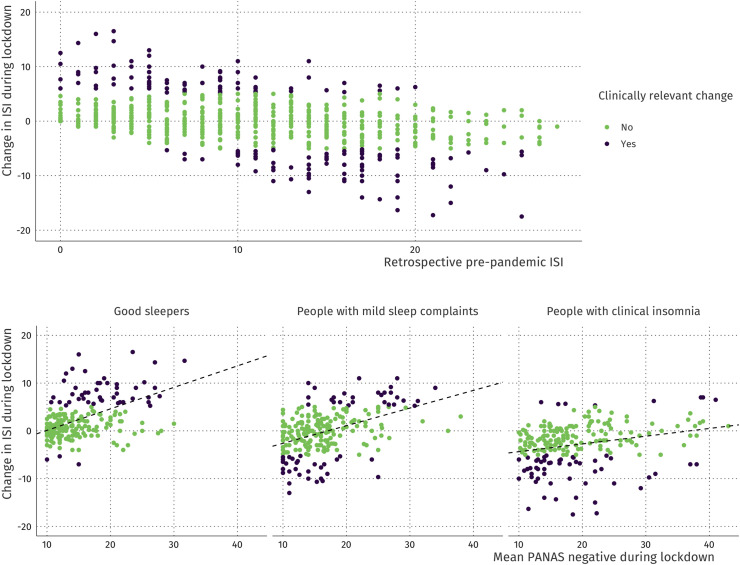
The effect of COVID -19 on sleep quality differs critically across participants, and depends on the pre-pandemic sleep quality. Interestingly, a quarter of people with pre-pandemic (clinical) insomnia experienced a meaningful improvement in sleep quality, whereas 20% of pre-pandemic good sleepers experienced worse sleep during the lockdown measures. Additionally, changes in sleep quality throughout the pandemic were associated with negative affect and worry.
Our data suggests that there is no uniform effect of the lockdown on sleep quality. COVID-19 lockdown measures more often worsened sleep complaints in pre-pandemic good sleepers, whereas a subset of people with pre-pandemic severe insomnia symptoms underwent a clinically meaningful alleviation of symptoms in our sample.
COVID-19 大流行给全世界的人们带来了长时间的压力,研究表明它显著影响了不同人群的睡眠时间。然而,睡眠质量的下降而不是睡眠时间的减少与不良心理健康影响有关。此外,在之前的研究中,三分之一的睡眠质量差的普通人群代表性不足。本研究旨在阐明 COVID-19 大流行对不同程度的大流行前睡眠抱怨人群的睡眠质量的影响,以及作为影响因素的情绪和担忧。
荷兰睡眠登记处(NSR)的参与者(n = 667)被邀请每周在线评估主要压力源、失眠、睡眠时间、痛苦、抑郁和焦虑的主观严重程度,使用经过验证的量表。
为了研究 COVID-19 大流行对有和没有失眠史的人群睡眠质量的总体影响,我们使用大流行前的失眠严重程度、负性情绪和担忧作为预测因子进行了混合模型分析。
COVID-19 对睡眠质量的影响在参与者之间存在显著差异,并且取决于大流行前的睡眠质量。有趣的是,四分之一的大流行前(临床)失眠患者的睡眠质量有明显改善,而 20%的大流行前睡眠良好者在封锁措施期间睡眠质量变差。此外,整个大流行期间睡眠质量的变化与负性情绪和担忧有关。
我们的数据表明,封锁措施对睡眠质量没有统一的影响。在大流行前睡眠良好的人群中,COVID-19 封锁措施更常恶化睡眠抱怨,而在我们的样本中,有一部分大流行前严重失眠症状的人症状得到了有临床意义的缓解。