Department of Neurosciences and Developmental Biology, University of Vienna, 1090 Vienna, Austria.
Department of Bioinformatics and Genetics, Swedish Museum of Natural History, 104 05 Stockholm, Sweden.
Genes (Basel). 2020 Oct 28;11(11):1267. doi: 10.3390/genes11111267.
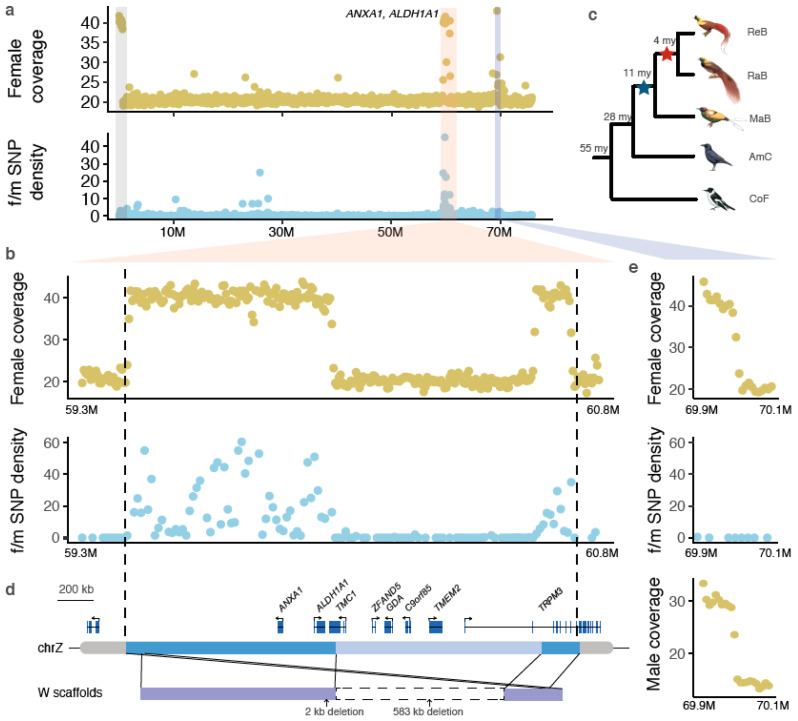
The female-specific W chromosomes of most Neognathae birds are highly degenerated and gene-poor. Previous studies have demonstrated that the gene repertoires of the Neognathae bird W chromosomes, despite being in small numbers, are conserved across bird species, likely due to purifying selection maintaining the regulatory and dosage-sensitive genes. Here we report the discovery of DNA-based sequence duplications from the Z to the W chromosome in birds-of-paradise (Paradisaeidae, Passeriformes), through sequence transposition. The original transposition involved nine genes, but only two of them ( and ) survived on the W chromosomes. Both and are predicted to be dosage-sensitive, and the expression of is restricted to ovaries in all the investigated birds. These analyses suggest the newly transposed gene onto the W chromosomes can be favored for their role in restoring dosage imbalance or through female-specific selection. After examining seven additional songbird genomes, we further identified five other transposed genes on the W chromosomes of Darwin's finches and one in the great tit, expanding the observation of the Z-to-W transpositions to a larger range of bird species, but not all transposed genes exhibit dosage-sensitivity or ovary-biased expression We demonstrate a new mechanism by which the highly degenerated W chromosomes of songbirds can acquire genes from the homologous Z chromosomes, but further functional investigations are needed to validate the evolutionary forces underlying the transpositions.
大多数新颌鸟类的雌性特异性 W 染色体高度退化且基因匮乏。先前的研究表明,尽管新颌鸟类 W 染色体的基因数量很少,但在鸟类物种中是保守的,这可能是由于纯化选择维持了调节和剂量敏感基因。在这里,我们通过序列转位报告了在天堂鸟(Paradisaeidae,雀形目)中发现的从 Z 染色体到 W 染色体的基于 DNA 的序列重复。最初的转位涉及九个基因,但只有其中两个(和)在 W 染色体上幸存下来。和都被预测为剂量敏感的,在所有研究的鸟类中,的表达仅限于卵巢。这些分析表明,新转位到 W 染色体上的基因可能因其在恢复剂量失衡或通过雌性特异性选择中的作用而受到青睐。在检查了另外七个鸣禽基因组后,我们还在达尔文雀的 W 染色体上进一步鉴定了另外五个转位基因,在大山雀中鉴定了一个,将 Z 到 W 的转位观察扩展到更大范围的鸟类物种,但并非所有转位基因都表现出剂量敏感性或卵巢偏性表达。我们证明了一种新的机制,即鸣禽高度退化的 W 染色体可以从同源 Z 染色体获得基因,但需要进一步的功能研究来验证转位背后的进化力量。