Department of Microbiology and Immunology, Emory Vaccine Center, Emory University School of Medicine, Atlanta, GA 30322, USA.
BioMarin Pharmaceuticals, Novato, CA 94949, USA.
Viruses. 2020 Oct 28;12(11):1221. doi: 10.3390/v12111221.
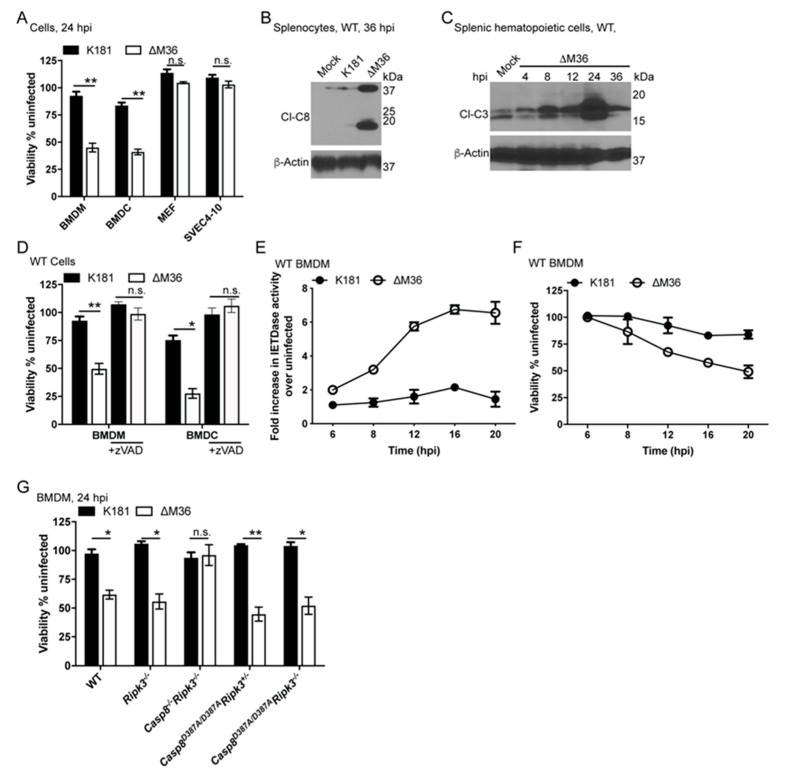
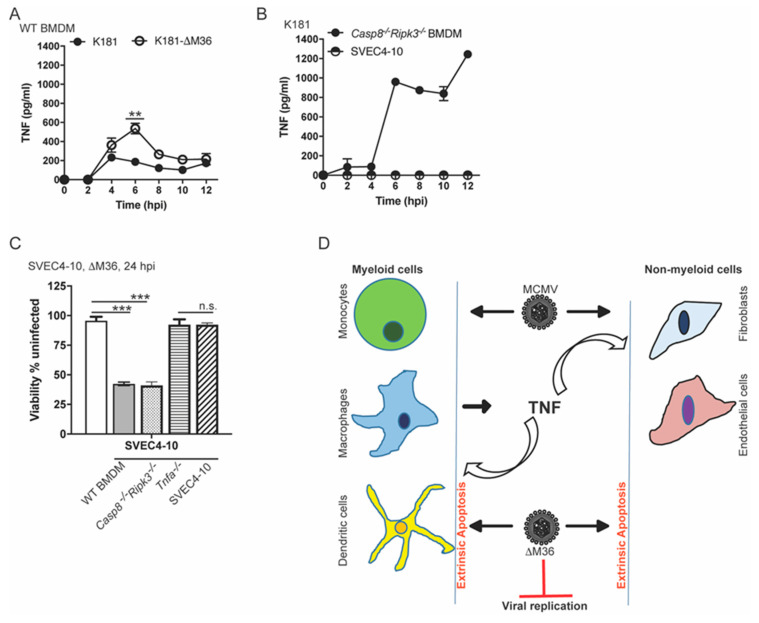
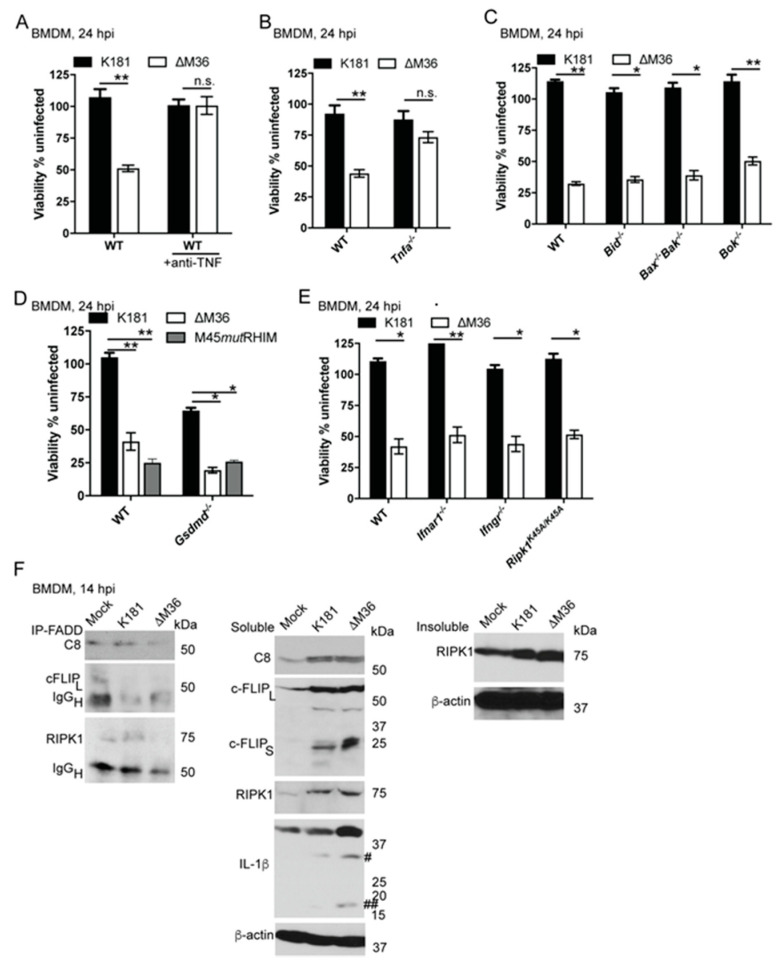
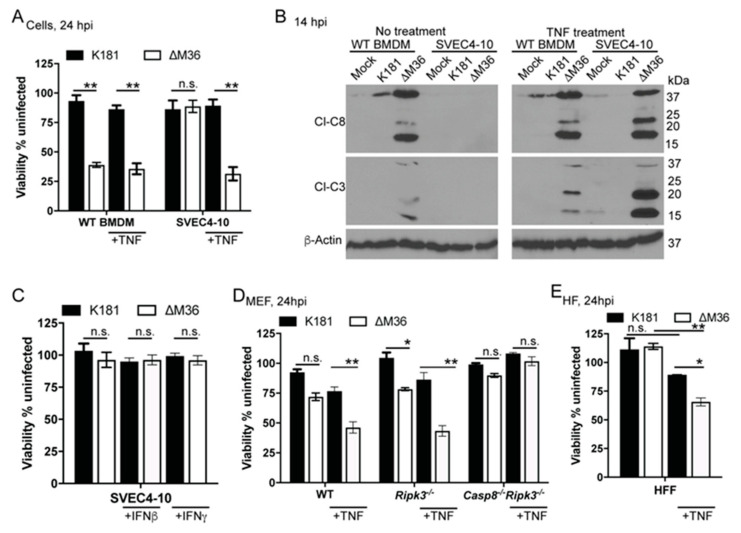
Cytomegaloviruses all encode the viral inhibitor of caspase-8-induced apoptosis (vICA). After binding to this initiator caspase, vICA blocks caspase-8 proteolytic activity and ability to activate caspase-3 and/or caspase-7. In this manner, vICA has long been known to prevent apoptosis triggered via tumor necrosis factor (TNF) family death receptor-dependent extrinsic signaling. Here, we employ fully wild-type murine cytomegalovirus (MCMV) and vICA-deficient MCMV (∆M36) to investigate the contribution of TNF signaling to apoptosis during infection of different cell types. ∆M36 shows the expected ability to kill mouse splenic hematopoietic cells, bone marrow-derived macrophages (BMDM), and dendritic cells (BMDC). Antibody blockade or genetic elimination of TNF protects myeloid cells from death, and caspase-8 activation accompanies cell death. Interferons, necroptosis, and pyroptotic gasdermin D (GSDMD) do not contribute to myeloid cell death. Human and murine fibroblasts or murine endothelial cells (SVEC4-10) normally insensitive to TNF become sensitized to ∆M36-induced apoptosis when treated with TNF or TNF-containing BMDM-conditioned medium. We demonstrate that myeloid cells are the natural source of TNF that triggers apoptosis in either myeloid (autocrine) or non-myeloid cells (paracrine) during ∆M36 infection of mice. Caspase-8 suppression by vICA emerges as key to subverting innate immune elimination of a wide variety of infected cell types.
巨细胞病毒均编码病毒半胱天冬酶-8 诱导凋亡抑制剂(vICA)。与起始半胱天冬酶结合后,vICA 阻断半胱天冬酶-8 的蛋白水解活性和激活半胱天冬酶-3 和/或半胱天冬酶-7 的能力。长期以来,vICA 一直被认为可防止通过肿瘤坏死因子(TNF)家族死亡受体依赖的外在信号传导触发的细胞凋亡。在这里,我们使用完全野生型鼠巨细胞病毒(MCMV)和 vICA 缺陷型 MCMV(∆M36)来研究 TNF 信号在不同细胞类型感染过程中对细胞凋亡的贡献。∆M36 能够杀死鼠脾造血细胞、骨髓来源的巨噬细胞(BMDM)和树突状细胞(BMDC)。TNF 的抗体阻断或基因缺失可保护髓样细胞免于死亡,并且伴随着半胱天冬酶-8 的激活。干扰素、坏死性凋亡和细胞焦亡的 GSDMD 均不参与髓样细胞死亡。人类和鼠成纤维细胞或鼠内皮细胞(SVEC4-10)通常对 TNF 不敏感,在用 TNF 或含有 TNF 的 BMDM 条件培养基处理时,会对 ∆M36 诱导的凋亡变得敏感。我们证明,髓样细胞是 TNF 的天然来源,在 ∆M36 感染小鼠时,它可在髓样细胞(自分泌)或非髓样细胞(旁分泌)中触发凋亡。vICA 对半胱天冬酶-8 的抑制作用是颠覆各种受感染细胞类型固有免疫消除的关键。