Department of Vaccinology and Applied Microbiology, Helmholtz Centre for Infection ResearchBraunschweig, Germany.
German Center for Infection ResearchBraunschweig, Germany.
Front Cell Infect Microbiol. 2017 Jul 14;7:312. doi: 10.3389/fcimb.2017.00312. eCollection 2017.
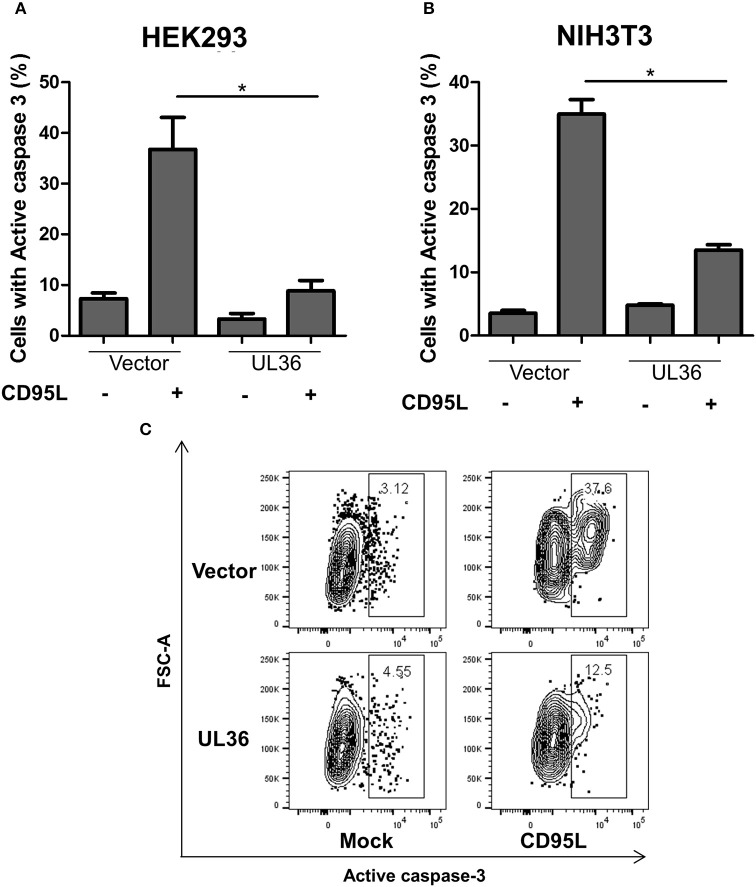
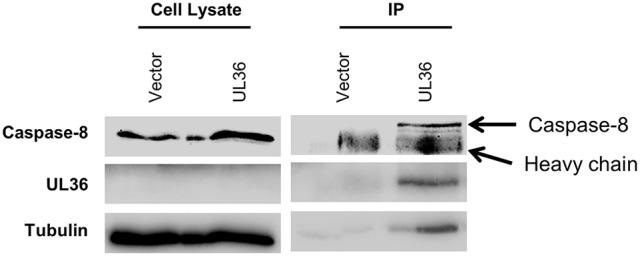
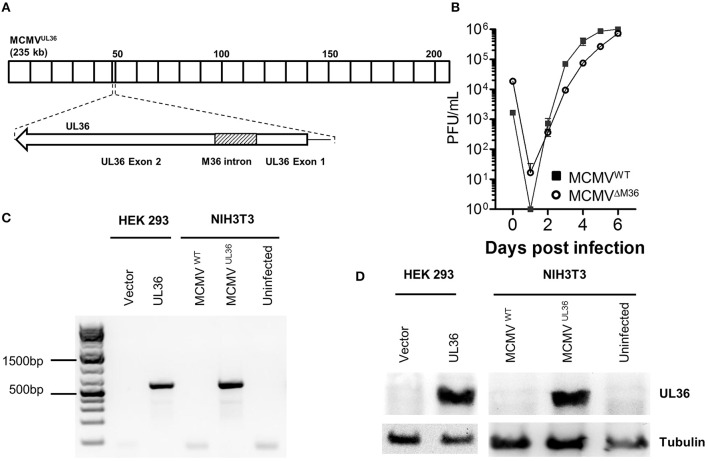
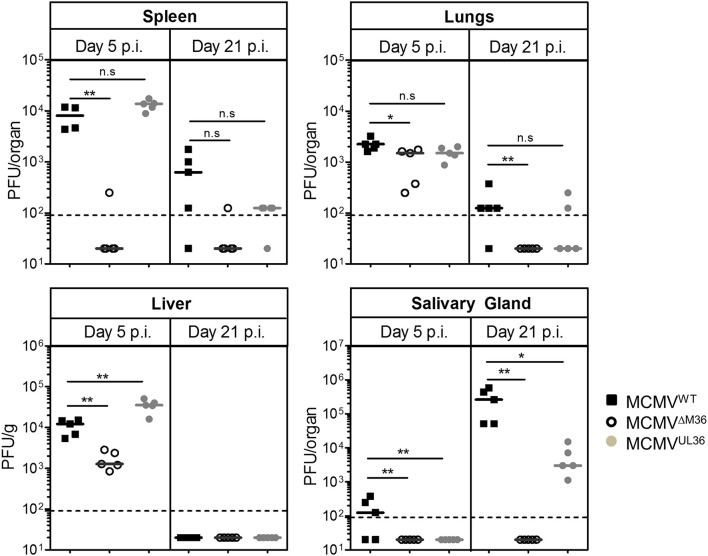
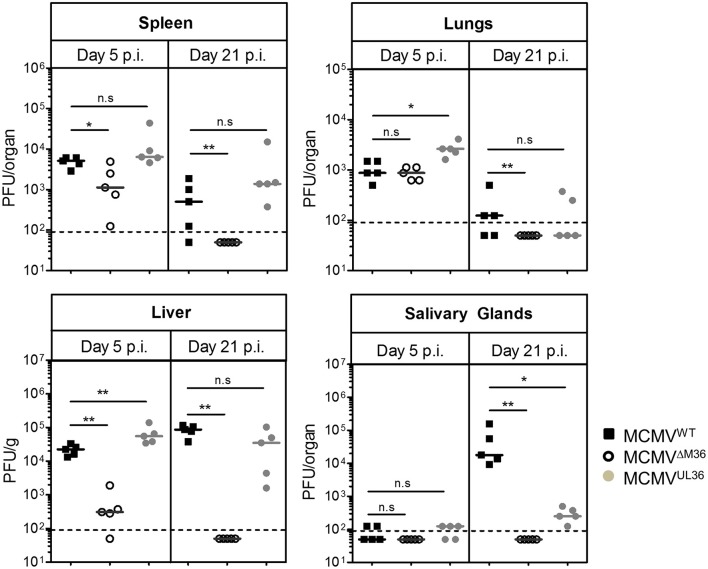
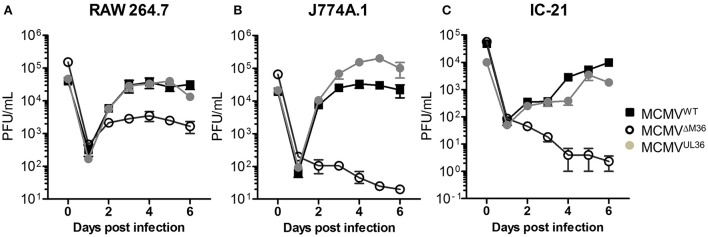
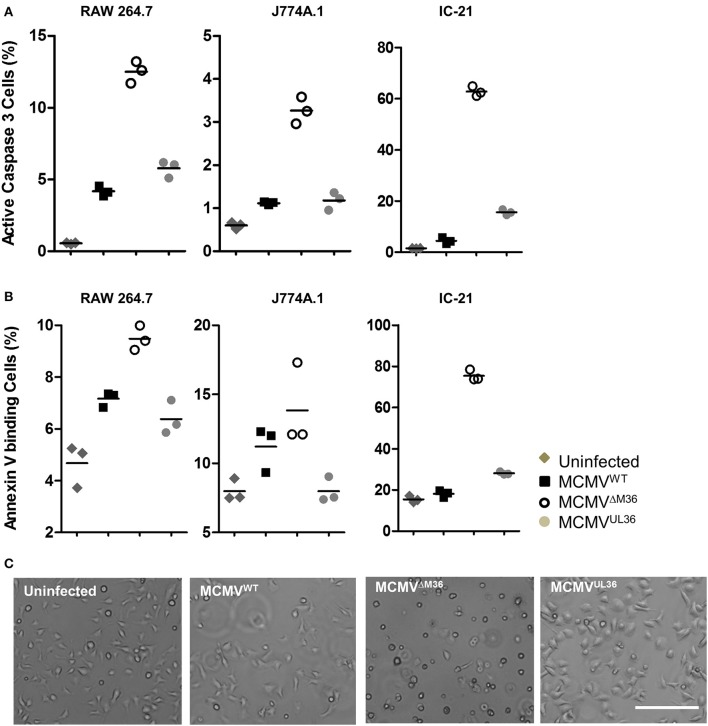
Apoptosis is an important defense mechanism mounted by the immune system to control virus replication. Hence, cytomegaloviruses (CMV) evolved and acquired numerous anti-apoptotic genes. The product of the human CMV (HCMV) UL36 gene, pUL36 (also known as vICA), binds to pro-caspase-8, thus inhibiting death-receptor apoptosis and enabling viral replication in differentiated THP-1 cells. studies of the function of HCMV genes are severely limited due to the strict host specificity of cytomegaloviruses, but CMV orthologues that co-evolved with other species allow the experimental study of CMV biology . The mouse CMV (MCMV) homolog of the UL36 gene is called M36, and its protein product (pM36) is a functional homolog of vICA that binds to murine caspase-8 and inhibits its activation. M36-deficient MCMV is severely growth impaired in macrophages and . Here we show that pUL36 binds to the murine pro-caspase-8, and that UL36 expression inhibits death-receptor apoptosis in murine cells and can replace M36 to allow MCMV growth and . We generated a chimeric MCMV expressing the UL36 ORF sequence instead of the M36 one. The newly generated MCMV inhibited apoptosis in macrophage lines RAW 264.7, J774A.1, and IC-21 and its growth was rescued to wild type levels. Similarly, growth was rescued in the liver and spleen, but only partially in the salivary glands of BALB/c and C57BL/6 mice. In conclusion, we determined that an immune-evasive HCMV gene is conserved enough to functionally replace its MCMV counterpart and thus allow its study in an setting. As UL36 and M36 proteins engage the same molecular host target, our newly developed model can facilitate studies of anti-viral compounds targeting pUL36 .
细胞凋亡是免疫系统控制病毒复制的重要防御机制。因此,巨细胞病毒(CMV)进化并获得了许多抗凋亡基因。人巨细胞病毒(HCMV)UL36 基因的产物,pUL36(也称为 vICA),与前胱天蛋白酶-8 结合,从而抑制死亡受体凋亡,并使病毒在分化的 THP-1 细胞中复制。由于巨细胞病毒的严格宿主特异性,对 HCMV 基因功能的研究受到严重限制,但与其他物种共同进化的 CMV 同源物允许对 CMV 生物学进行实验研究。UL36 基因的小鼠 CMV(MCMV)同源物称为 M36,其蛋白产物(pM36)是 vICA 的功能同源物,与鼠胱天蛋白酶-8 结合并抑制其激活。M36 缺陷型 MCMV 在巨噬细胞中生长严重受损,。在这里,我们表明 pUL36 与鼠前胱天蛋白酶-8 结合,并且 UL36 表达抑制鼠细胞中的死亡受体凋亡,并可以替代 M36 以允许 MCMV 生长和。我们生成了一种表达 UL36 ORF 序列而不是 M36 的嵌合 MCMV。新生成的 MCMV 抑制巨噬细胞系 RAW 264.7、J774A.1 和 IC-21 中的凋亡,其生长恢复到野生型水平。类似地,在 BALB/c 和 C57BL/6 小鼠的肝脏和脾脏中得到挽救,但仅在唾液腺中部分得到挽救。总之,我们确定一种免疫逃避的 HCMV 基因足够保守,可以替代其 MCMV 对应物发挥功能,从而可以在体内环境中对其进行研究。由于 UL36 和 M36 蛋白与相同的分子宿主靶标结合,我们新开发的模型可以促进针对 pUL36 的抗病毒化合物的研究。