Cordeanu Elena-Mihaela, Jambert Lucas, Severac Francois, Lambach Hélène, Tousch Jonathan, Heitz Marie, Mirea Corina, Hamadé Amer, Younes Waël, Frantz Anne-Sophie, Merdji Hamid, Schini-Kerth Valérie, Bilbault Pascal, Meziani Ferhat, Ohlmann Patrick, Andres Emmanuel, Stephan Dominique
Department of Hypertension, Vascular Disease and Clinical Pharmacology, Strasbourg Regional University Hospital, 67091 Strasbourg, France.
Department of Vascular Medicine, Mulhouse Regional Hospital, 68100 Mulhouse, France.
J Clin Med. 2020 Oct 28;9(11):3472. doi: 10.3390/jcm9113472.
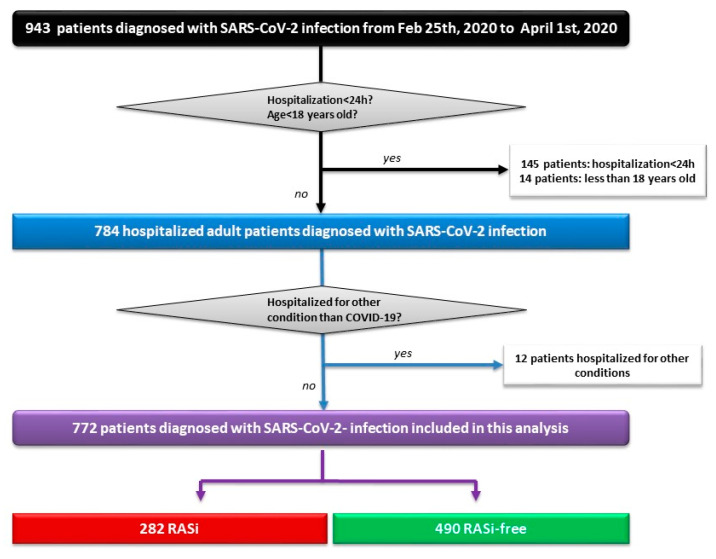
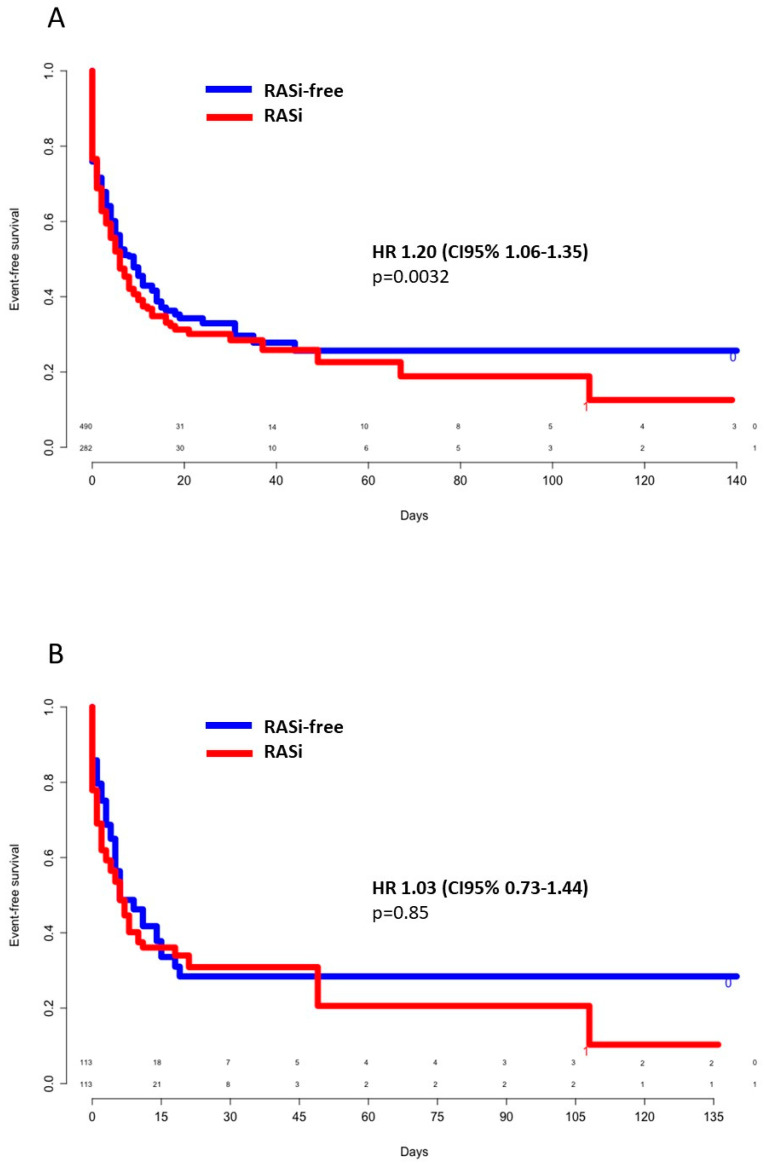
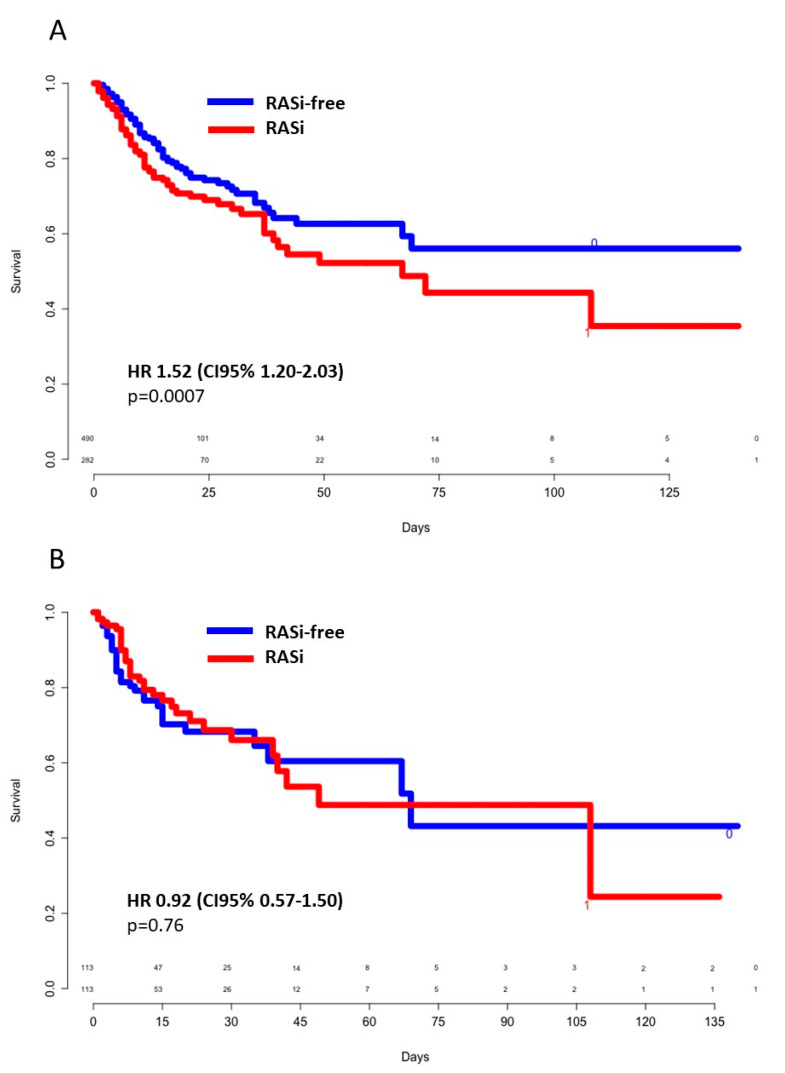
(1) Background: Severe acute respiratory syndrome coronavirus 2 (SARS-CoV-2) penetrates respiratory epithelium through angiotensin-converting enzyme-2 binding, raising concerns about the potentially harmful effects of renin-angiotensin system inhibitors (RASi) on Human Coronavirus Disease 2019 (COVID-19) evolution. This study aimed to provide insight into the impact of RASi on SARS-CoV-2 outcomes in patients hospitalized for COVID-19. (2) Methods: This was a retrospective analysis of hospitalized adult patients with SARS-CoV-2 infection admitted to a university hospital in France. The observation period ended at hospital discharge. (3) Results: During the study period, 943 COVID-19 patients were admitted to our institution, of whom 772 were included in this analysis. Among them, 431 (55.8%) had previously known hypertension. The median age was 68 (56-79) years. Overall, 220 (28.5%) patients were placed under mechanical ventilation and 173 (22.4%) died. According to previous exposure to RASi, we defined two groups, namely, "RASi" ( = 282) and "RASi-free" ( = 490). Severe pneumonia (defined as leading to death and/or requiring intubation, high-flow nasal oxygen, noninvasive ventilation, and/or oxygen flow at a rate of ≥5 L/min) and death occurred more frequently in RASi-treated patients (64% versus 53% and 29% versus 19%, respectively). However, in a propensity score-matched cohort derived from the overall population, neither death (hazard ratio (HR) 0.93 (95% confidence interval (CI) 0.57-1.50), = 0.76) nor severe pneumonia (HR 1.03 (95%CI 0.73-1.44), = 0.85) were associated with RASi therapy. (4) Conclusion: Our study showed no correlation between previous RASi treatment and death or severe COVID-19 pneumonia after adjustment for confounders.
(1)背景:严重急性呼吸综合征冠状病毒2(SARS-CoV-2)通过与血管紧张素转换酶2结合穿透呼吸道上皮,这引发了人们对肾素-血管紧张素系统抑制剂(RASi)对2019年人类冠状病毒病(COVID-19)病程可能产生的有害影响的担忧。本研究旨在深入了解RASi对因COVID-19住院患者的SARS-CoV-2感染结局的影响。(2)方法:这是一项对法国一家大学医院收治的成年SARS-CoV-2感染住院患者的回顾性分析。观察期至出院结束。(3)结果:在研究期间,943例COVID-19患者入住我院,其中772例纳入本分析。其中,431例(55.8%)既往有高血压病史。中位年龄为68(56 - 79)岁。总体而言,220例(28.5%)患者接受了机械通气,173例(22.4%)死亡。根据既往是否使用RASi,我们定义了两组,即“使用RASi组”(n = 282)和“未使用RASi组”(n = 490)。在使用RASi治疗的患者中,重症肺炎(定义为导致死亡和/或需要插管、高流量鼻导管吸氧、无创通气和/或吸氧流速≥5 L/分钟)和死亡的发生率更高(分别为64%对53%和29%对19%)。然而,在从总体人群中得出的倾向评分匹配队列中,死亡(风险比(HR)0.93(95%置信区间(CI)0.57 - 1.50),P = 0.76)和重症肺炎(HR 1.03(95%CI 0.73 - 1.44),P = 0.85)均与RASi治疗无关。(4)结论:我们的研究表明,在对混杂因素进行调整后,既往RASi治疗与死亡或COVID-19重症肺炎之间无相关性。