Oliveira Tafnes, Ribeiro Isabella, Jurema-Santos Gabriela, Nobre Isabele, Santos Ravi, Rodrigues Camilla, Oliveira Kevin, Henrique Rafael, Ferreira-E-Silva Wylla, Araújo Alice
Department of Nutrition, Universidade Federal de Pernambuco (UFPE), Recife-PE 50670-901, Brazil.
Department of Nutrition, Centro Acadêmico de Vitória (CAV)-Universidade Federal de Pernambuco (UFPE), Vitória de Santo Antão-PE 55608-680, Brazil.
Foods. 2020 Oct 28;9(11):1567. doi: 10.3390/foods9111567.
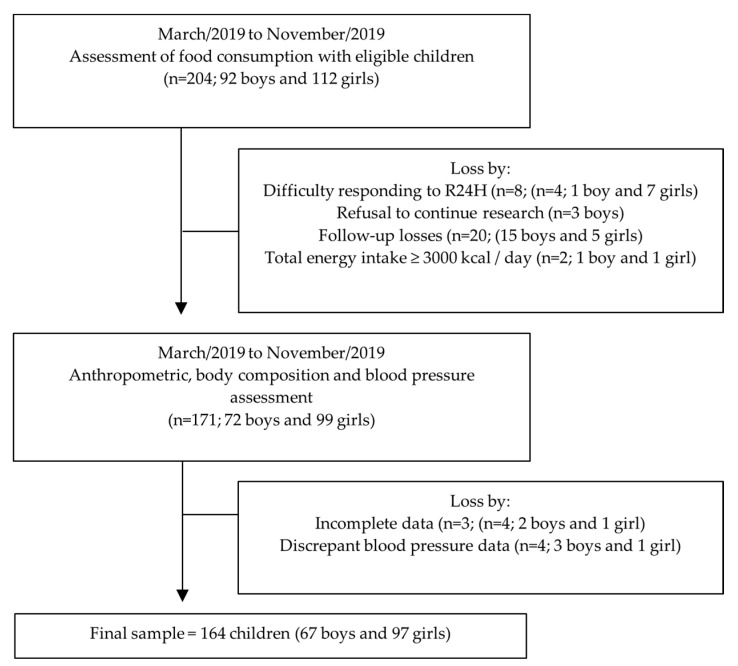
The consumption of ultra-processed foods plays an important role in the development of obesity and hypertension. The present study investigated the association between consumption of food according to the degree of processing and anthropometric indicators of obesity and blood pressure in children. This is a cross-sectional study with 164 children aged 7-10 years. The body mass index (BMI) for age, waist circumference (WC), and waist-to-height ratio (WHtR) was evaluated. Food consumption was analyzed by three 24-h dietary recalls, and classified as: G1-unprocessed or minimally processed; G2-culinary ingredients and processed food; and G3-ultra-processed food. Linear regression analyses were used to investigate the associations among variables. The average energy consumption was 1762.76 kcal/day, split into 45.42%, 10.88%, and 43.70%, provided by G1, G2, and G3, respectively. Adjusted linear regression analyses identified that the caloric contribution of G1 was inversely associated with DBP, showing that for each 10% increase in the energy intake of minimally processed foods, there was a reduction of 0.96 mmHg in the DBP (β:-0.10; 95% CI:-0.19 to -0.01; r = 0.20). There was no association between the caloric contribution of food groups and BMI, WC, WHtR, and SBP. Increasing consumption of G1 could be a strategy for the prevention and treatment of hypertension in schoolchildren.
超加工食品的消费在肥胖和高血压的发展中起着重要作用。本研究调查了根据加工程度划分的食物消费与儿童肥胖和血压的人体测量指标之间的关联。这是一项针对164名7至10岁儿童的横断面研究。评估了年龄别体重指数(BMI)、腰围(WC)和腰高比(WHtR)。通过三次24小时饮食回顾分析食物消费情况,并将其分类为:G1-未加工或最低限度加工食品;G2-烹饪原料和加工食品;以及G3-超加工食品。使用线性回归分析来研究变量之间的关联。平均能量消耗为1762.76千卡/天,分别由G1、G2和G3提供的能量占比为45.42%、10.88%和43.70%。调整后的线性回归分析表明,G1的热量贡献与舒张压呈负相关,即未加工食品能量摄入每增加10%,舒张压降低0.96 mmHg(β:-0.10;95%置信区间:-0.19至-0.01;r = 0.20)。食物组的热量贡献与BMI、WC、WHtR和收缩压之间无关联。增加G1的消费量可能是预防和治疗学童高血压的一种策略。