Pelloni Lorenzo Stefano, Pelloni Raffaele, Borradori Luca
Department of Dermatology, University Hospital of Bern, Inselspital, Bern, Switzerland.
ENT, Lugano, Switzerland.
BMC Dermatol. 2020 Oct 30;20(1):12. doi: 10.1186/s12895-020-00110-1.
Herpes zoster, also known as shingles, results from reactivation of the varicella-zoster virus. It commonly presents with burning pain and vesicular lesions with unilateral distribution and affects the thoracic and cervical sites in up to 60 and 20% of cases, respectively. The branches of the trigeminal nerves are affected in up to 20% of cases. Multidermatomal involvement of the trigeminal nerves has been only anecdotally described in immunocompetent subjects.
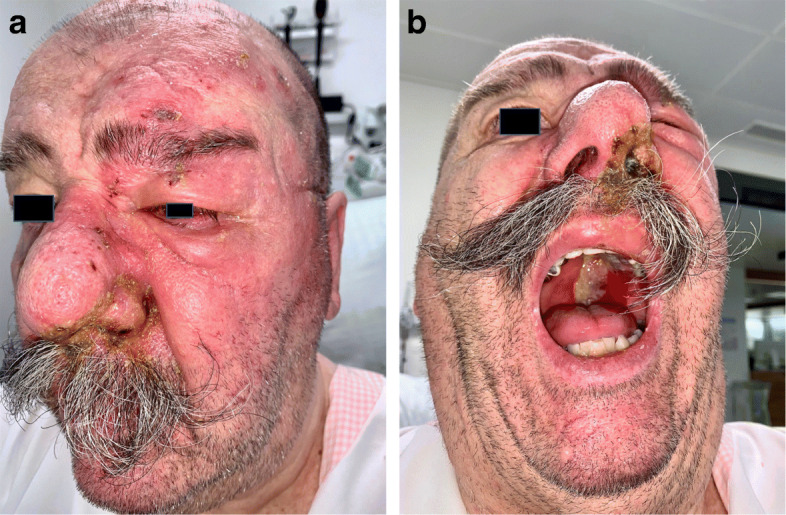
A 71-year-old previously healthy male presented with grouped vesicular and impetiginized lesions with crusts on the left half of the face of two-weeks duration. The lesions first developed on the left nasal tip and progressively worsened with unilateral appearance of vesicular lesions on the left forehead, face, ala nasi, nasal vestibulum and columella, as well as on the left side of hard and soft palate. The affected edematous erythematous areas corresponded to the distribution of the left ophthalmic (V1) and maxillary (V2) branches of the trigeminal nerve, including the infraorbital and nasopalatine nerves of the maxillary branch responsible for the oral cavity involvement. Viral DNA amplification by polymerase chain reaction confirmed the presence of Varicella zoster virus. The patient was started on oral valaciclovir with rapid recovery.
Among immunocompetent patients, herpes zoster is considered a self-limited localized infection. Our observation provides a rare but paradigmatic example of herpes zoster with involvement of both the ophthalmic and maxillary divisions of the trigeminal nerve in an immunocompetent patient. Immunocompetence status and age-specific screening should be warranted in case of atypical involvement and according to the patient's history, while treatment with antiviral drugs should be rapidily initiated in patients at risk.
带状疱疹,又称蛇串疮,是由水痘-带状疱疹病毒再激活引起的。其通常表现为灼痛和单侧分布的水疱性皮损,分别有高达60%和20%的病例累及胸段和颈段部位。高达20%的病例中三叉神经分支会受累。免疫功能正常的个体中,三叉神经多皮节受累仅有零星报道。
一名71岁既往健康男性,左侧面部出现成簇水疱及脓疱化皮损并伴有结痂,病程两周。皮损最初出现在左鼻尖,随后逐渐加重,左侧前额、面部、鼻翼、鼻前庭和鼻中隔以及硬腭和软腭左侧出现单侧水疱性皮损。受累的水肿性红斑区域与三叉神经左侧眼支(V1)和上颌支(V2)的分布相对应,包括上颌支的眶下神经和鼻腭神经,后者负责口腔受累。通过聚合酶链反应进行病毒DNA扩增证实存在水痘-带状疱疹病毒。患者开始口服伐昔洛韦后迅速康复。
在免疫功能正常的患者中,带状疱疹被认为是一种自限性局部感染。我们的观察提供了一个罕见但典型的例子,即免疫功能正常的患者中带状疱疹累及三叉神经的眼支和上颌支。对于非典型受累情况,应根据患者病史确定免疫功能状态并进行年龄特异性筛查,而对于有风险的患者应迅速启动抗病毒药物治疗。