Department of Microbiology, Vardhman Mahavir Medical College and Safdarjung Hospital, New Delhi, India.
Cell Biology Laboratory and Malaria Parasite Bank, ICMR-National Institute of Malaria Research, New Delhi, India.
Ann Clin Microbiol Antimicrob. 2020 Oct 30;19(1):49. doi: 10.1186/s12941-020-00393-9.
Plasmodium vivax, once considered benign species, is recently being recognised to be causing severe malaria like Plasmodium falciparum. In the present study, the authors report the trends in malaria severity in P. vivax among patients from a Delhi government hospital. The aim of the study was to understand the disease severity and the burden of severe vivax malaria.
A hospital based study was carried out from June 2017 to December 2018 at a tertiary care centre from Delhi, India. Patients were tested for malaria using peripheral blood smear (PBS) and/or rapid malaria antigen test (RMAT). The severe and non-severe vivax malaria categorization was done as per the WHO guidelines. Sociodemographic, clinic and paraclinical data were collected from patients and their medical records.
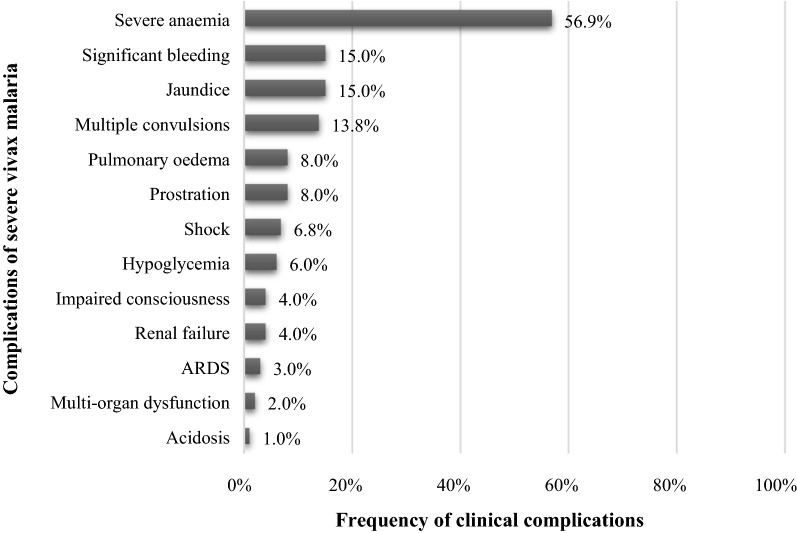
Of the 205 patients, 177 (86.3%) had P. vivax infection, 22 (10.7%) had P. falciparum infection and six (2.9%) had mixed infection with both the species. Out of 177 P. vivax cases included in this study one or more manifestations of severe malaria was found in 58 cases (32.7%). Severe anaemia (56.9%), jaundice (15%) and significant bleeding (15%) were the most common complications reported in most of patients, along with thrombocytopenia.
In this study, it is evident that vivax malaria is emerging as the new severe disease in malaria patients, a significant shift in the paradigm of P. vivax pathogenesis. The spectrum of complications and alterations in the laboratory parameters in P. vivax clinical cases also indicate the recent shift in the disease severity.
曾经被认为是良性物种的间日疟原虫,最近被认为与恶性疟原虫一样会引起严重疟疾。在本研究中,作者报告了德里政府医院的间日疟患者中疟疾严重程度的趋势。本研究的目的是了解严重间日疟的疾病严重程度和负担。
这是一项 2017 年 6 月至 2018 年 12 月在印度德里的一家三级护理中心进行的基于医院的研究。使用外周血涂片(PBS)和/或快速疟疾抗原检测(RMAT)对患者进行疟疾检测。根据世界卫生组织的指南对严重和非严重间日疟进行分类。从患者及其病历中收集社会人口学、临床和实验室数据。
在 205 名患者中,177 名(86.3%)患有间日疟原虫感染,22 名(10.7%)患有恶性疟原虫感染,6 名(2.9%)患有两种病原体混合感染。在包括在本研究中的 177 例间日疟原虫病例中,有 58 例(32.7%)发现一种或多种严重疟疾表现。最常见的并发症是严重贫血(56.9%)、黄疸(15%)和明显出血(15%),大多数患者伴有血小板减少症。
在这项研究中,间日疟原虫作为疟疾患者的新的严重疾病正在出现,这是间日疟原虫发病机制的一个重要转变。间日疟临床病例的并发症谱和实验室参数的改变也表明疾病严重程度的最近转变。