Department of Molecular Medicine and Surgery, Stockholm Sports Trauma Research Center, Karolinska Institutet, Stockholm, Sweden.
Capio Artro Clinic, FIFA Medical Centre of Excellence, Sophiahemmet Hospital, Valhallavägen 91, 11486, Stockholm, Sweden.
Knee Surg Sports Traumatol Arthrosc. 2021 Sep;29(9):3025-3036. doi: 10.1007/s00167-020-06334-5. Epub 2020 Oct 31.
To evaluate and compare changes in quadriceps and hamstring strength and single-leg-hop (SLH) test performance over the first 24 postoperative months in patients who underwent anterior cruciate ligament reconstruction (ACLR) with bone-patellar tendon-bone (BPTB) or hamstring tendon (HT) autografts and followed either a standard or an accelerated rehabilitation protocol.
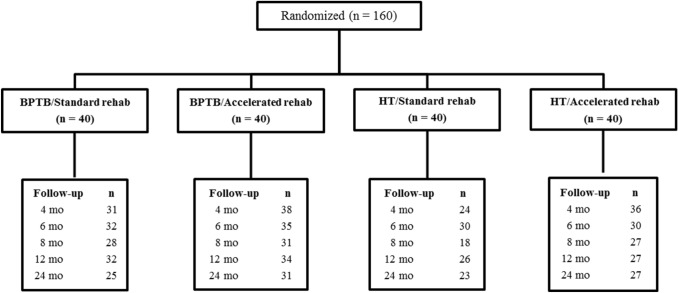
A total of 160 patients undergoing ACLR were randomised in four groups depending on the graft that was used and the rehabilitation protocol (40 BPTB/standard rehab, 40 BPTB/accelerated rehab, 40 HT/standard rehab, 40 HT/accelerated rehab). Isokinetic concentric quadriceps and hamstring strength at 90°/s and the SLH test performance were assessed preoperatively and 4,6,8,12 and 24 months postoperatively. The results were reported as the limb symmetry index (LSI) at the same time point. Linear mixed models were used to compare the groups at the different time points.
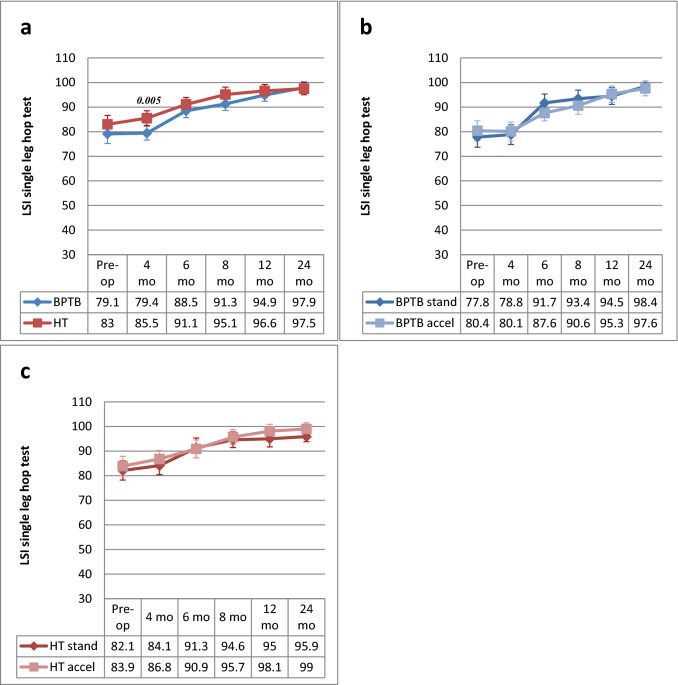
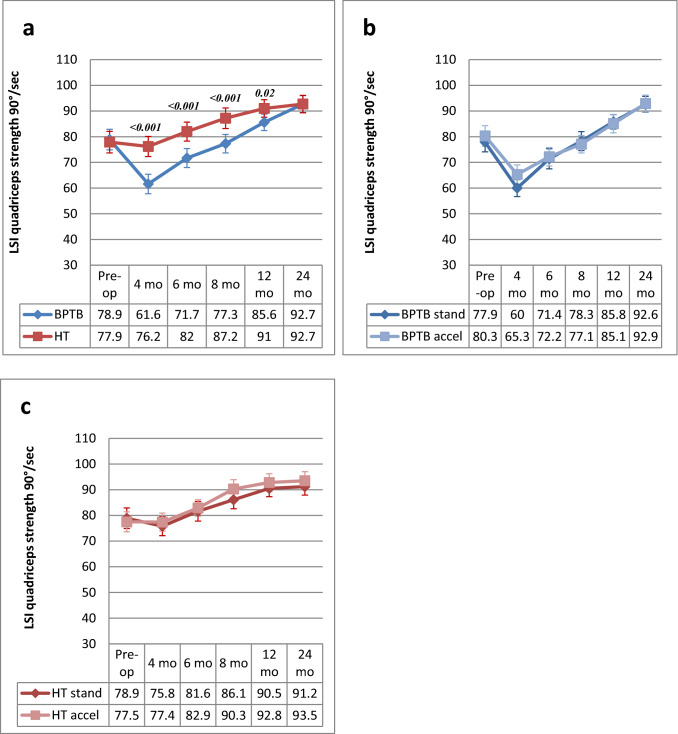
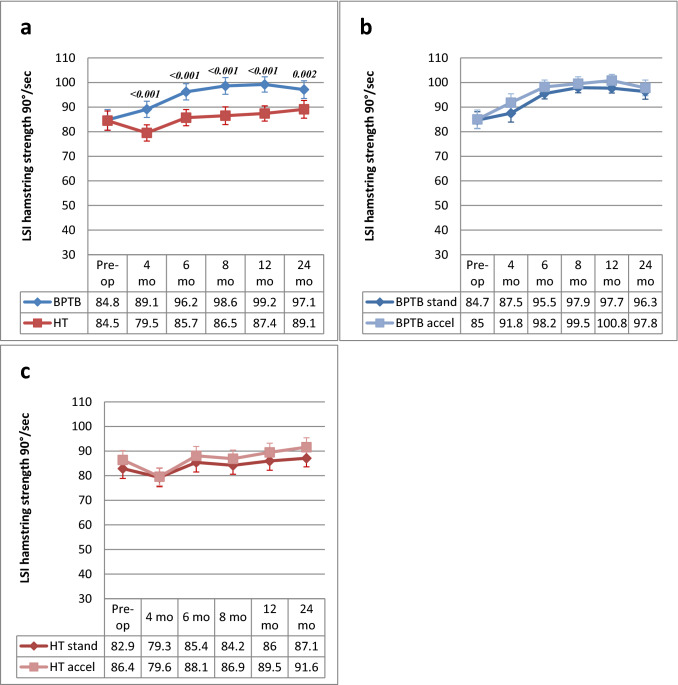
An average quadriceps strength LSI of 78.4% was found preoperatively. After ACLR, the LSI first decreased at 4 months and then increased from 6 to 24 months, reaching an overall value of 92.7% at the latest follow-up. The BPTB group showed a significantly decreased LSI at 4, 6, 8 and 12 months compared with the HT group. No significant differences between the graft groups were found at 24 months. An average hamstring strength LSI of 84.6% was found preoperatively. After ACLR, the LSI increased from 4 to 24 months in the BTPB group. In the HT group, the LSI first decreased at 4 months and then increased from 6 to 24 months. An LSI of 97.1% and 89.1% was found at the latest follow-up for the BPTB and the HT group, respectively. The HT group showed a significantly decreased LSI at all follow-ups compared with the BPTB group. An average SLH test LSI of 81% was found preoperatively. After ACLR, the LSI increased from 4 to 24 months, reaching 97.6% overall at the latest follow-up. The BPTB group showed a significantly decreased LSI only at 4 months postoperatively compared with the HT group. No significant differences in any of the three tests were found between the standard and accelerated rehabilitation groups for either of the graft groups at any time point.
Muscle strength and SLH test performance recovered progressively after ACLR overall, but they did not all fully recover, as the injured leg performed on average less than 100% compared with the uninjured leg even 24 months postoperatively. After ACLR, inferior quadriceps strength and a poorer SLH test performance were found at 4, 6, 8 and 12 months and at 4 months, respectively, for the BTPB group compared with the HT group. Persistent, inferior hamstring strength was found at all postoperative follow-ups in the HT group. Rehabilitation, standard or accelerated, had no significant impact on the recovery of muscle strength and SLH test performance after ACLR in any of the graft groups.
Level I.
评估并比较前交叉韧带重建(ACLR)后前交叉韧带重建患者的股四头肌和腘绳肌力量以及单腿跳跃(SLH)测试表现在前 24 个月的变化,这些患者分别使用骨-髌腱-骨(BPTB)或腘绳肌腱(HT)自体移植物,并遵循标准或加速康复方案。
160 名接受 ACLR 的患者根据移植物的使用和康复方案(40 名 BPTB/标准康复,40 名 BPTB/加速康复,40 名 HT/标准康复,40 名 HT/加速康复)随机分为四组。术前和术后 4、6、8、12 和 24 个月评估等速向心股四头肌和腘绳肌力量 90°/s 和 SLH 测试表现。结果以同一时间点的肢体对称性指数(LSI)报告。线性混合模型用于比较不同时间点的组。
术前平均股四头肌力量 LSI 为 78.4%。ACL 后,LSI 首先在 4 个月时下降,然后从 6 个月增加到 24 个月,在最后一次随访时达到 92.7%的总体值。与 HT 组相比,BPTB 组在 4、6、8 和 12 个月时的 LSI 明显降低。在 24 个月时,在移植物组之间未发现显着差异。术前平均腘绳肌力量 LSI 为 84.6%。ACL 后,BTPB 组的 LSI 从 4 个月增加到 24 个月。在 HT 组中,LSI 首先在 4 个月时下降,然后从 6 个月增加到 24 个月。BPTB 和 HT 组的最后随访 LSI 分别为 97.1%和 89.1%。与 BPTB 组相比,HT 组在所有随访中 LSI 明显降低。术前平均 SLH 测试 LSI 为 81%。ACL 后,LSI 从 4 个月增加到 24 个月,在最后一次随访时达到 97.6%的总体值。与 HT 组相比,BPTB 组仅在术后 4 个月时 LSI 明显降低。在任何时间点,对于任何移植物组,标准和加速康复组之间在任何三项测试中均未发现显着差异。
总体而言,ACL 后肌肉力量和 SLH 测试表现逐渐恢复,但即使在术后 24 个月,受伤的腿也没有完全恢复,与未受伤的腿相比,受伤的腿平均表现不到 100%。与 HT 组相比,BPTB 组在术后 4、6、8 和 12 个月以及 4 个月时分别出现较差的股四头肌力量和 SLH 测试表现。在 HT 组中,在所有术后随访中均存在持续的,较差的腘绳肌力量。在任何移植物组中,康复,无论是标准还是加速,都没有对 ACLR 后肌肉力量和 SLH 测试表现的恢复产生显着影响。
一级。