National Institutes of Health, National Cancer Institute, Center for Cancer Research, Surgery Branch, Bethesda, MD 20892, USA.
National Institutes of Health, National Cancer Institute Laboratory of Pathology, Bethesda, MD 20892, USA.
Mol Ther. 2021 Feb 3;29(2):702-717. doi: 10.1016/j.ymthe.2020.10.008. Epub 2020 Oct 14.
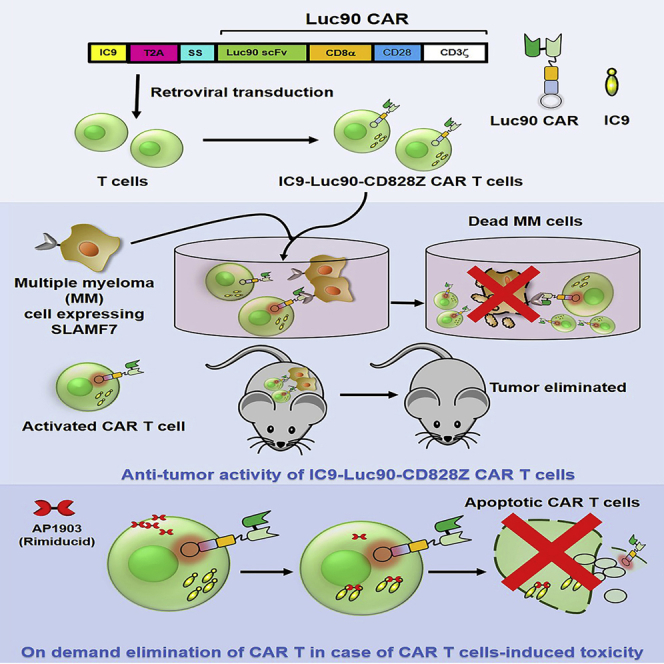
Chimeric antigen receptors (CARs) are fusion proteins that contain antigen-recognition domains and T cell signaling domains. Signaling lymphocytic-activation molecule F7 (SLAMF7) is a promising target for CAR T cell therapies of the plasma cell malignancy multiple myeloma (MM) because SLAMF7 is expressed by MM but not normal nonhematopoietic cells. We designed CARs targeting SLAMF7. We transduced human T cells with anti-SLAMF7 CARs containing either CD28 or 4-1BB costimulatory domains. T cells expressing CD28-containing CARs or 4-1BB-containing CARs recognized SLAMF7 in vitro. SLAMF7-specific cytokine release was higher for T cells expressing CARs with CD28 versus 4-1BB domains. In murine solid tumor and disseminated tumor models, anti-tumor activity of T cells was superior with CD28-containing CARs versus 4-1BB-containing CARs. Because of SLAMF7 expression on some normal leukocytes, especially natural killer cells that control certain viral infections, the inclusion of a suicide gene with an anti-SLAMF7 CAR is prudent. We designed a construct with a CD28-containing anti-SLAMF7 CAR and a suicide gene. The suicide gene encoded a dimerization domain fused to a caspase-9 domain. T cells expressing the anti-SLAMF7 CAR plus suicide-gene construct specifically recognized SLAMF7 in vitro and eliminated tumors from mice. T cells expressing this construct were eliminated on demand by administering the dimerizing agent AP1903 (rimiducid).
嵌合抗原受体 (CARs) 是一种融合蛋白,包含抗原识别结构域和 T 细胞信号结构域。信号淋巴细胞激活分子 F7 (SLAMF7) 是浆细胞恶性肿瘤多发性骨髓瘤 (MM) 的 CAR T 细胞治疗的一个有前途的靶点,因为 SLAMF7 在 MM 中表达,但不在正常非造血细胞中表达。我们设计了针对 SLAMF7 的 CAR。我们用含有 CD28 或 4-1BB 共刺激结构域的抗 SLAMF7 CAR 转导人 T 细胞。表达含有 CD28 的 CAR 或含有 4-1BB 的 CAR 的 T 细胞在体外识别 SLAMF7。表达含有 CD28 的 CAR 的 T 细胞比表达含有 4-1BB 的 CAR 的 T 细胞释放的 SLAMF7 特异性细胞因子更高。在鼠实体瘤和播散性肿瘤模型中,表达含有 CD28 的 CAR 的 T 细胞的抗肿瘤活性优于表达含有 4-1BB 的 CAR 的 T 细胞。由于 SLAMF7 在某些正常白细胞上表达,特别是控制某些病毒感染的自然杀伤细胞,因此在含有抗 SLAMF7 CAR 的自杀基因中包含一个自杀基因是谨慎的。我们设计了一个含有 CD28 的抗 SLAMF7 CAR 和自杀基因的构建体。自杀基因编码一个与 caspase-9 结构域融合的二聚化结构域。表达抗 SLAMF7 CAR 和自杀基因构建体的 T 细胞在体外特异性识别 SLAMF7,并从小鼠中消除肿瘤。通过给予二聚化剂 AP1903(rimiducid),可以按需消除表达该构建体的 T 细胞。