Department of Molecular Neuropathology, Beijing Neurosurgical Institute, Capital Medical University, Beijing, China.
Department of Neurosurgery, Beijing Tiantan Hospital, Capital Medical University, Beijing, China.
Front Immunol. 2020 Oct 8;11:581209. doi: 10.3389/fimmu.2020.581209. eCollection 2020.
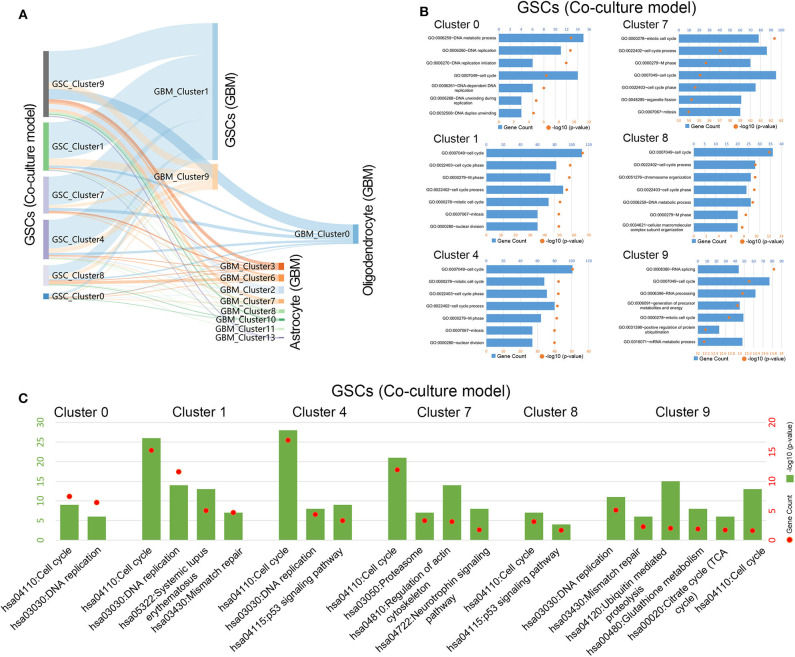
Glioblastoma is one of the most common neoplasms in the central nervous system characterized by limited immune response and unlimited expansion capability. Cancer stem cells (GSCs), a small fraction of the tumor cells, possess a pivotal regulation capability in the tumor microenvironment with a superior proliferation ability. We aimed to reveal the interaction between glioma stem cells (GSCs) and immune cells during tumorigenesis. Single-cell sequencing data from seven surgical specimens of glioblastoma patients and patient-derived GSCs cocultured with peripheral leukocytes were used for the analysis. Cell grouping and trajectory analysis were performed using Seurat and Monocle 3 packages in R software. The gene set of Cancer Genome Anatomy Project was used to define different cell types. Cells with the ability of proliferation and differentiation in glioblastoma tissue were defined as GSCs, which had a similar expression pattern to that in the GSCs . Astrocytes in glioblastoma were mainly derived from differentiated GSCs, while oligodendrocytes were most likely to be derived from different precursor cells. No remarkable evolutionary trajectory was observed among the subgroups of T cells in glioblastoma. The immune checkpoint interaction between GSCs and immune cells was changed from stimulatory to inhibitory during tumorigenesis. The patient-derived GSCs system is an ideal model for GSC research. The above research revealed that the interaction pattern between GSC glioma stem cells and immune cells during tumorigenesis provides a theoretical basis for GSC glioma stem cell-targeted immunotherapy.
胶质母细胞瘤是中枢神经系统最常见的肿瘤之一,其特征为免疫反应有限和无限扩张能力。癌症干细胞(GSCs)是肿瘤细胞的一小部分,在肿瘤微环境中具有关键的调节能力,具有优越的增殖能力。我们旨在揭示肿瘤发生过程中神经胶质瘤干细胞(GSCs)与免疫细胞之间的相互作用。使用来自 7 名胶质母细胞瘤患者的 7 个手术标本的单细胞测序数据和与外周白细胞共培养的患者来源的 GSCs 进行分析。使用 R 软件中的 Seurat 和 Monocle 3 包进行细胞分组和轨迹分析。癌症基因组解剖项目的基因集用于定义不同的细胞类型。在胶质母细胞瘤组织中具有增殖和分化能力的细胞被定义为 GSCs,其表达模式与 GSCs 相似。胶质母细胞瘤中的星形胶质细胞主要来源于分化的 GSCs,而少突胶质细胞最有可能来源于不同的前体细胞。在胶质母细胞瘤的 T 细胞亚群中没有观察到明显的进化轨迹。在肿瘤发生过程中,GSCs 和免疫细胞之间的免疫检查点相互作用从刺激转变为抑制。患者来源的 GSCs 系统是 GSC 研究的理想模型。上述研究揭示了肿瘤发生过程中 GSC 与免疫细胞之间的相互作用模式,为 GSC 靶向免疫治疗提供了理论依据。