Li Ji-Bin, Guo Shan-Shan, Tang Lin-Quan, Guo Ling, Mo Hao-Yuan, Chen Qiu-Yan, Mai Hai-Qiang
Department of Clinical Research, Sun Yat-sen University Cancer Center, Guangzhou, China.
State Key Laboratory of Oncology in South China, Guangdong Key Laboratory of Nasopharyngeal Carcinoma Diagnosis and Therapy, Collaborative Innovation Center for Cancer Medicine, Sun Yat-sen University Cancer Center, Guangzhou, China.
Front Oncol. 2020 Oct 8;10:579292. doi: 10.3389/fonc.2020.579292. eCollection 2020.
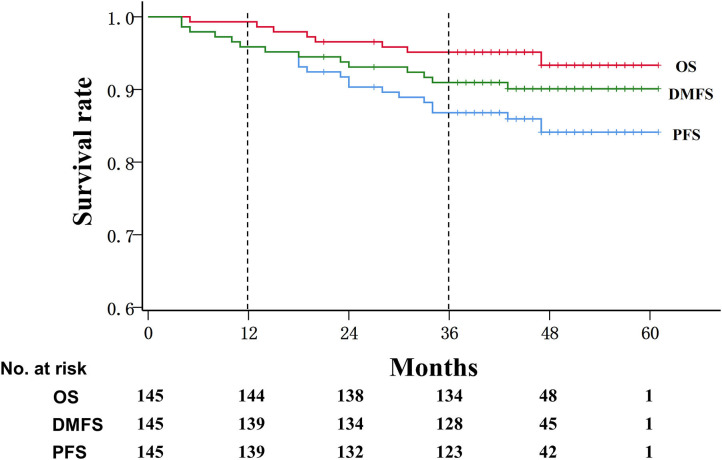
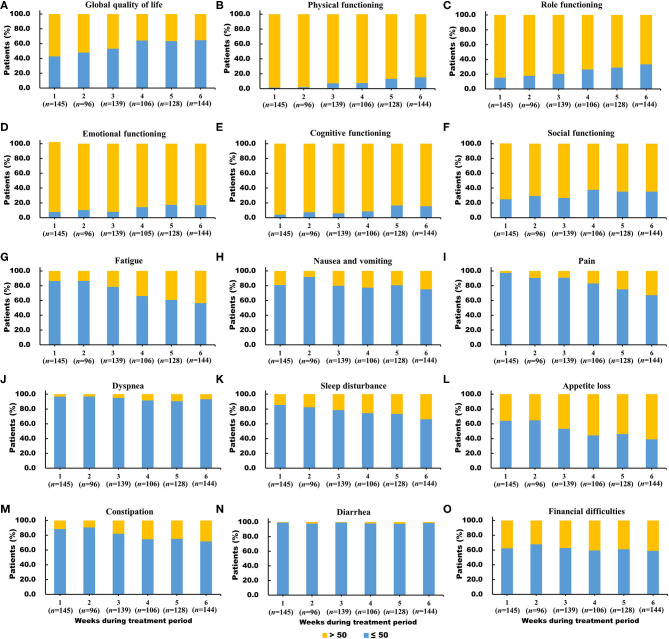
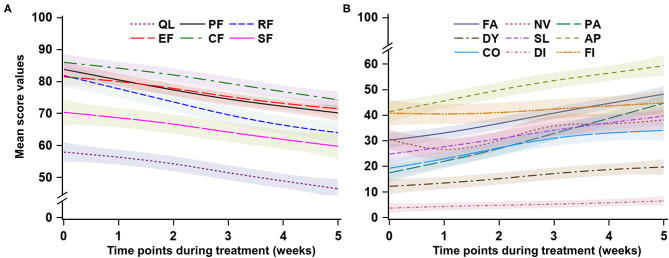
To investigate the longitudinal trend of health-related quality of life (HRQOL) from the start to the end of concurrent chemoradiotherapy and survival in patients with advanced nasopharyngeal carcinoma (NPC). A total of 145 patients with stage II-IVb NPC, who were a subsample of a randomized phase III clinical trial, were recruited in this study. HRQOL was measured weekly for a total of 6 weeks during concurrent chemoradiotherapy by the Chinese version of the European Organization for Research and Treatment of Cancer Quality of Life Questionnaire core 30. Longitudinal trends of HRQOL domains over time were analyzed using mixed models. Survival rates were estimated using Kaplan-Meier method. During a median follow-up of 45 months, the 3-year progression-free survival rate, overall survival rate, and distant metastasis-free survival rate were highly at 86.8% (95% CI: 80.1%, 91.4%), 95.1% (95% CI: 90.1%, 97.6%), and 91.0% (95% CI: 84.9%, 94.6%), respectively. The average weekly declines of five functioning domains were 1.83-3.52 points during the treatment period, with role functioning having the largest decline rate (-2.52 points per week, 95% CI: -4.50, -2.55; < 0.001). Loss of appetite is the most affected symptom, with severe appetite loss ranging from 35.9 to 61.1%. The average increases of symptoms were 0.63-5.16 points per week during treatment period (all -values for time <0.001, except for financial difficulties), with pain symptoms having the largest increase (5.16 points, 95%CI: 4.25, 6.08; < 0.001), followed by fatigue (3.62 points, 95%CI: 2.90, 4.35; < 0.001). The HRQOL of patients with advanced NPC is poor and substantially deteriorated during the concurrent chemoradiotherapy (CCRT) period. Psychological care and support is necessary for patients with advanced NPC during the treatment period.
探讨晚期鼻咽癌(NPC)患者在同步放化疗开始至结束期间健康相关生活质量(HRQOL)的纵向变化趋势及生存情况。本研究纳入了145例II-IVb期NPC患者,这些患者是一项随机III期临床试验的子样本。在同步放化疗期间,使用欧洲癌症研究与治疗组织生活质量问卷核心30中文版每周测量一次HRQOL,共测量6周。使用混合模型分析HRQOL各领域随时间的纵向变化趋势。采用Kaplan-Meier法估计生存率。在中位随访45个月期间,3年无进展生存率、总生存率和无远处转移生存率分别高达86.8%(95%CI:80.1%,91.4%)、95.1%(95%CI:90.1%,97.6%)和91.0%(95%CI:84.9%,94.6%)。在治疗期间,五个功能领域每周平均下降1.83-3.52分,其中角色功能下降率最大(每周-2.52分,95%CI:-4.50,-2.55;P<0.001)。食欲减退是受影响最严重的症状,严重食欲减退发生率在35.9%至61.1%之间。在治疗期间,症状每周平均增加0.63-5.16分(除经济困难外,所有时间的P值均<0.001),其中疼痛症状增加最大(5.16分,95%CI:4.25,6.08;P<0.001),其次是疲劳(3.62分,95%CI:2.90,4.35;P<0.001))。晚期NPC患者的HRQOL较差,在同步放化疗(CCRT)期间显著恶化。在治疗期间,晚期NPC患者需要心理护理和支持。