Kersebaum Dilara, Fabig Sophie-Charlotte, Sendel Manon, Sachau Juliane, Lassen Josephine, Rehm Stefanie, Hüllemann Philipp, Baron Ralf, Gierthmühlen Janne
Division of Neurological Pain Research and Therapy, Department of Neurology, University Hospital of Schleswig-Holstein, Campus Kiel, Germany.
Pain Rep. 2020 Oct 14;5(6):e858. doi: 10.1097/PR9.0000000000000858. eCollection 2020 Nov-Dec.
The SARS-Cov-2 pandemic requires special attention on its psychological effects and the impact on patients with chronic pain.
This study aimed at examining the influence of the COVID-19 pandemic-associated regulations initiated by the German government on pain intensity and characteristics, emotional well-being, and everyday life of patients with painful polyneuropathy.
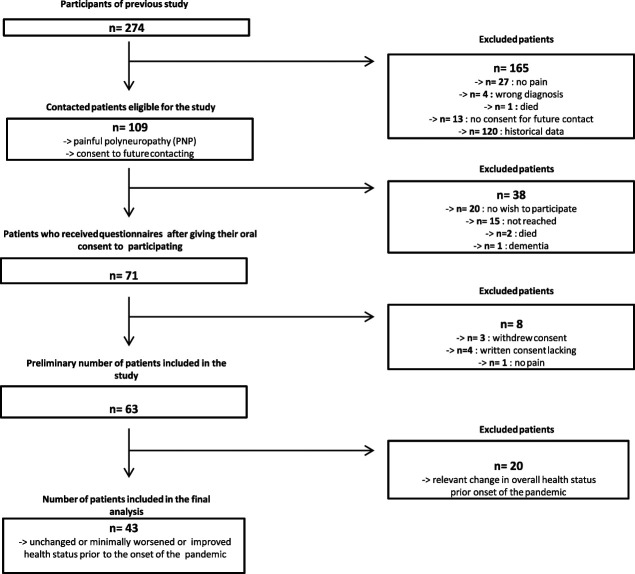
Forty-three patients (well assessed with questionnaires before the pandemic and without change of their health status between baseline and current assessment) were investigated with validated, self-reported questionnaires and COVID-19-specific items 2 weeks after the regulations came into effect.
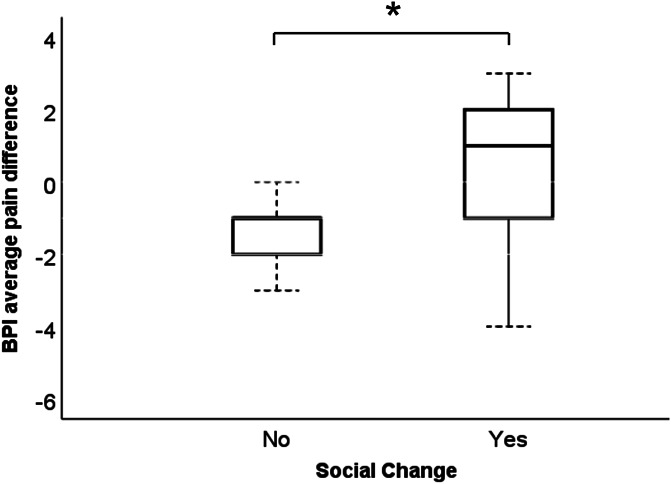
Pain intensity remained stable or even improved like the neuropathic pain symptom inventory total score (t0: 33.54 ± 20.48 vs t1: 27.38 ± 16.16, = 0.008). Only 11.6% reported a pandemic-associated pain worsening. Rumination scores of the Pain Catastrophizing Scale were lower during t1 compared to before the pandemic regulations (t0: 7.81 ± 4.70, t1: 6.49 ± 4.39; = 0.030). Interestingly, pain ratings for the last 7 days were higher in patients with a changed social life compared to those without (-1.63 ± 1.60 vs 0.31 ± 1.83; = 0.01). Quality of life was decreased and helplessness increased in those with higher pain ratings.
Results suggest a shift of attention from the chronic pain condition towards the imminent threat of a global pandemic. As the impacts of the pandemic are persistent and evolving, the development of the measured parameters in the forthcoming weeks will be of great interest.
严重急性呼吸综合征冠状病毒2(SARS-CoV-2)大流行需要特别关注其心理影响以及对慢性疼痛患者的影响。
本研究旨在探讨德国政府实施的与2019冠状病毒病(COVID-19)大流行相关的规定对疼痛性多发性神经病患者的疼痛强度和特征、情绪健康及日常生活的影响。
43名患者(在大流行前通过问卷进行了充分评估,且基线与当前评估之间健康状况无变化)在相关规定生效2周后,使用经过验证的自我报告问卷及COVID-19特定项目进行调查。
疼痛强度保持稳定甚至有所改善,神经病理性疼痛症状量表总分亦是如此(t0:33.54±20.48 对比 t1:27.38±16.16,P = 0.008)。仅有11.6%的患者报告大流行导致疼痛加剧。与大流行规定实施前相比,疼痛灾难化量表的沉思分数在t1时更低(t0:7.81±4.70,t1:6.49±4.39;P = 0.030)。有趣的是,社交生活发生变化的患者过去7天的疼痛评分高于未发生变化的患者(-1.63±1.60对比0.31±1.83;P = 0.01)。疼痛评分较高者的生活质量下降,无助感增加。
结果表明注意力从慢性疼痛状况转向了全球大流行这一迫在眉睫的威胁。由于大流行的影响持续存在且不断演变,未来几周测量参数的变化将备受关注。