Lyon-Est Medical Faculty, Claude Bernard University (Lyon 1), Lyon, France; Hospices Civils de Lyon, Edouard Herriot Hospital, Department of Transplantation, Nephrology and Clinical Immunology, Lyon, France; CIRI, INSERM U1111, Université Claude Bernard Lyon I, CNRS UMR5308, Ecole Normale Supérieure de Lyon, University Lyon, 21, Lyon, France.
Agence de la Biomédecine, Saint Denis la Plaine, France.
Kidney Int. 2020 Dec;98(6):1568-1577. doi: 10.1016/j.kint.2020.10.008. Epub 2020 Oct 31.
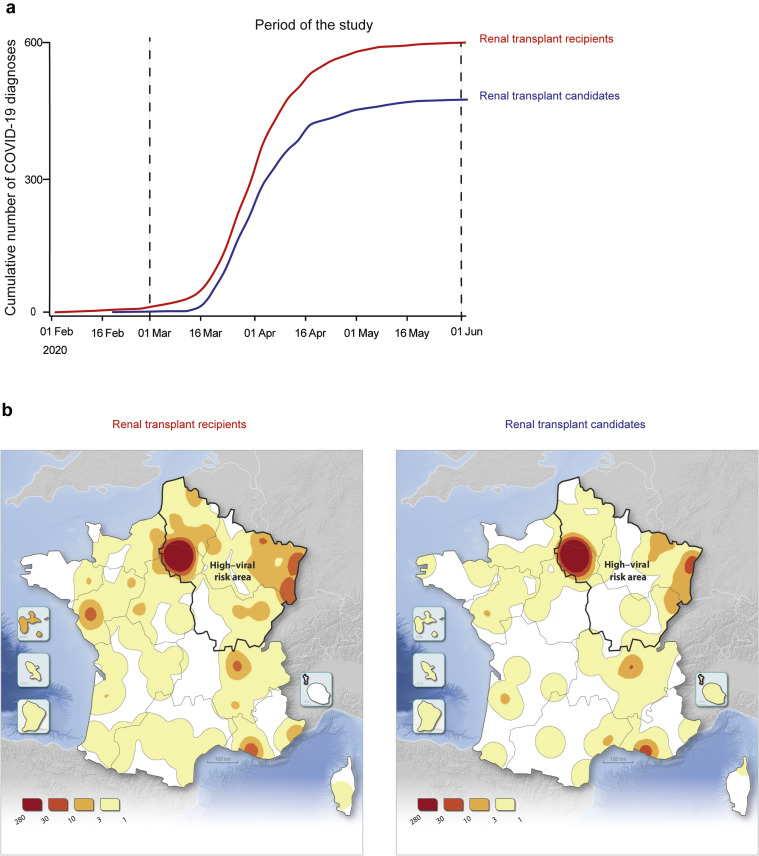
End stage kidney disease increase the risk of COVID-19 related death but how the kidney replacement strategy should be adapted during the pandemic is unknown. Chronic hemodialysis makes social distancing difficult to achieve. Alternatively, kidney transplantation could increase the severity of COVID-19 due to therapeutic immunosuppression and contribute to saturation of intensive care units. For these reasons, kidney transplantation was suspended in France during the first epidemic wave. Here, we retrospectively evaluated this strategy by comparing the overall and COVID-19 related mortality in kidney transplant recipients and candidates over the last three years. Cross-interrogation of two national registries for the period 1 March and 1 June 2020, identified 275 deaths among the 42812 kidney transplant recipients and 144 deaths among the 16210 candidates. This represents an excess of deaths for both populations, as compared with the same period the two previous years (mean of two previous years: 253 in recipients and 112 in candidates). This difference was integrally explained by COVID-19, which accounted for 44% (122) and 42% (60) of the deaths in recipients and candidates, respectively. Taking into account the size of the two populations and the geographical heterogeneity of virus circulation, we found that the excess of risk of death due to COVID-19 was similar for recipients and candidates in high viral risk area but four-fold higher for candidates in the low viral risk area. Thus, in case of a second epidemic wave, kidney transplantation should be suspended in high viral risk areas but maintained outside those areas, both to reduce the excess of deaths of candidates and avoid wasting precious resources.
终末期肾病会增加 COVID-19 相关死亡的风险,但在大流行期间应如何调整肾脏替代策略尚不清楚。慢性血液透析使保持社交距离变得困难。另一方面,由于治疗性免疫抑制,肾移植可能会使 COVID-19 加重,并导致重症监护病房饱和。出于这些原因,法国在第一波疫情期间暂停了肾移植。在这里,我们通过比较过去三年中肾移植受者和候选者的总死亡率和 COVID-19 相关死亡率来回顾性评估该策略。对 2020 年 3 月 1 日至 6 月 1 日期间的两个国家登记处进行交叉查询,在 42812 名肾移植受者中发现了 275 例死亡,在 16210 名候选者中发现了 144 例死亡。与前两年同期相比,这两种人群的死亡人数都有所增加(前两年同期的平均值:受者为 253 例,候选者为 112 例)。这一差异完全可以由 COVID-19 来解释,COVID-19 在受者和候选者中的死亡人数分别占 44%(122 例)和 42%(60 例)。考虑到这两个群体的规模和病毒传播的地理异质性,我们发现,高病毒风险地区受者和候选者因 COVID-19 导致的死亡风险过高,但低病毒风险地区候选者的风险高四倍。因此,如果出现第二波疫情,高病毒风险地区应暂停肾移植,但在这些地区之外应继续进行,这既能减少候选者因 COVID-19 导致的超额死亡,又能避免浪费宝贵资源。