Barambu Nafiu Umar, Bilad Muhammad Roil, Bustam Mohamad Azmi, Huda Nurul, Jaafar Juhana, Narkkun Thanitporn, Faungnawakij Kajornsak
Department of Chemical Engineering, Universiti Teknologi PETRONAS, Bandar Seri Iskandar 32610, Perak, Malaysia.
HICoE-Centre for Biofuel and Biochemical Research, Institute of Self-Sustainable Building, Universiti Teknologi PETRONAS, Seri Iskandar 32610, Perak, Malaysia.
Polymers (Basel). 2020 Oct 29;12(11):2519. doi: 10.3390/polym12112519.
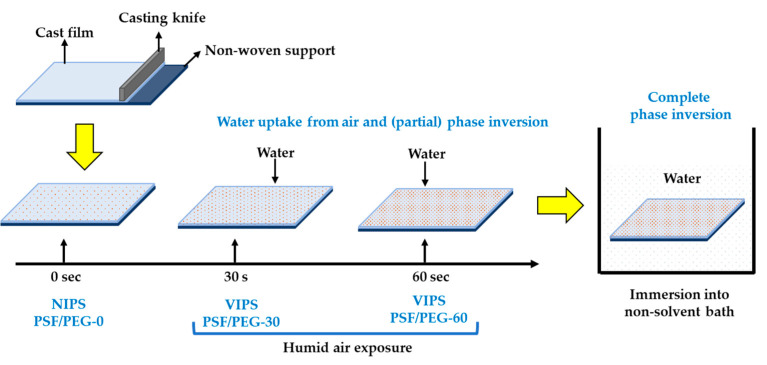
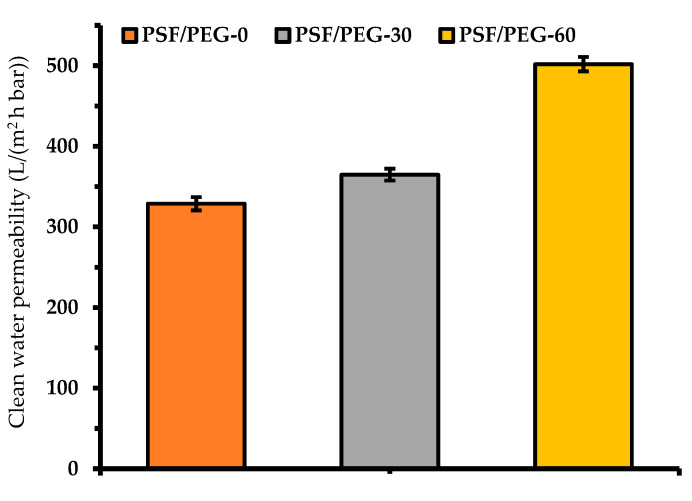
The discharge of improperly treated oil/water emulsion by industries imposes detrimental effects on human health and the environment. The membrane process is a promising technology for oil/water emulsion treatment. However, it faces the challenge of being maintaining due to membrane fouling. It occurs as a result of the strong interaction between the hydrophobic oil droplets and the hydrophobic membrane surface. This issue has attracted research interest in developing the membrane material that possesses high hydraulic and fouling resistance performances. This research explores the vapor-induced phase separation (VIPS) method for the fabrication of a hydrophilic polysulfone (PSF) membrane with the presence of polyethylene glycol (PEG) as the additive for the treatment of oil/water emulsion. Results show that the slow nonsolvent intake in VIPS greatly influences the resulting membrane structure that allows the higher retention of the additive within the membrane matrix. By extending the exposure time of the cast film under humid air, both surface chemistry and morphology of the resulting membrane can be enhanced. By extending the exposure time from 0 to 60 s, the water contact angle decreases from 70.28 ± 0.61° to 57.72 ± 0.61°, and the clean water permeability increases from 328.70 ± 8.27 to 501.89 ± 8.92 (L·m·h·bar). Moreover, the oil rejection also improves from 85.06 ± 1.6 to 98.48 ± 1.2%. The membrane structure was transformed from a porous top layer with a finger-like macrovoid sub-structure to a relatively thick top layer with a sponge-like macrovoid-free sub-structure. Overall results demonstrate the potential of the VIPS process to enhance both surface chemistry and morphology of the PSF membrane.
工业排放未经妥善处理的油/水乳液会对人类健康和环境造成不利影响。膜工艺是一种很有前景的油/水乳液处理技术。然而,由于膜污染,它面临着维护方面的挑战。这是由于疏水性油滴与疏水性膜表面之间的强烈相互作用导致的。这个问题引发了对开发具有高水力和抗污染性能的膜材料的研究兴趣。本研究探索了气相诱导相分离(VIPS)方法,以制备一种亲水性聚砜(PSF)膜,该膜在制备过程中使用聚乙二醇(PEG)作为添加剂来处理油/水乳液。结果表明,VIPS中缓慢的非溶剂吸入对最终的膜结构有很大影响,这使得添加剂在膜基质中的保留率更高。通过延长流延膜在潮湿空气中的暴露时间,可以增强所得膜的表面化学性质和形态。将暴露时间从0秒延长到60秒,水接触角从70.28±0.61°降至57.72±0.61°,清水渗透率从328.70±8.27增加到501.89±8.92(L·m·h·bar)。此外,除油率也从85.06±1.6%提高到98.48±1.2%。膜结构从具有指状大孔亚结构的多孔顶层转变为具有海绵状无大孔亚结构的相对较厚的顶层。总体结果表明,VIPS工艺在增强PSF膜的表面化学性质和形态方面具有潜力。