Department of Social Security, School of Public Administration, Hebei University of Economics and Business, Shijiazhuang 050061, China.
Sau Po Centre on Ageing, The University of Hong Kong, Hong Kong, China.
Int J Environ Res Public Health. 2020 Oct 29;17(21):7947. doi: 10.3390/ijerph17217947.
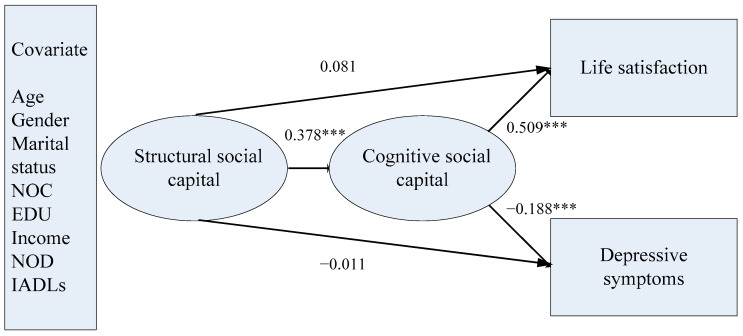
Although social capital has been found to be an important social determinant of mental health in later life, research on social capital in the context of COVID-19 and the interplay among subdimensions of social capital is lacking. The present study examined the mediating role of cognitive social capital on the relationship between structural social capital and mental health among older adults in urban China in the context of the COVID-19 pandemic. Data were collected from the Yangpu district in Shanghai, China, in July-August 2020. A quota sampling approach was used to recruit 472 respondents aged 60 years and older from 23 communities in the Yangpu district. Mental health was measured by depressive symptoms and life satisfaction. Cognitive social capital was assessed through trust and reciprocity, and structural social capital was assessed through organization memberships, and COVID-19 related volunteering and citizenship activity. Structural equation modeling was used to test the mediation model. The results show that cognitive social capital had a full mediation effect on the association between structural social capital and mental health indicators (life satisfaction: = 0.122, = 0.029, < 0.001; depressive symptoms: = -0.343, = 0.119, < 0.01). The findings indicate that social capital can play an important role in sustaining and improving mental health in the context of the COVID-19 pandemic. Policy and intervention implications are discussed.
尽管社会资本已被发现是晚年心理健康的一个重要社会决定因素,但在 COVID-19 背景下以及社会资本各子维度之间相互作用的研究仍然缺乏。本研究考察了认知社会资本在 COVID-19 大流行背景下中国城市老年人的结构性社会资本与心理健康之间关系中的中介作用。数据来自 2020 年 7 月至 8 月在中国上海杨浦区的收集。采用配额抽样方法从杨浦区的 23 个社区招募了 472 名 60 岁及以上的受访者。心理健康通过抑郁症状和生活满意度来衡量。认知社会资本通过信任和互惠来评估,结构性社会资本通过组织成员、与 COVID-19 相关的志愿服务和公民活动来评估。结构方程模型用于检验中介模型。结果表明,认知社会资本对结构性社会资本与心理健康指标(生活满意度: = 0.122, = 0.029, < 0.001;抑郁症状: = -0.343, = 0.119, < 0.01)之间的关联具有完全中介作用。研究结果表明,在 COVID-19 大流行背景下,社会资本可以在维持和改善心理健康方面发挥重要作用。讨论了政策和干预措施的意义。