Department of Psychology, Loyola Marymount University, 1 LMU Drive, Suite 4700, Los Angeles, CA 90045, United States.
Department of Psychiatry, University of Pittsburgh, Pittsburgh, PA, United States.
Psychiatry Res. 2020 Nov;293:113419. doi: 10.1016/j.psychres.2020.113419. Epub 2020 Aug 20.
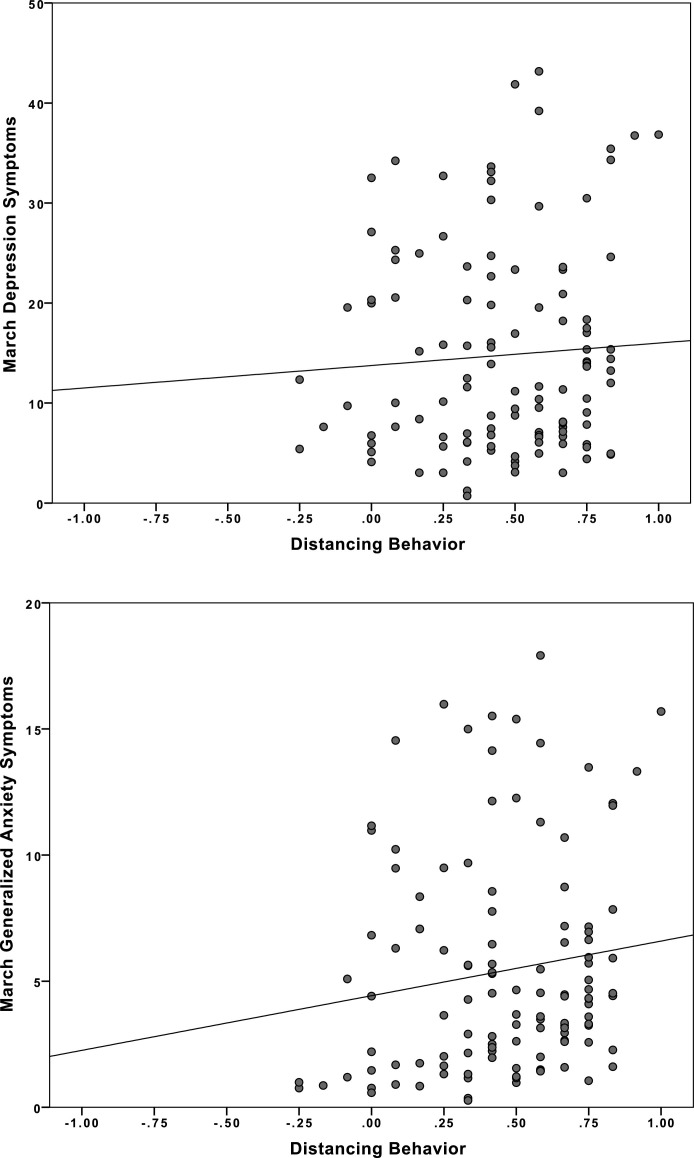
Social distancing is the most visible public health response to the COVID-19 pandemic, but its implications for mental health are unknown. In a nationwide online sample of 435 U.S. adults, conducted in March 2020 as the pandemic accelerated and states implemented stay-at-home orders, we examined whether stay-at-home orders and individuals' personal distancing behavior were associated with symptoms of depression, generalized anxiety disorder (GAD), intrusive thoughts, insomnia, and acute stress. Stay-at-home order status and personal distancing were independently associated with higher symptoms, beyond protective effects of available social resources (social support and social network size). A subsample of 118 participants who had completed symptom measures earlier in the outbreak (February 2020) showed increases in depression and GAD between February and March, and personal distancing behavior was associated with these increases. Findings suggest that there are negative mental health correlates of social distancing, which should be addressed in research, policy, and clinical approaches to the COVID-19 pandemic.
社交距离是应对 COVID-19 大流行的最明显的公共卫生措施,但它对心理健康的影响尚不清楚。在 2020 年 3 月大流行加速和各州实施居家令期间,我们对美国全国范围内的 435 名成年人进行了一项在线调查,研究了居家令和个人的社交隔离行为是否与抑郁、广泛性焦虑症(GAD)、侵入性思维、失眠和急性应激症状有关。居家令的状况和个人的社交隔离行为与更高的症状有关,这超出了可用社会资源(社会支持和社交网络规模)的保护作用。在疫情早期(2020 年 2 月)完成症状测量的 118 名参与者的子样本显示,2 月至 3 月期间抑郁和广泛性焦虑症的症状有所增加,而个人的社交隔离行为与这些增加有关。研究结果表明,社交隔离与负面的心理健康结果有关,这在 COVID-19 大流行的研究、政策和临床方法中都应得到重视。