Division of Medical Oncology, Department of Internal Medicine, Seoul St. Mary's Hospital, College of Medicine, The Catholic University of Korea, Seoul, Korea.
Cancer Research Institute, The Catholic University of Korea, Seoul, Korea.
Cancer Res Treat. 2021 Apr;53(2):409-423. doi: 10.4143/crt.2020.451. Epub 2020 Oct 28.
Use of cyclin-dependent kinase 4/6 inhibitors improved survival outcome of hormone receptor (HR) positive metastatic breast cancer (MBC) patients, including Asian population. However, Asian real-world data of palbociclib is limited. We analyzed the real-world clinical practice patterns and outcome in HR-positive, MBC Asian patients treated with palbociclib.
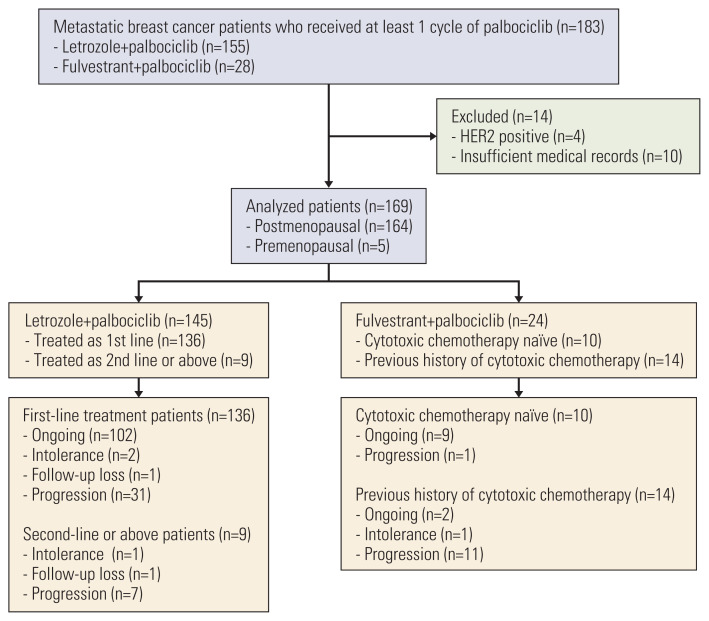
Between April 2017 to November 2019, 169 HR-positive, human epidermal growth factor-2-negative MBC patients treated with letrozole or fulvestrant plus palbocilib were enrolled from eight institutions. Survival outcome (progression-free survival [PFS]), treatment response and toxicity profiles were analyzed.
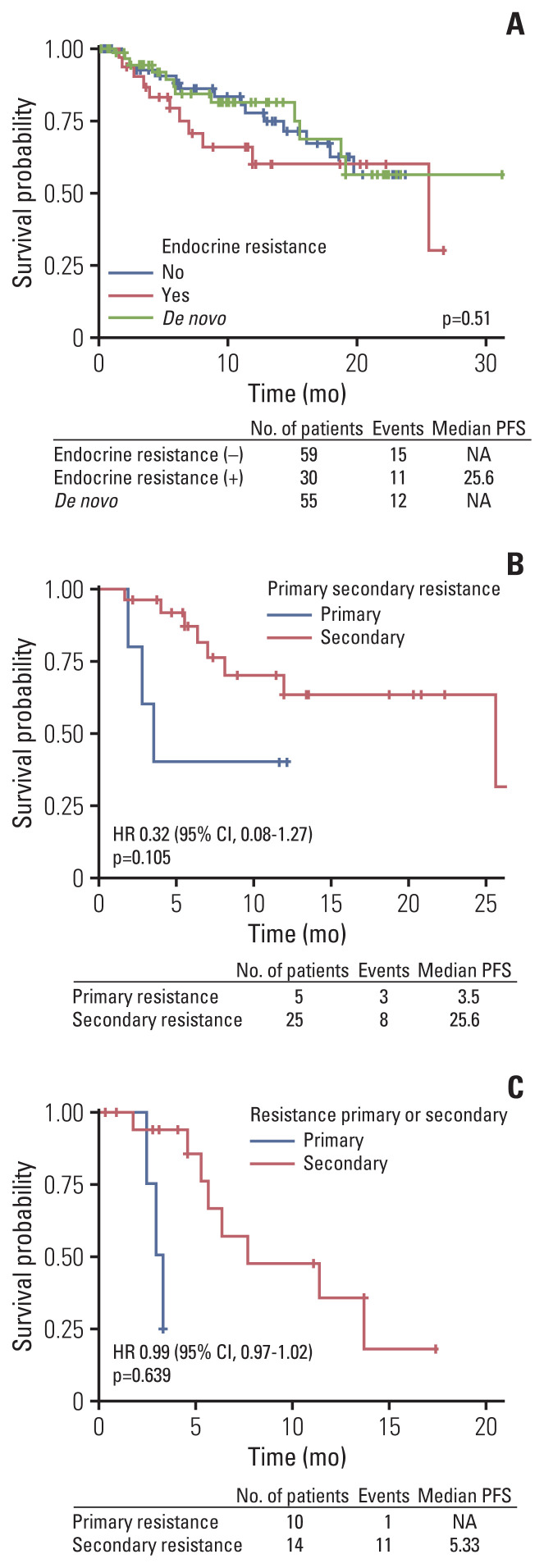
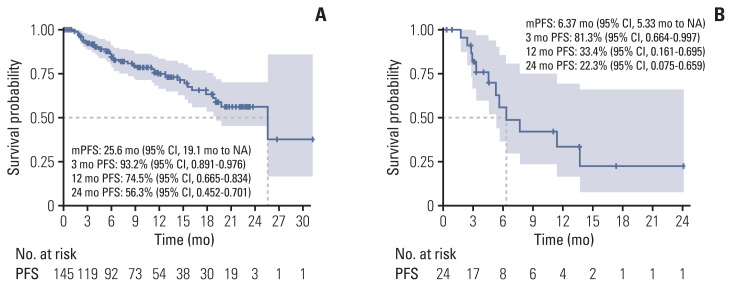
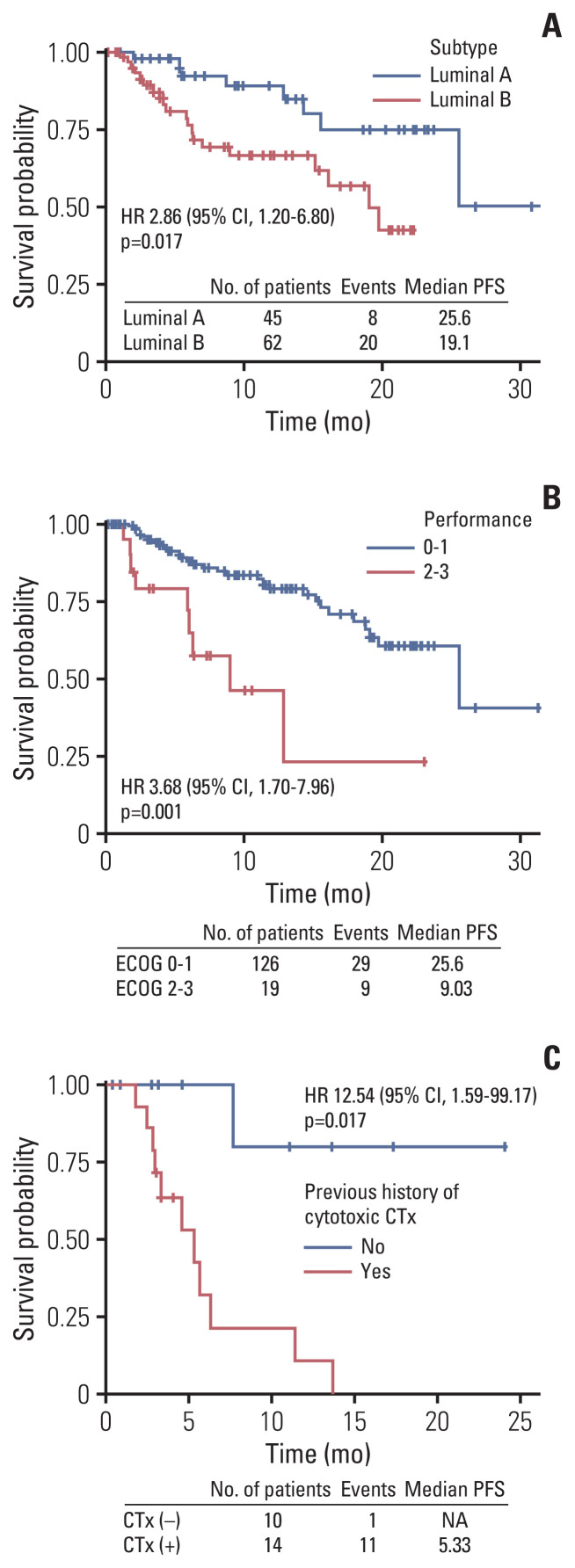
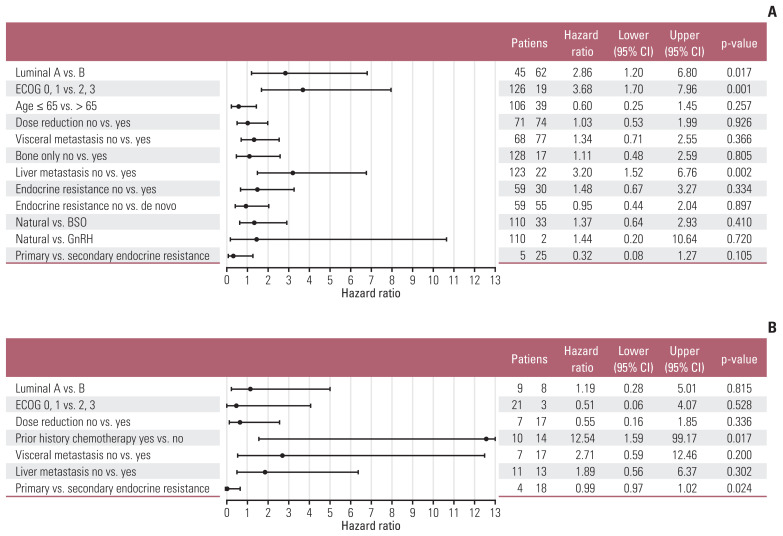
Median age of letrozole plus palbociclib (145 patients, 85.8%) and fulvestrant plus palbociclib (24 patients, 14.2%) was 58 and 53.5 years, with median follow-up duration of 14.63 months (range 0.2 to 33.9 months). Median PFS (mPFS) of letrozole plus palbociclib and fulvestrant plus palbociclib was 25.6 (95% confidence interval [CI], 19.1 to not reached) and 6.37 months (95% CI, 5.33 to not reached), comparable to previous phase 3 trials. In letrozole plus palbociclib arm, luminal A (hazard ratio, 2.86; 95% CI, 1.20 to 6.80; p=0.017) and patients with good performance (Eastern Cooperative Oncology Group 0-1 [hazard ratio, 3.68; 95% CI, 1.70 to 7.96]) showed better mPFS. In fulvestrant plus palbociclib group, chemotherapy naïve patients showed better mPFS (hazard ratio, 12.51, 95% CI, 1.59 to 99.17; p=0.017). The most common grade 3 or 4 adverse event was neutropenia (letrozole 86.3%, fulvestrant 88.3%).
To our knowledge, this is the first real-world data of palbociclib reported in Asia. Palbociclib showed comparable benefit to previous phase 3 trials in Asian patients during daily clinical practice.
细胞周期蛋白依赖性激酶 4/6 抑制剂的使用改善了激素受体(HR)阳性转移性乳腺癌(MBC)患者的生存结局,包括亚洲人群。然而,亚洲关于哌柏西利的真实世界数据有限。我们分析了 HR 阳性、MBC 亚洲患者接受哌柏西利治疗的真实世界临床实践模式和结局。
2017 年 4 月至 2019 年 11 月,从 8 家机构招募了 169 名接受来曲唑或氟维司群联合哌柏西利治疗的 HR 阳性、人表皮生长因子受体-2 阴性 MBC 患者。分析了生存结局(无进展生存期[PFS])、治疗反应和毒性特征。
来曲唑联合哌柏西利(145 例,85.8%)和氟维司群联合哌柏西利(24 例,14.2%)的中位年龄分别为 58 岁和 53.5 岁,中位随访时间为 14.63 个月(0.2 至 33.9 个月)。来曲唑联合哌柏西利和氟维司群联合哌柏西利的中位 PFS(mPFS)分别为 25.6(95%置信区间[CI],19.1 至未达到)和 6.37 个月(95%CI,5.33 至未达到),与之前的 III 期试验相当。在来曲唑联合哌柏西利组中,luminal A(风险比,2.86;95%CI,1.20 至 6.80;p=0.017)和表现良好的患者(东部合作肿瘤学组 0-1 [风险比,3.68;95%CI,1.70 至 7.96])显示出更好的 mPFS。在氟维司群联合哌柏西利组中,化疗初治患者显示出更好的 mPFS(风险比,12.51,95%CI,1.59 至 99.17;p=0.017)。最常见的 3 级或 4 级不良事件是中性粒细胞减少症(来曲唑 86.3%,氟维司群 88.3%)。
据我们所知,这是亚洲首例哌柏西利的真实世界数据报告。哌柏西利在亚洲患者的日常临床实践中显示出与之前的 III 期试验相当的获益。