
排序进化树的距离度量。
Distance metrics for ranked evolutionary trees.
机构信息
Department of Biology, Stanford University, Stanford, CA 94305.
Department of Statistics, Stanford University, Stanford, CA 94305;
出版信息
Proc Natl Acad Sci U S A. 2020 Nov 17;117(46):28876-28886. doi: 10.1073/pnas.1922851117. Epub 2020 Nov 2.
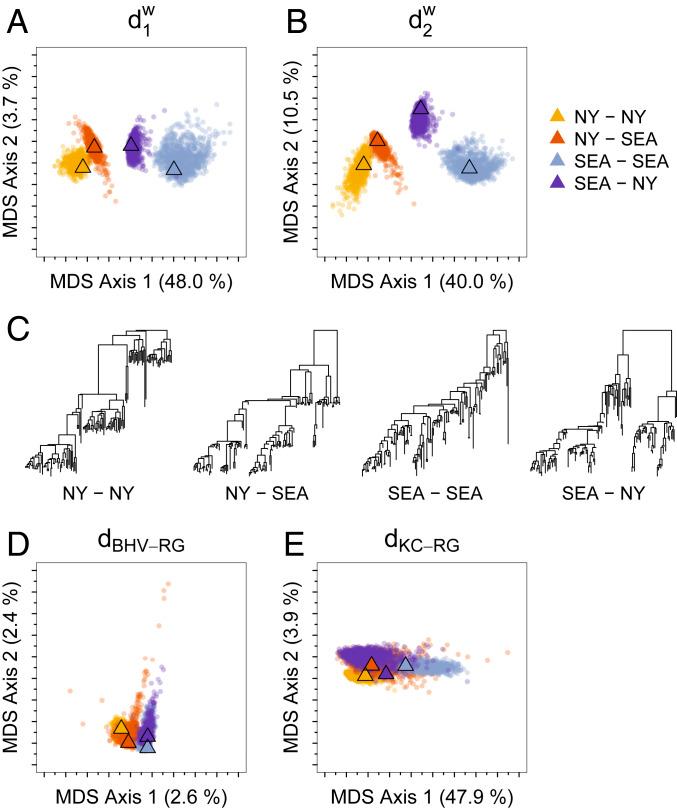
Genealogical tree modeling is essential for estimating evolutionary parameters in population genetics and phylogenetics. Recent mathematical results concerning ranked genealogies without leaf labels unlock opportunities in the analysis of evolutionary trees. In particular, comparisons between ranked genealogies facilitate the study of evolutionary processes of different organisms sampled at multiple time periods. We propose metrics on ranked tree shapes and ranked genealogies for lineages isochronously and heterochronously sampled. Our proposed tree metrics make it possible to conduct statistical analyses of ranked tree shapes and timed ranked tree shapes or ranked genealogies. Such analyses allow us to assess differences in tree distributions, quantify estimation uncertainty, and summarize tree distributions. We show the utility of our metrics via simulations and an application in infectious diseases.
系统发育树建模对于估计群体遗传学和系统发生学中的进化参数至关重要。最近关于没有叶标签的排序谱系的数学结果为进化树的分析提供了机会。特别是,排序谱系之间的比较促进了对在多个时间点采样的不同生物体的进化过程的研究。我们为同时和异时采样的谱系提出了基于排序树形状和排序谱系的度量。我们提出的树度量使对排序树形状和定时排序树形状或排序谱系进行统计分析成为可能。这些分析使我们能够评估树分布的差异,量化估计不确定性,并总结树分布。我们通过模拟和传染病学中的应用展示了我们的度量的实用性。


 Zotero 插件