Zhang Duo, Davoodi Pooya, Li Xia, Liu Ye, Wang Wenyu, Huang Yan Yan Shery
Department of Engineering, University of Cambridge, Trumpington Street, Cambridge, CB2 1PZ, UK.
The Nanoscience Centre, University of Cambridge, 11 JJ Thomson Ave, Cambridge, CB3 0FF, UK.
Sci Rep. 2020 Nov 2;10(1):18783. doi: 10.1038/s41598-020-74542-7.
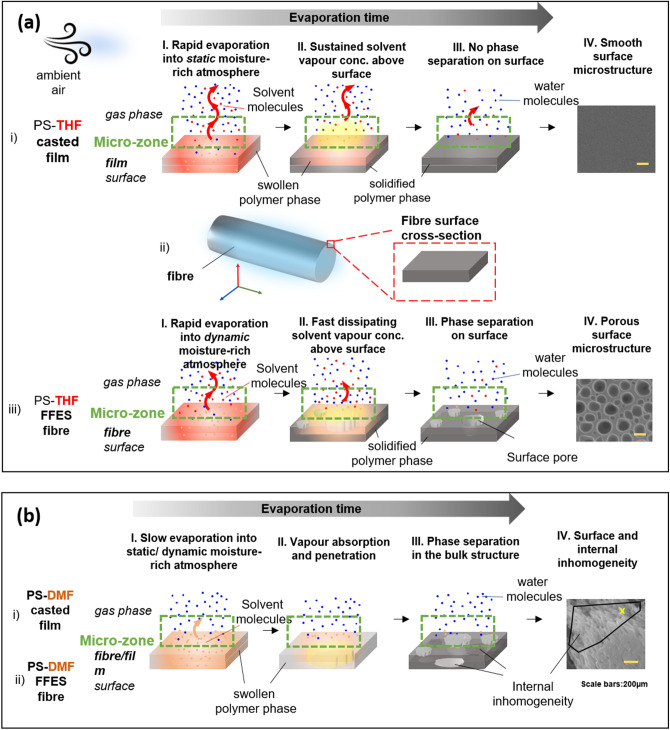
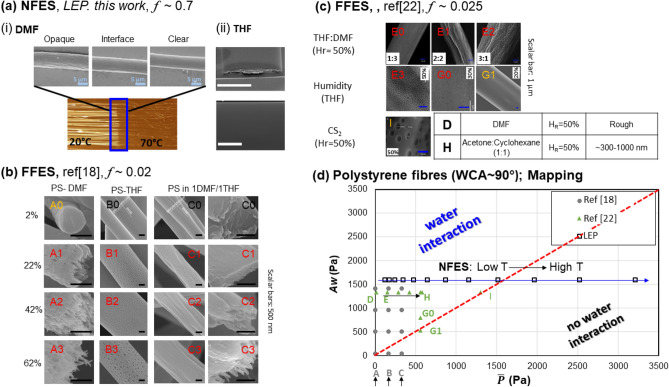
Controlling environmental humidity level and thus moisture interaction with an electrospinning solution jet has led to a fascinating range of polymer fibre morphological features; these include surface wrinkles, creases and surface/internal porosity at the individual fibre level. Here, by cross-correlating literature data of far-field electrospinning (FFES), together with our experimental data from near-field electrospinning (NFES), we propose a theoretical model, which can account, phenomenologically, for the onset of fibre microstructures formation from electrospinning solutions made of a hydrophobic polymer dissolved in a water-miscible or polar solvent. This empirical model provides a quantitative evaluation on how the evaporating solvent vapour could prevent or disrupt water vapor condensation onto the electrospinning jet; thus, on the condition where vapor condensation does occur, morphological features will form on the surface, or bulk of the fibre. A wide range of polymer systems, including polystyrene, poly(methyl methacrylate), poly-L-lactic acid, polycaprolactone were tested and validated. Our analysis points to the different operation regimes associated FFES versus NFES, when it comes to the system's sensitivity towards environmental moisture. Our proposed model may further be used to guide the process in creating desirable fibre microstructure.
控制环境湿度水平,进而控制与静电纺丝溶液射流的水分相互作用,已产生了一系列引人入胜的聚合物纤维形态特征;这些特征包括单个纤维层面的表面皱纹、褶皱以及表面/内部孔隙率。在此,通过将远场静电纺丝(FFES)的文献数据与我们近场静电纺丝(NFES)的实验数据进行交叉关联,我们提出了一个理论模型,该模型从现象学角度能够解释由溶解在与水混溶或极性溶剂中的疏水性聚合物制成的静电纺丝溶液形成纤维微观结构的起始过程。这个经验模型对蒸发的溶剂蒸汽如何防止或扰乱水蒸气在静电纺丝射流上的凝结进行了定量评估;因此,在确实发生蒸汽凝结的情况下,形态特征将在纤维表面或内部形成。对包括聚苯乙烯、聚甲基丙烯酸甲酯、聚-L-乳酸、聚己内酯在内的多种聚合物体系进行了测试和验证。我们的分析指出了在系统对环境湿度的敏感性方面,FFES与NFES相关的不同操作模式。我们提出的模型可能进一步用于指导制造理想纤维微观结构的过程。