Department of Pharmaceutics, Education and Research Center for Pharmaceutical Sciences, Osaka University of Pharmaceutical Sciences, 4-20-1 Nasahara, Takatsuki, Osaka, 569-1094, Japan.
Sci Rep. 2020 Nov 2;10(1):18876. doi: 10.1038/s41598-020-76007-3.
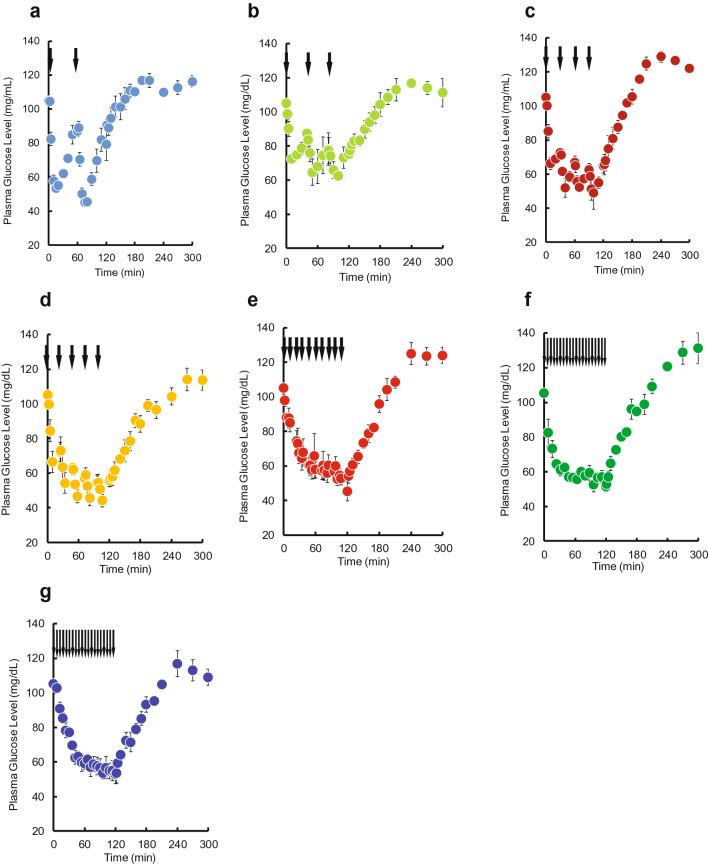
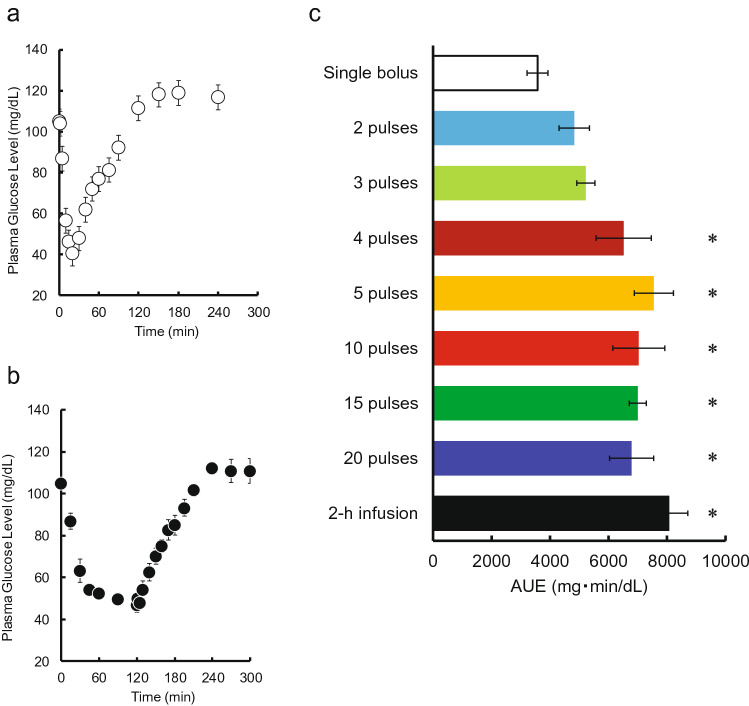
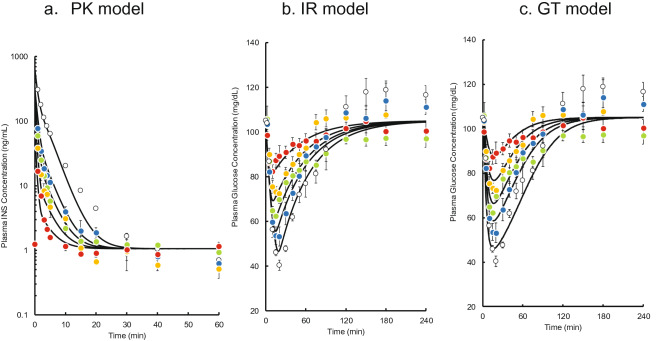
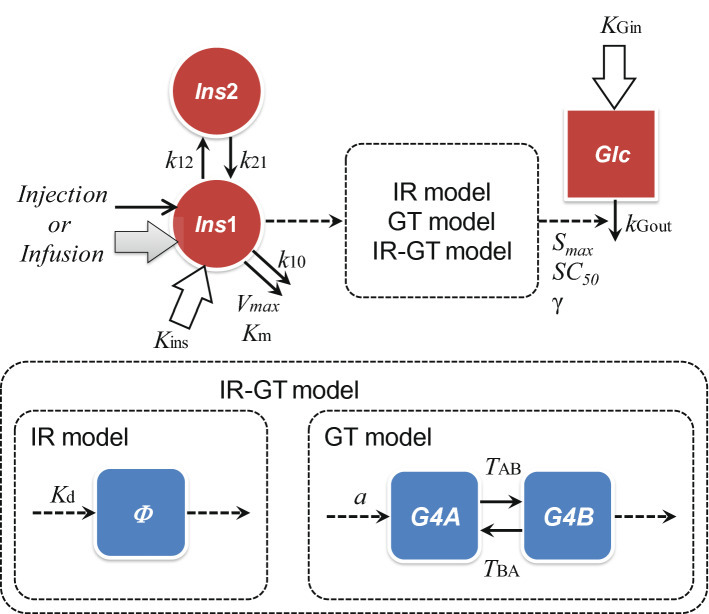
The relationship between the plasma insulin (INS) concentration-time course and plasma glucose concentration-time course during and after pulsatile INS administration to rats was characterized using a pharmacokinetic-pharmacodynamic (PK-PD) model. A total INS dose of 0.5 IU/kg was intravenously injected in 2 to 20 pulses over a 2-h period. Compared with the single bolus administration, the area under the effect-time curve (AUE) increased depending on the number of pulses, and the AUEs for more than four pulses plateaued at a significantly larger value, which was similar to that after the infusion of a total of 0.5 IU/kg of INS over 2 h. No increase in plasma INS concentration occurred after pulsatile administration. Two indirect response models primarily reflecting the receptor-binding process (IR model) or glucose transporter 4 (GLUT4) translocation (GT model) were applied to describe the PK-PD relationship after single intravenous bolus administration of INS. These models could not explain the observed data after pulsatile administration. However, the IR-GT model, which was a combination of the IR and GT models, successfully explained the effects of pulsatile administration and intravenous infusion. These results indicate that the receptor-binding process and GLUT4 translocation are responsible for the change in AUE after pulsatile administration.
采用药代动力学-药效学(PK-PD)模型研究了大鼠在脉冲式胰岛素给药期间和之后的血浆胰岛素(INS)浓度-时间曲线和血浆葡萄糖浓度-时间曲线之间的关系。在 2 小时内以 2 到 20 个脉冲的方式静脉内注射 0.5 IU/kg 的总 INS 剂量。与单次推注给药相比,随着脉冲数的增加,效应时间曲线下面积(AUE)增加,并且超过 4 个脉冲的 AUE 趋于平稳,并且显著增加到一个更大的值,这与在 2 小时内输注总共 0.5 IU/kg 的 INS 相似。脉冲式给药后,血浆 INS 浓度没有增加。两种主要反映受体结合过程的间接反应模型(IR 模型)或葡萄糖转运蛋白 4(GLUT4)易位(GT 模型)被应用于描述 INS 单次静脉推注后的 PK-PD 关系。这些模型无法解释脉冲式给药后的观察数据。然而,IR-GT 模型(IR 和 GT 模型的组合)成功地解释了脉冲式给药和静脉输注的作用。这些结果表明,受体结合过程和 GLUT4 易位是脉冲式给药后 AUE 变化的原因。