School of Life Sciences, University of Lincoln, Lincoln, UK.
Poultry Product Development, Devenish Nutrition, Belfast, Northern Ireland.
Poult Sci. 2020 Nov;99(11):6062-6070. doi: 10.1016/j.psj.2020.08.015. Epub 2020 Aug 26.
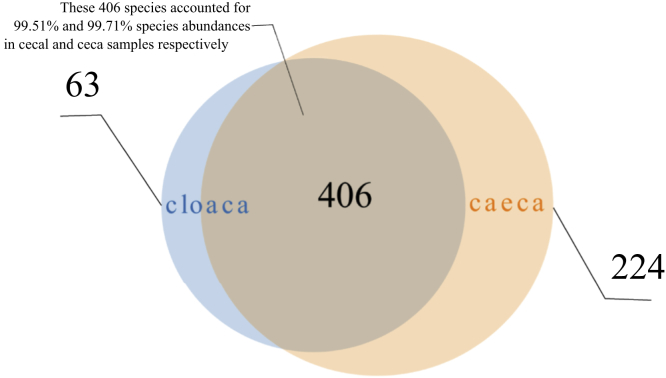
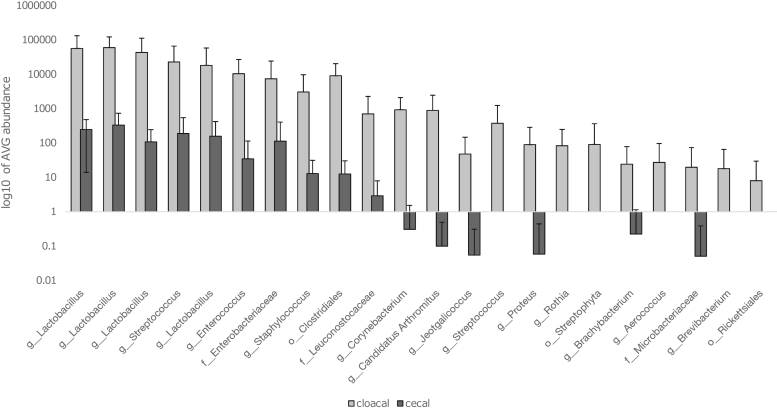
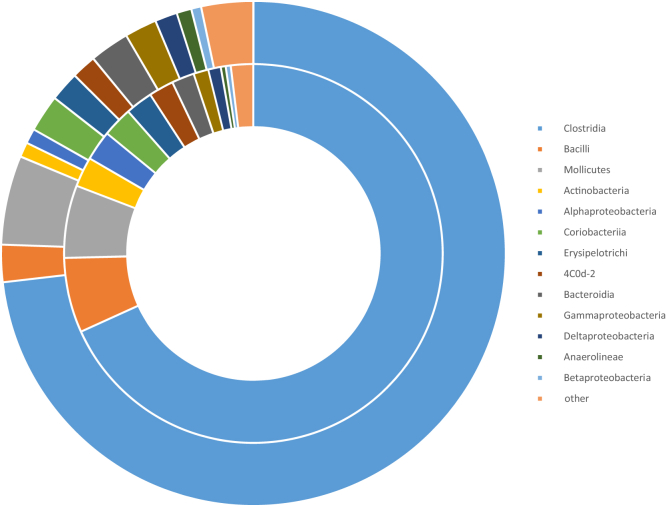
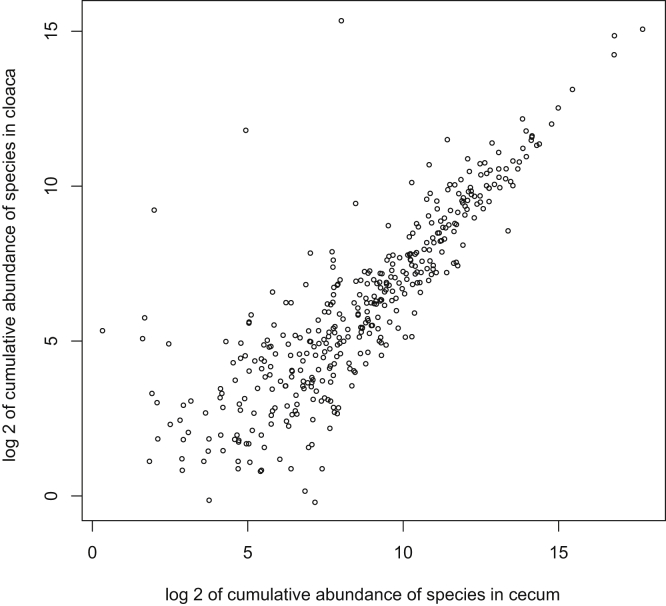
Gut microbiota play an important role in animal health. For livestock, an understanding of the effect of husbandry interventions on gut microbiota helps develop methods that increase sustainable productivity, animal welfare, and food safety. Poultry microbiota of the mid-gut and hind-gut can only be investigated postmortem; however, samples from the terminal cloaca may be collected from live animals. This study tests whether cloacal microbiota reflect cecal microbiota in European broiler poultry by evaluating total and paired cecal and cloacal microbiomes from 47 animals. 16S amplicon libraries were constructed and sequenced with a MiSeq 250 bp PE read metric. The composition of cloacal and cecal microbiomes were significantly affected by the age and location of animals, but the effect was very small. Bacilli were relatively more abundant in ceca and Clostridia in cloaca. There was an overlap of 99.5% for the abundances and 59% for the types of taxa between cloacal and cecal communities, but the small fraction of rare nonshared taxa were sufficient to produce a signal for differentiation between cecal and cloacal communities. There was a significant positive correlation between specific taxa abundances in cloacal and cecal communities (Rho = 0.66, P = 2 × 10). Paired analyses revealed that cloacal communities were more closely related to cecal communities from the same individual than expected by chance. This study is in line with the only other study to evaluate the relationship between cecal and cloacal microbiomes in broiler poultry, but it extends previous findings by analyzing paired cecal-cloacal samples from the same birds and reveals that abundant bacterial taxa in ceca may be reasonably inferred by sampling cloaca. Together, the findings from Europe and Australasia demonstrate that sampling cloaca shows promise as a method to estimate cecal microbiota, and especially abundant taxa, from live broiler poultry in a manner which reduces cost and increases welfare for husbandry and research purposes.
肠道微生物在动物健康中发挥着重要作用。对于家畜而言,了解养殖干预措施对肠道微生物群的影响有助于开发提高可持续生产力、动物福利和食品安全的方法。中肠和后肠的家禽微生物群只能在死后进行研究;然而,可以从活体动物中采集末端泄殖腔的样本。本研究通过评估 47 只动物的总粪便和配对的盲肠和泄殖腔微生物组,测试了泄殖腔微生物群是否反映了欧洲肉鸡的盲肠微生物群。构建了 16S 扩增子文库,并使用 MiSeq 250bp PE 读取指标进行测序。盲肠和盲肠微生物组的组成受到动物年龄和位置的显著影响,但影响很小。芽孢杆菌在盲肠中相对更为丰富,而梭菌在泄殖腔中更为丰富。泄殖腔和盲肠群落的丰度有 99.5%的重叠,而分类群的类型有 59%的重叠,但稀有非共享分类群的一小部分足以产生盲肠和泄殖腔群落之间差异的信号。泄殖腔和盲肠群落中特定分类群的丰度之间存在显著正相关(Rho=0.66,P=2×10)。配对分析表明,泄殖腔群落与同一个体的盲肠群落比随机预期更为密切相关。本研究与唯一另一项评估肉鸡盲肠和泄殖腔微生物群之间关系的研究一致,但通过分析来自同一鸟类的配对盲肠-泄殖腔样本,扩展了以前的发现,并揭示了盲肠中丰富的细菌分类群可以通过采集泄殖腔来合理推断。来自欧洲和澳大拉西亚的研究结果表明,从活体肉鸡中采集泄殖腔样本作为一种估计盲肠微生物群的方法具有很大的前景,特别是对于丰富的分类群,这种方法可以降低成本,提高养殖和研究目的的动物福利。