Massart Isabelle S, Paulissen Geneviève, Loumaye Audrey, Lause Pascale, Pötgens Sarah A, Thibaut Morgane M, Balan Estelle, Deldicque Louise, Atfi Azeddine, Louis Edouard, Gruson Damien, Bindels Laure B, Meuwis Marie-Alice, Thissen Jean-Paul
Pole of Endocrinology, Diabetes and Nutrition, Institute of Experimental and Clinical Research, Université catholique de Louvain, 1200 Brussels, Belgium.
Laboratory of translational Gastroenterology, GIGA institute, Université de Liège, 4000 Liège, Belgium.
Cancers (Basel). 2020 Oct 31;12(11):3221. doi: 10.3390/cancers12113221.
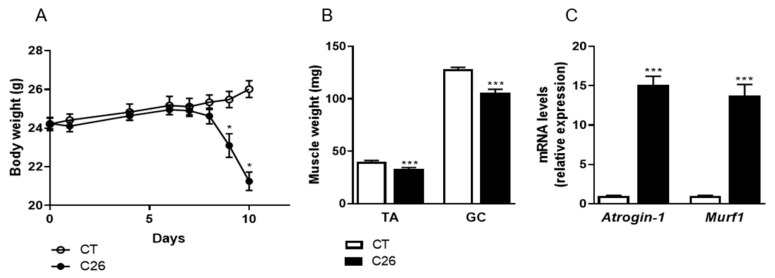
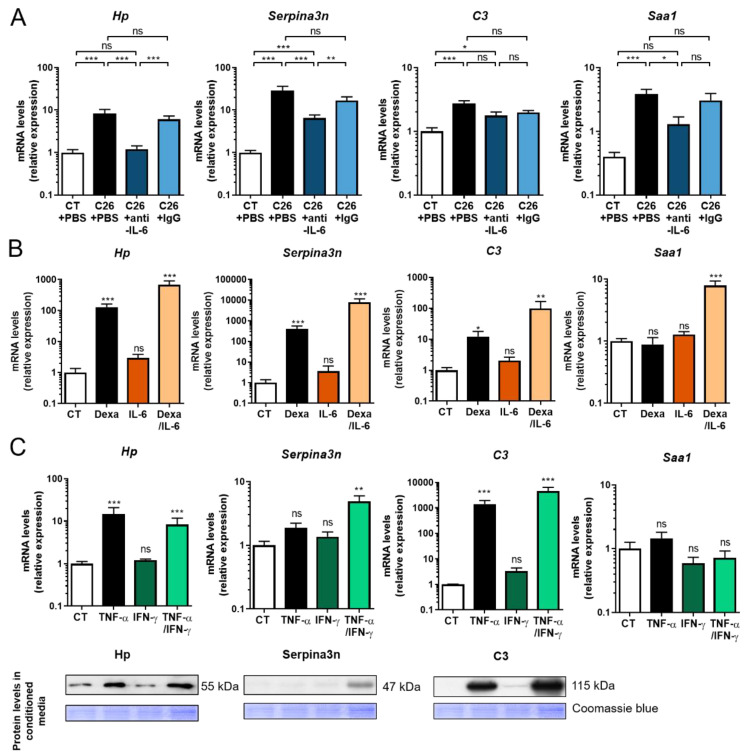
Loss of skeletal muscle mass in cancer cachexia is recognized as a predictor of mortality. This study aimed to characterize the changes in the muscle secretome associated with cancer cachexia to gain a better understanding of the mechanisms involved and to identify secreted proteins which may reflect this wasting process. The changes in the muscle proteome of the C26 model were investigated by label-free proteomic analysis followed by a bioinformatic analysis in order to identify potentially secreted proteins. Multiple reaction monitoring and Western blotting were used to verify the presence of candidate proteins in the circulation. Our results revealed a marked increased muscular production of several acute phase reactants (APR: Haptoglobin, Serine protease inhibitor A3N, Complement C3, Serum amyloid A-1 protein) which are released in the circulation during C26 cancer cachexia. This was confirmed in other models of cancer cachexia as well as in cancer patients. Glucocorticoids and proinflammatory cytokines are responsible for an increased production of APR by muscle cells. Finally, their muscular expressions are strongly positively correlated with body weight loss as well as the muscular induction of atrogens. Our study demonstrates therefore a marked increased production of APR by the muscle in cancer cachexia.
癌症恶病质中骨骼肌质量的丧失被认为是死亡率的一个预测指标。本研究旨在描述与癌症恶病质相关的肌肉分泌组的变化,以便更好地理解其中涉及的机制,并鉴定可能反映这种消瘦过程的分泌蛋白。通过无标记蛋白质组分析,随后进行生物信息学分析,研究C26模型肌肉蛋白质组的变化,以鉴定潜在的分泌蛋白。采用多反应监测和蛋白质印迹法验证循环中候选蛋白的存在。我们的结果显示,在C26癌症恶病质期间,几种急性期反应物(APR:触珠蛋白、丝氨酸蛋白酶抑制剂A3N、补体C3、血清淀粉样蛋白A-1)的肌肉产生显著增加,这在循环中释放。在其他癌症恶病质模型以及癌症患者中也得到了证实。糖皮质激素和促炎细胞因子导致肌肉细胞中APR的产生增加。最后,它们在肌肉中的表达与体重减轻以及肌肉中促萎缩蛋白的诱导呈强烈正相关。因此,我们的研究表明,癌症恶病质中肌肉产生的APR显著增加。