Lee Ye-Rin, Lim Chae-Yeon, Lim Sohee, Park Se Ra, Hong Jong-Pil, Kim Jinhee, Lee Hye-Eun, Ko Kisung, Kim Do-Sun
Vegetable Research Division, National Institute of Horticultural and Herbal Science, Rural Development Administration, Wanju-gun 55365, Korea.
Department of Medicine, College of Medicine, Chung-Ang University, Seoul 06974, Korea.
Plants (Basel). 2020 Oct 30;9(11):1466. doi: 10.3390/plants9111466.
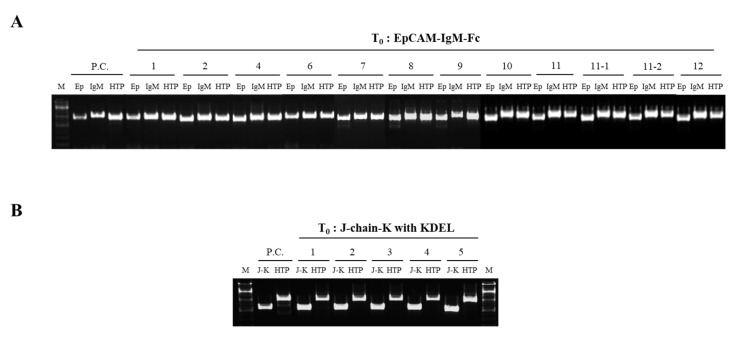
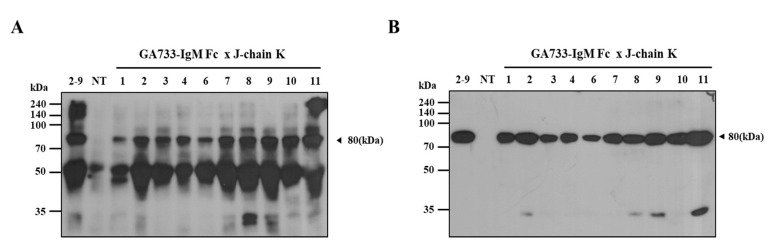
The epithelial cell adhesion molecule (EpCAM) is a tumor-associated antigen and a potential target for tumor vaccine. The EpCAM is a cell-surface glycoprotein highly expressed in colorectal carcinomas. The objective of the present study is to develop an edible vaccine system through -mediated transformation in Chinese cabbage (). For the transformation, two plant expression vectors containing genes encoding for the EpCAM recombinant protein along with the fragment crystallizable (Fc) region of immunoglobulin M (IgM) and Joining (J)-chain tagged with the KDEL endoplasmic reticulum retention motif (J-chain K) were constructed. The vectors were successfully transformed and expressed in the Chinese cabbage individually using . The transgenic Chinese cabbages were screened using genomic polymerase chain reaction (PCR) in T transgenic plant lines generated from both transformants. Similarly, the immunoblot analysis revealed the expression of recombinant proteins in the transformants. Further, the T transgenic plants were generated by selfing the transgenic plants (T) carrying EpCAM-IgM Fc and J-chain K proteins, respectively. Subsequently, the T plants generated from EpCAM-IgM Fc and J-chain K transformants were crossed to generate F plants carrying both transgenes. The presence of both transgenes was validated using PCR in the F plants. In addition, the expression of Chinese cabbage-derived EpCAM-IgM Fc × J-chain K was evaluated using immunoblot and ELISA analyses in the F plants. The outcomes of the present study can be utilized for the development of a potential anti-cancer vaccine candidate using Chinese cabbage.
上皮细胞粘附分子(EpCAM)是一种肿瘤相关抗原,也是肿瘤疫苗的潜在靶点。EpCAM是一种在结直肠癌中高度表达的细胞表面糖蛋白。本研究的目的是通过农杆菌介导的转化在大白菜中开发一种可食用疫苗系统。为了进行转化,构建了两个植物表达载体,其中包含编码EpCAM重组蛋白以及免疫球蛋白M(IgM)的可结晶片段(Fc)区域和带有KDEL内质网保留基序(J链-K)的连接(J)链的基因。使用农杆菌将这些载体分别成功转化并在大白菜中表达。使用基因组聚合酶链反应(PCR)在由两种转化体产生的T0转基因植株系中筛选转基因大白菜。同样,免疫印迹分析揭示了转化体中重组蛋白的表达。此外,通过分别使携带EpCAM-IgM Fc和J链-K蛋白的转基因植株(T0)自交来产生T1转基因植株。随后,将由EpCAM-IgM Fc和J链-K转化体产生的T1植株杂交,以产生携带两个转基因的F1植株。使用PCR在F1植株中验证两个转基因的存在。此外,在F1植株中使用免疫印迹和酶联免疫吸附测定(ELISA)分析评估大白菜来源的EpCAM-IgM Fc×J链-K的表达。本研究的结果可用于利用大白菜开发潜在的抗癌疫苗候选物。