Bickford Wesley A, Zak Donald R, Kowalski Kurt P, Goldberg Deborah E
U.S. Geological Survey - Great Lakes Science Center Ann Arbor MI USA.
Department of Ecology and Evolutionary Biology University of Michigan Ann Arbor MI USA.
Ecol Evol. 2020 Sep 29;10(20):11739-11751. doi: 10.1002/ece3.6811. eCollection 2020 Oct.
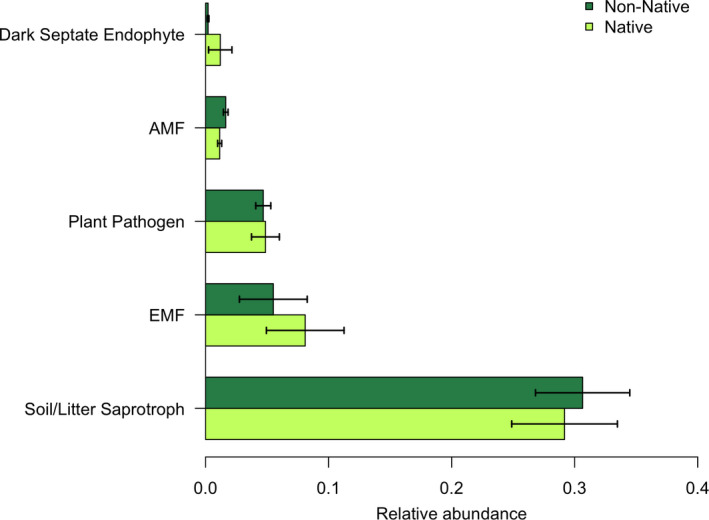
Microorganisms surrounding plant roots may benefit invasive species through enhanced mutualism or decreased antagonism, when compared to surrounding native species. We surveyed the rhizosphere soil microbiome of a prominent invasive plant, , and its co-occurring native subspecies for evidence of microbial drivers of invasiveness. If the rhizosphere microbial community is important in driving plant invasions, we hypothesized that non-native would cultivate a different microbiome from native , containing fewer pathogens, more mutualists, or both. We surveyed populations of native and non-native across Michigan and Ohio USA, and we described rhizosphere microbial communities using culture-independent next-generation sequencing. We found little evidence that native and non-native cultivate distinct bacterial, fungal, or oomycete rhizosphere communities. Microbial community differences in our Michigan survey were not associated with plant lineage but were mainly driven by environmental factors, such as soil saturation and nutrient concentrations. Intensive sampling along transects consisting of dense monocultures of each lineage and mixed zones revealed bacterial community differences between lineages in dense monoculture, but not in mixture. We found no evidence of functional differences in the microbial communities surrounding each lineage. We extrapolate that the invasiveness of non-native , when compared to its native congener, does not result from the differential cultivation of beneficial or antagonistic rhizosphere microorganisms.
与周围的本地物种相比,植物根系周围的微生物可能通过增强共生关系或减少拮抗作用,使入侵物种受益。我们调查了一种著名入侵植物及其同时存在的本地亚种的根际土壤微生物组,以寻找入侵微生物驱动因素的证据。如果根际微生物群落对推动植物入侵很重要,我们推测非本地植物会培育出与本地植物不同的微生物组,其中病原体更少,共生菌更多,或者两者兼而有之。我们在美国密歇根州和俄亥俄州调查了本地和非本地植物的种群,并使用非培养的下一代测序技术描述了根际微生物群落。我们几乎没有发现证据表明本地和非本地植物培育出不同的细菌、真菌或卵菌根际群落。我们在密歇根州的调查中发现,微生物群落差异与植物谱系无关,主要由环境因素驱动,如土壤饱和度和养分浓度。沿着由每个谱系的密集单一栽培和混合区组成的样带进行密集采样,结果显示在密集单一栽培中,不同谱系之间存在细菌群落差异,但在混合区中没有。我们没有发现每个谱系周围微生物群落功能差异的证据。我们推断,与本地同属植物相比,非本地植物的入侵性并非源于有益或拮抗根际微生物的差异培育。