Kim Min Young, Brennan Daniel C, Shah Pali
Department of Internal Medicine, Johns Hopkins School of Medicine, Baltimore, MD USA.
Division of Pulmonary and Critical Care, Johns Hopkins University School of Medicine, Baltimore, MD 21205 USA.
Curr Transplant Rep. 2020;7(4):366-378. doi: 10.1007/s40472-020-00305-y. Epub 2020 Oct 29.
Insufficient knowledge about COVID-19 and the potential risks of COVID-19 are limiting organ transplantation in wait-listed candidates and deferring essential health care in solid organ transplant recipients. In this review, we expand the understanding and present an overview of the optimized management of COVID-19 in solid organ transplant recipients.
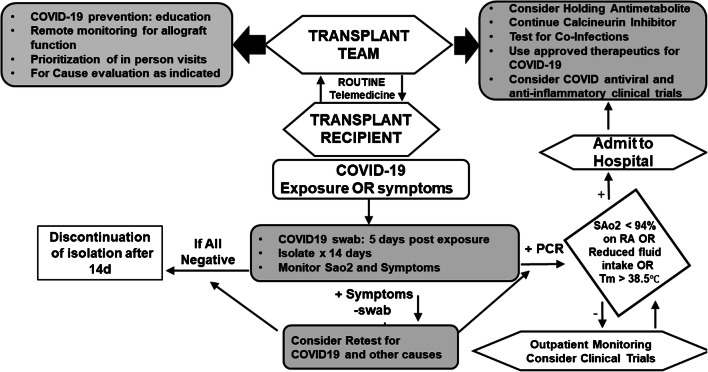
Transplant recipients are at an increased risk of severe COVID-19. The unique characteristics of transplant recipients can make it more difficult to identify COVID-19 Based on the COVID-19 data to date and our experience, we present testing, management, and prevention methods for COVID-19. Comprehensive diagnostic tests should be performed to determine disease severity, phase of illness, and identify other comorbidities in transplant recipients diagnosed with COVID-19. Outpatients should receive education for preventative measures and optimal health care delivery minimizing potential infectious exposures. Multidisciplinary interventions should be provided to hospitalized transplant recipients for COVID-19 because of the complexity of caring for transplant recipients.
Transplant recipients should strictly adhere to infection prevention measures. Understanding of the transplant specific pathophysiology and development of effective treatment strategies for COVID-19 should be prioritized.
对新型冠状病毒肺炎(COVID-19)的了解不足以及COVID-19的潜在风险,限制了等待名单上候选者的器官移植,并推迟了实体器官移植受者的必要医疗保健。在本综述中,我们拓展了认识,并概述了实体器官移植受者中COVID-19的优化管理。
移植受者发生重症COVID-19的风险增加。移植受者的独特特征可能使识别COVID-19更加困难。基于目前的COVID-19数据和我们的经验,我们介绍了COVID-19的检测、管理和预防方法。对于诊断为COVID-19的移植受者,应进行全面诊断测试以确定疾病严重程度、疾病阶段,并识别其他合并症。门诊患者应接受预防措施教育以及优化医疗保健服务,以尽量减少潜在的感染暴露。由于照顾移植受者的复杂性,对于住院的COVID-19移植受者应提供多学科干预措施。
移植受者应严格遵守感染预防措施。应优先了解移植特异性病理生理学并制定有效的COVID-19治疗策略。