North Mal, Bourne Simon, Green Ben, Chauhan Anoop J, Brown Tom, Winter Jonathan, Jones Tom, Neville Dan, Blythin Alison, Watson Alastair, Johnson Matthew, Culliford David, Elkes Jack, Cornelius Victoria, Wilkinson Tom M A
my mhealth Limited, Bournemouth, UK.
Portsmouth Hospitals NHS Trust, Portsmouth, UK.
NPJ Digit Med. 2020 Oct 30;3:145. doi: 10.1038/s41746-020-00347-7. eCollection 2020.
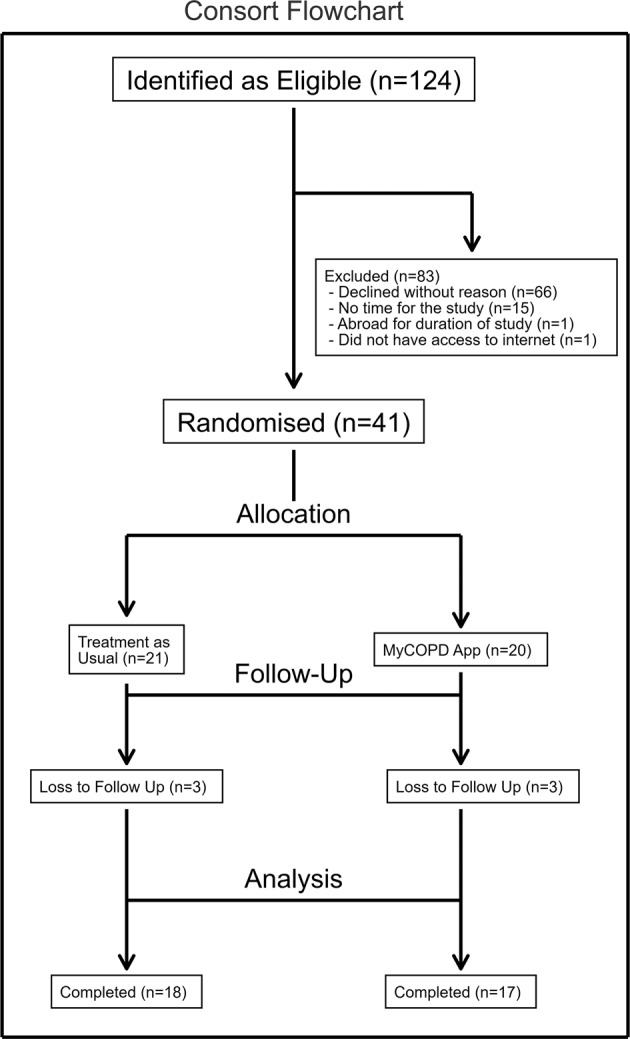
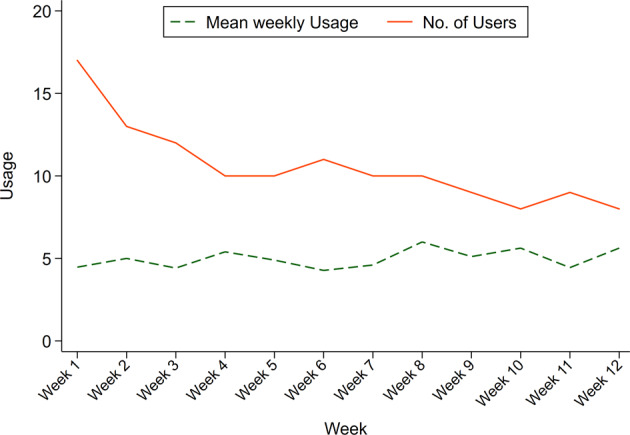
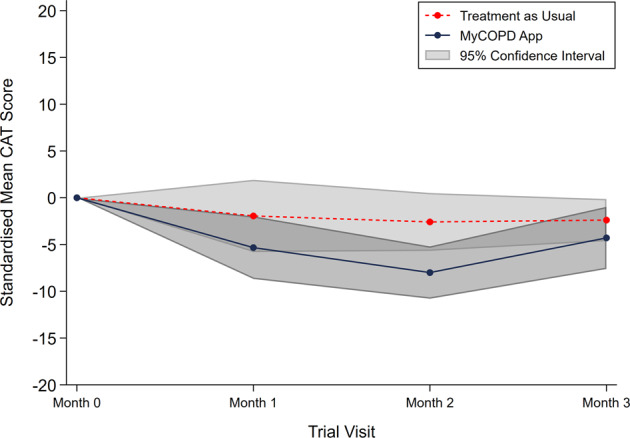
Exacerbations of COPD are one of the commonest causes of admission and readmission to hospital. The role of digital interventions to support self-management in improving outcomes is uncertain. We conducted an open, randomised controlled trial of a digital health platform application (app) in 41 COPD patients recruited following hospital admission with an acute exacerbation. Subjects were randomised to either receive usual care, including a written self-management plan ( = 21), or the myCOPD app ( = 20) for 90 days. The primary efficacy outcome was recovery rate of symptoms measured by COPD assessment test (CAT) score. Exacerbations, readmission, inhaler technique quality of life and patient activation (PAM) scores were also captured by a blinded team. The app was acceptable in this care setting and was used by 17 of the 20 patients with sustained use over the study period. The treatment effect on the CAT score was 4.49 (95% CI: -8.41, -0.58) points lower in the myCOPD arm. Patients' inhaler technique improved in the digital intervention arm (101 improving to 20 critical errors) compared to usual care (100 to 72 critical errors). Exacerbations tended to be less frequent in the digital arm compared to usual care; 34 vs 18 events. Hospital readmissions risk was numerically lower in the digital intervention arm: OR for readmission 0.383 (95% CI: 0.074, 1.987; = 35). In this feasibility study of the digital self-management platform myCOPD, the app has proven acceptable to patients to use and use has improved exacerbation recovery rates, with strong signals of lower re-exacerbation and readmission rates over 90 days. myCOPD reduced the number of critical errors in inhaler technique compared to usual care with written self-management. This provides a strong basis for further exploration of the use of app interventions in the context of recently hospitalised patients with COPD and informs the potential design of a large multi-centre trial.
慢性阻塞性肺疾病(COPD)急性加重是住院和再次入院最常见的原因之一。数字干预在支持自我管理以改善结局方面的作用尚不确定。我们对41例因急性加重住院后招募的COPD患者进行了一项关于数字健康平台应用程序(app)的开放随机对照试验。受试者被随机分为两组,一组接受常规护理,包括书面自我管理计划(n = 21),另一组使用myCOPD应用程序(n = 20),为期90天。主要疗效指标是通过慢性阻塞性肺疾病评估测试(CAT)评分衡量的症状恢复率。由一个盲法团队记录急性加重、再次入院、吸入器使用技术、生活质量和患者激活(PAM)评分。该应用程序在这种护理环境中是可接受的,20例患者中有17例在研究期间持续使用。myCOPD组对CAT评分的治疗效果低4.49(95%CI:-8.41,-0.58)分。与常规护理相比,数字干预组患者的吸入器使用技术有所改善(关键错误从101次减少到20次),而常规护理组从100次减少到72次。与常规护理相比,数字干预组的急性加重往往不太频繁;分别为34次和18次事件。数字干预组再次入院风险在数值上较低:再次入院的OR为0.383(95%CI:0.074,1.987;n = 35)。在这项关于数字自我管理平台myCOPD的可行性研究中,该应用程序已被证明患者可以接受使用,并且使用该应用程序提高了急性加重的恢复率,有强烈迹象表明在90天内再次急性加重和再次入院率较低。与书面自我管理的常规护理相比,myCOPD减少了吸入器使用技术中的关键错误数量。这为进一步探索在近期住院的COPD患者中使用应用程序干预提供了有力依据,并为大型多中心试验的潜在设计提供了参考。