Nicholls Luke, Suh Yae-Eun, Chapman Ewan, Henderson Daniel, Jones Caroline, Morrison Kirsty, Sohaib Aslam, Taylor Helen, Tree Alison, van As Nicholas
Royal Marsden NHS Foundation Trust, 203 Fulham Road, London SW3 6JJ, UK.
School of Medicine, University of Queensland, Brisbane, Australia.
Clin Transl Radiat Oncol. 2020 Oct 20;25:88-93. doi: 10.1016/j.ctro.2020.10.004. eCollection 2020 Nov.
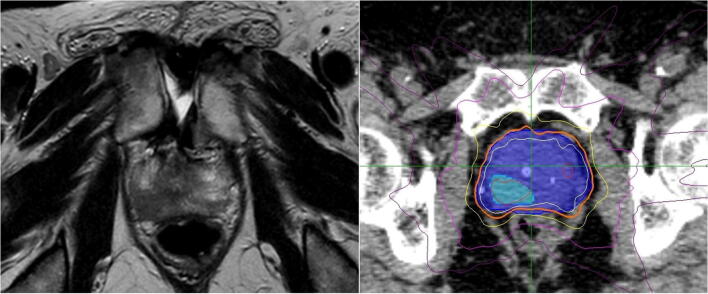
Dose escalation to dominant intraprostatic lesions (DILs) is a novel method to increase the therapeutic ratio in localised prostate cancer. The Stereotactic Prostate Augmented Radiotherapy with Cyberknife (SPARC) trial was designed to determine the feasibility of a focal boost defined with multiparametric magnetic resonance imaging (mpMRI) using stereotactic ablative body radiotherapy (SABR).
Patients were included with newly diagnosed intermediate to high risk prostate cancer with at least one of: Gleason score 4 + 3, stage T3a, or PSA > 20 ng/ml. Visible disease on mpMRI was mandatory and up to 2 separate nodules were allowed. All patients received androgen deprivation. Patients received 36.25 Gy in 5 fractions using CyberKnife® and the DIL received a simultaneous boost to a maximum of 47.5 Gy, as allowed by OAR constraints. Genitourinary (GU) and gastrointestinal (GI) toxicity was reported using the RTOG scoring criteria. International Index of Erectile Function (IIEF) and EQ-5D global health scores were regularly captured.
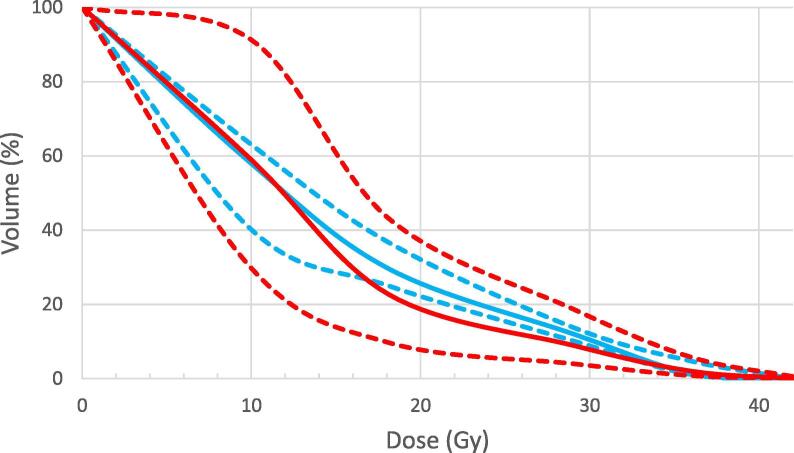
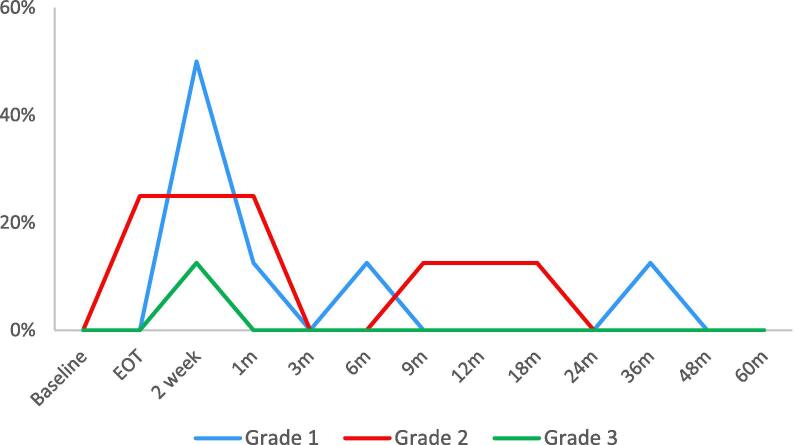
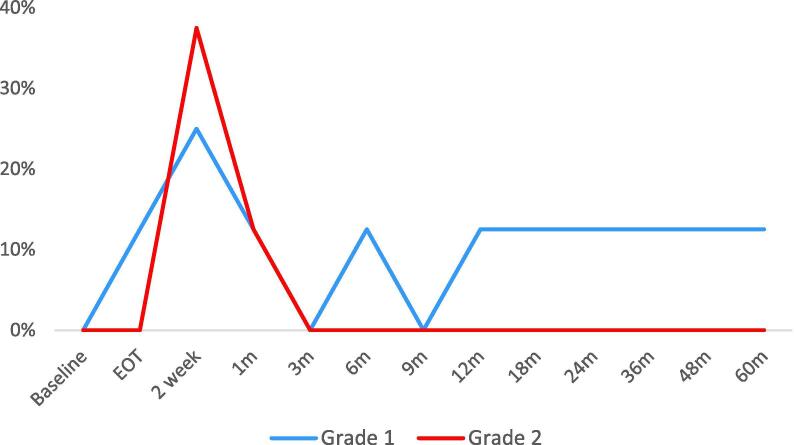
An interim safety analysis was performed on the first 8 patients, recruited between July 2013 and December 2015. Median follow up was 56 months (range 50-74). Median D95 values for the prostate PTV and boost volume were 36.55 Gy (range 35.87-36.99) and 46.62 Gy (range 44.85-48.25) respectively. Of the dose constraints, 10/80 were not achieved but all were minor dose variations. Grade 2+ acute GU and GI toxicities were 37.5% respectively while grade 2+ late GU and GI toxicities were 12.5% and 0% respectively. IIEF and quality of life scores recovered over time and all patients remain in biochemical remission.
The first patients have been successfully treated with prostate SABR and focal boost on the SPARC trial, with excellent adherence to the planning protocol. Toxicity and efficacy results are promising and further recruitment is underway.
对前列腺内主要病灶(DILs)进行剂量递增是一种提高局限性前列腺癌治疗比的新方法。立体定向前列腺增强放射治疗联合射波刀(SPARC)试验旨在确定使用立体定向消融体部放射治疗(SABR)对多参数磁共振成像(mpMRI)定义的局部增敏的可行性。
纳入新诊断的中高危前列腺癌患者,具备以下至少一项: Gleason评分4 + 3、T3a期或PSA > 20 ng/ml。mpMRI上可见病灶是必需的,允许最多2个独立结节。所有患者均接受雄激素剥夺治疗。患者使用射波刀接受5次分割的36.25 Gy照射,在OAR限制允许的情况下,DIL同时接受最大47.5 Gy的增敏照射。使用RTOG评分标准报告泌尿生殖系统(GU)和胃肠道(GI)毒性。定期记录国际勃起功能指数(IIEF)和EQ-5D全球健康评分。
对2013年7月至2015年12月招募的前8例患者进行了中期安全性分析。中位随访时间为56个月(范围50 - 74个月)。前列腺PTV和增敏体积的中位D95值分别为36.55 Gy(范围35.87 - 36.99)和46.62 Gy(范围44.85 - 48.25)。在剂量限制方面,80项中有10项未达到,但均为轻微剂量变化。2级及以上急性GU和GI毒性分别为37.5%,而2级及以上晚期GU和GI毒性分别为12.5%和0%。IIEF和生活质量评分随时间恢复,所有患者均保持生化缓解。
在SPARC试验中,首批患者已成功接受前列腺SABR和局部增敏治疗,对计划方案的依从性良好。毒性和疗效结果令人鼓舞,进一步的招募工作正在进行中。