Johns Hopkins University School of Medicine, Baltimore, MD, USA.
Health Economics and Outcomes Research, AbbVie Inc., North Chicago, IL, USA.
Adv Ther. 2021 Jan;38(1):423-440. doi: 10.1007/s12325-020-01535-3. Epub 2020 Nov 3.
Although hepatitis C virus (HCV) infection remains a major clinical, economic, and societal burden, the development of curative antiviral therapy may accelerate the path toward elimination. This analysis assessed the progress of United States (US) states towards achieving the World Health Organization's (WHO) 2030 HCV elimination targets for incidence, mortality, diagnosis, and treatment.
A previously published Markov model was used to simulate HCV progression over time to estimate the path to HCV elimination in each state based on prevalence, annual treatment, and diagnosis inputs from two large US laboratory datasets from January 2013 to December 2017. State-specific fibrosis stage restrictions on treatment in 2017 were included. The model estimated the year individual states would meet the WHO targets for diagnosing 90% of the HCV-infected population, treating 80% of the eligible population, reducing new HCV infections by 80%, and reducing HCV-related deaths by 65%. The minimum number of annual treatments needed between 2020 and 2030 to achieve the WHO treatment target was also calculated.
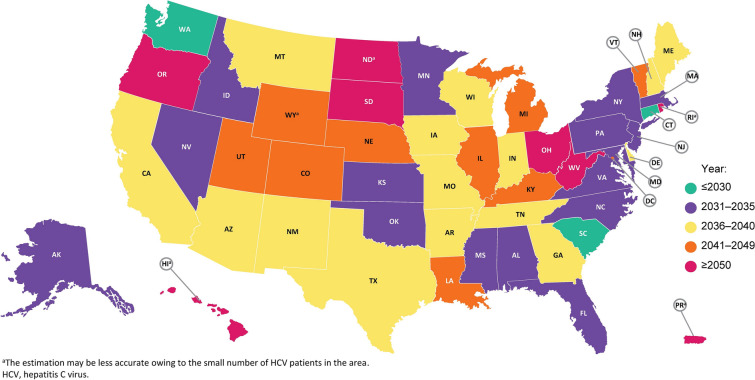
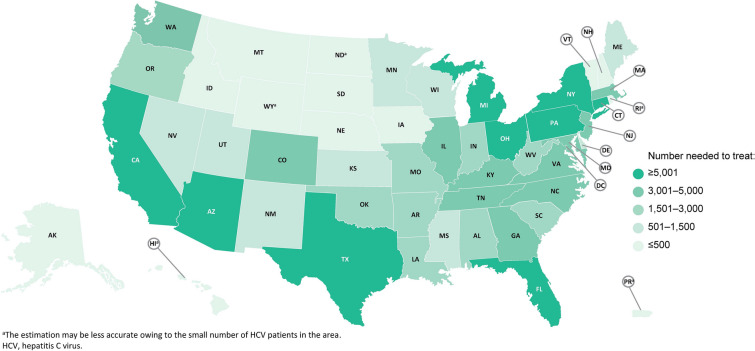
Overall, the USA is projected to achieve HCV elimination by 2037, with individual targets related to mortality, diagnosis, treatment, and incidence being achieved by 2020, 2027, 2033, and 2037, respectively. Three states (Connecticut, South Carolina, and Washington) are on track to meet all four elimination targets by 2030, and 18 states are not expected to meet these targets before 2040. The estimated annual number of treatments required during 2020-2030 nationally to reach the WHO treatment target is 173,514.
With the exception of three states, the USA is not on target to meet the WHO 2030 elimination targets and 35% are off track by 10 years or more. Strategies must be implemented to reduce overall prevalence by preventing new infections, increasing rates of screening, improving linkage to care, and implementing unfettered access to curative therapy.
尽管丙型肝炎病毒(HCV)感染仍是一个主要的临床、经济和社会负担,但治愈性抗病毒治疗的发展可能会加速消除该病毒的进程。本分析评估了美国各州在实现世界卫生组织(WHO)2030 年 HCV 发病率、死亡率、诊断和治疗消除目标方面的进展。
使用先前发表的马尔可夫模型来模拟 HCV 随时间的进展,以根据 2013 年 1 月至 2017 年 12 月来自两个大型美国实验室数据集的流行率、年度治疗和诊断输入,来估算每个州消除 HCV 的路径。2017 年纳入了针对各州纤维化阶段的治疗限制。该模型估计各州实现 WHO 目标的时间,即诊断出 90%的 HCV 感染人群,治疗 80%的合格人群,减少 80%的新 HCV 感染和减少 65%的 HCV 相关死亡。还计算了 2020 年至 2030 年期间实现 WHO 治疗目标所需的每年治疗的最小次数。
总体而言,预计美国将在 2037 年实现 HCV 消除,相关的死亡率、诊断、治疗和发病率目标将分别在 2020 年、2027 年、2033 年和 2037 年实现。三个州(康涅狄格州、南卡罗来纳州和华盛顿州)有望在 2030 年前达到所有四个消除目标,而 18 个州预计在 2040 年前无法达到这些目标。全国范围内 2020-2030 年期间达到 WHO 治疗目标所需的每年治疗估计次数为 173514 次。
除了三个州以外,美国都没有达到 WHO 2030 年消除目标,其中 35%的州落后 10 年或更长时间。必须实施策略来减少总体流行率,预防新感染,提高筛查率,改善与护理的联系,并实施无限制的治愈性治疗。