Department of Neurology, Cairo University, Cairo, Egypt.
Department of Neurology, Beni-Suef University, Beni-Suef, Egypt.
Cephalalgia. 2020 Nov;40(13):1422-1431. doi: 10.1177/0333102420965140.
To study the characteristics of headache attributed to COVID-19 infection and predictors of its severity.
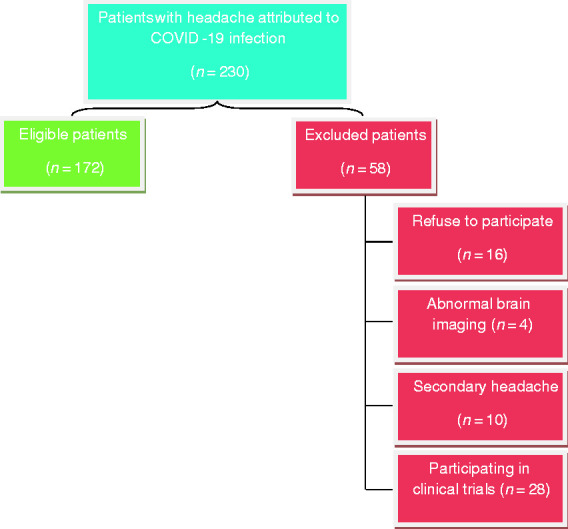
A cross-sectional study involved 172 individuals who had headache due to COVID-19 infection. A detailed analysis of such headache was done through a face-to-face interview. Patients with any other form of secondary headache were excluded. Labs, including lymphocytic count, C-reactive protein, D-dimer and ferritin and chest imaging, were made available.
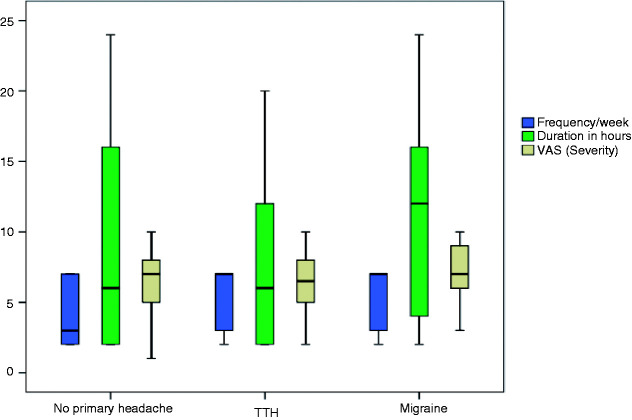
THE: majority of our patients had a diffuse headache (52.9%). It was pressing in 40.7%, with median intensity of 7 (assessed by visual analogue scale) and median frequency of 7 days/week. Patients with preexisting primary headache (52.9%) had significantly more frequent COVID-19 related headache than those without (47.1%) ( = 0.001). Dehydrated patients (64.5%) had more frequent COVID-19 related headache than those who were not dehydrated (35.5%) ( = 0.029). Patients with fever (69.8%) had significantly higher frequency and intensity of COVID-19 related headache compared to those without fever (30.2%) ( = 0.003, 0.012). Patients with comorbidities (19.8%) had significantly higher frequency and intensity of headache than those without comorbidities (80.2%) ( = 0.006, 0.003). After multiple linear regression, primary headache disorders, dehydration and comorbidities were considered predictors of frequency of COVID-19 related headache. Meanwhile, fever and dehydration were predictors of pain intensity.
Healthcare providers of COVID-19 patients need to be aware of frequency and intensity predictors of COVID-19 related headache: Primary headache disorders, fever, dehydration, and comorbidities.
研究与 COVID-19 感染相关的头痛的特征和严重程度的预测因素。
本横断面研究纳入了 172 名因 COVID-19 感染而出现头痛的患者。通过面对面访谈对这种头痛进行了详细分析。排除了任何其他形式的继发性头痛的患者。提供了实验室检查,包括淋巴细胞计数、C 反应蛋白、D-二聚体和铁蛋白以及胸部影像学检查。
我们的大多数患者(52.9%)患有弥漫性头痛。其中 40.7%为压迫性头痛,视觉模拟评分中位数为 7,中位数频率为每周 7 天。有原发性头痛病史的患者(52.9%)比无原发性头痛病史的患者(47.1%)发生 COVID-19 相关头痛的频率更高( = 0.001)。脱水患者(64.5%)发生 COVID-19 相关头痛的频率高于未脱水患者(35.5%)( = 0.029)。发热患者(69.8%)发生 COVID-19 相关头痛的频率和强度明显高于无发热患者(30.2%)( = 0.003,0.012)。合并症患者(19.8%)发生头痛的频率和强度明显高于无合并症患者(80.2%)( = 0.006,0.003)。经多元线性回归分析,原发性头痛障碍、脱水和合并症被认为是 COVID-19 相关头痛频率的预测因素。同时,发热和脱水是疼痛强度的预测因素。
COVID-19 患者的医护人员需要了解 COVID-19 相关头痛的频率和强度预测因素:原发性头痛障碍、发热、脱水和合并症。