
疟疾流行国家间日疟原虫疟疾的快速诊断检测
Rapid diagnostic tests for Plasmodium vivax malaria in endemic countries.
作者信息
Agarwal Ridhi, Choi Leslie, Johnson Samuel, Takwoingi Yemisi
机构信息
Institute of Applied Health Research, University of Birmingham, Birmingham, UK.
Department of Clinical Sciences, Liverpool School of Tropical Medicine, Liverpool, UK.
出版信息
Cochrane Database Syst Rev. 2020 Nov 4;11(11):CD013218. doi: 10.1002/14651858.CD013218.pub2.
BACKGROUND
Plasmodium vivax (P vivax) is a focus of malaria elimination. It is important because P vivax and Plasmodium falciparum infection are co-endemic in some areas. There are asymptomatic carriers of P vivax, and the treatment for P vivax and Plasmodium ovale malaria differs from that used in other types of malaria. Rapid diagnostic tests (RDTs) will help distinguish P vivax from other malaria species to help treatment and elimination. There are RDTs available that detect P vivax parasitaemia through the detection of P vivax-specific lactate dehydrogenase (LDH) antigens.
OBJECTIVES
To assess the diagnostic accuracy of RDTs for detecting P vivax malaria infection in people living in malaria-endemic areas who present to ambulatory healthcare facilities with symptoms suggestive of malaria; and to identify which types and brands of commercial tests best detect P vivax malaria.
SEARCH METHODS
We undertook a comprehensive search of the following databases up to 30 July 2019: Cochrane Infectious Diseases Group Specialized Register; Central Register of Controlled Trials (CENTRAL), published in the Cochrane Library; MEDLINE (PubMed); Embase (OVID); Science Citation Index Expanded (SCI-EXPANDED) and Conference Proceedings Citation Index-Science (CPCI-S), both in the Web of Science.
SELECTION CRITERIA
Studies comparing RDTs with a reference standard (microscopy or polymerase chain reaction (PCR)) in blood samples from patients attending ambulatory health facilities with symptoms suggestive of malaria in P vivax-endemic areas.
DATA COLLECTION AND ANALYSIS
For each included study, two review authors independently extracted data using a pre-piloted data extraction form. The methodological quality of the studies were assessed using a tailored Quality Assessment of Diagnostic Accuracy Studies-2 (QUADAS-2) tool. We grouped studies according to commercial brand of the RDT and performed meta-analysis when appropriate. The results given by the index tests were based on the antibody affinity (referred to as the strength of the bond between an antibody and an antigen) and avidity (referred to as the strength of the overall bond between a multivalent antibody and multiple antigens). All analyses were stratified by the type of reference standard. The bivariate model was used to estimate the pooled sensitivity and specificity with 95% confidence intervals (CIs), this model was simplified when studies were few. We assessed the certainty of the evidence using the GRADE approach.
MAIN RESULTS
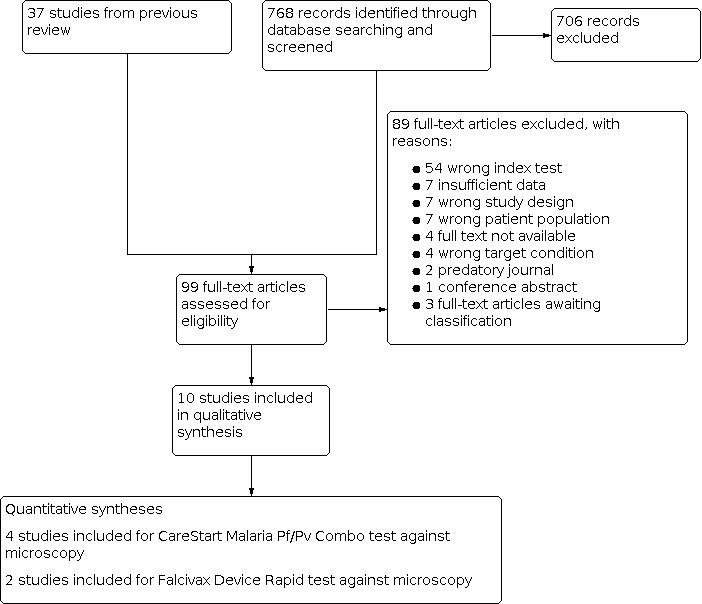
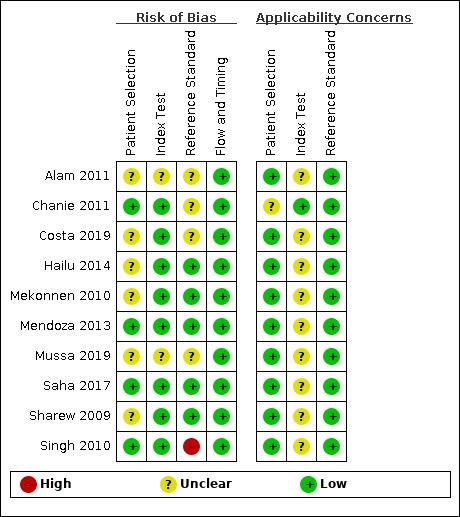
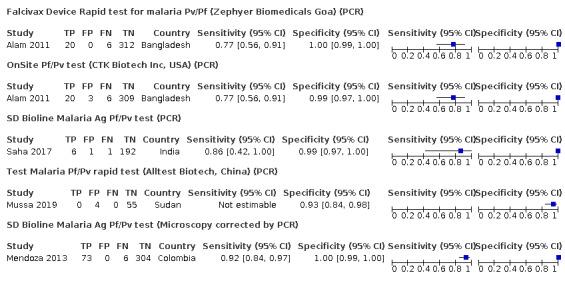
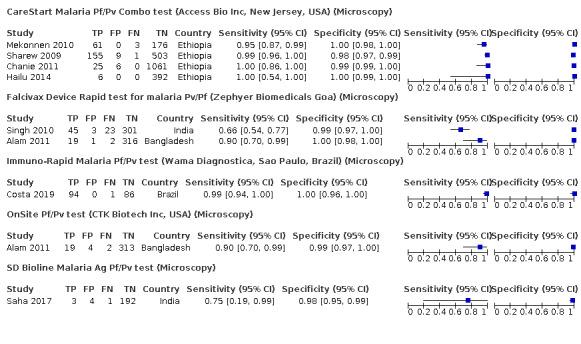
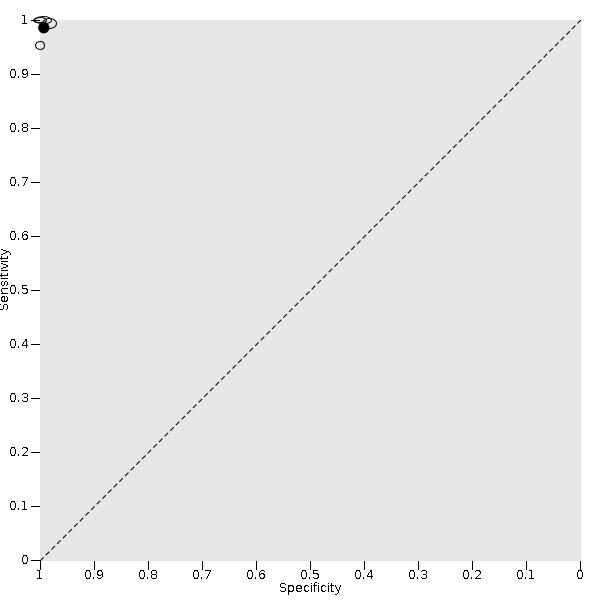
We included 10 studies that assessed the accuracy of six different RDT brands (CareStart Malaria Pf/Pv Combo test, Falcivax Device Rapid test, Immuno-Rapid Malaria Pf/Pv test, SD Bioline Malaria Ag Pf/Pv test, OnSite Pf/Pv test and Test Malaria Pf/Pv rapid test) for detecting P vivax malaria. One study directly compared the accuracy of two RDT brands. Of the 10 studies, six used microscopy, one used PCR, two used both microscopy and PCR separately and one used microscopy corrected by PCR as the reference standard. Four of the studies were conducted in Ethiopia, two in India, and one each in Bangladesh, Brazil, Colombia and Sudan. The studies often did not report how patients were selected. In the patient selection domain, we judged the risk of bias as unclear for nine studies. We judged all studies to be of unclear applicability concern. In the index test domain, we judged most studies to be at low risk of bias, but we judged nine studies to be of unclear applicability concern. There was poor reporting on lot testing, how the RDTs were stored, and background parasitaemia density (a key variable determining diagnostic accuracy of RDTs). Only half of the included studies were judged to be at low risk of bias in the reference standard domain, Studies often did not report whether the results of the reference standard could classify the target condition or whether investigators knew the results of the RDT when interpreting the results of the reference standard. All 10 studies were judged to be at low risk of bias in the flow and timing domain. Only two brands were evaluated by more than one study. Four studies evaluated the CareStart Malaria Pf/Pv Combo test against microscopy and two studies evaluated the Falcivax Device Rapid test against microscopy. The pooled sensitivity and specificity were 99% (95% CI 94% to 100%; 251 patients, moderate-certainty evidence) and 99% (95% CI 99% to 100%; 2147 patients, moderate-certainty evidence) for CareStart Malaria Pf/Pv Combo test. For a prevalence of 20%, about 206 people will have a positive CareStart Malaria Pf/Pv Combo test result and the remaining 794 people will have a negative result. Of the 206 people with positive results, eight will be incorrect (false positives), and of the 794 people with a negative result, two would be incorrect (false negative). For the Falcivax Device Rapid test, the pooled sensitivity was 77% (95% CI: 53% to 91%, 89 patients, low-certainty evidence) and the pooled specificity was 99% (95% CI: 98% to 100%, 621 patients, moderate-certainty evidence), respectively. For a prevalence of 20%, about 162 people will have a positive Falcivax Device Rapid test result and the remaining 838 people will have a negative result. Of the 162 people with positive results, eight will be incorrect (false positives), and of the 838 people with a negative result, 46 would be incorrect (false negative).
AUTHORS' CONCLUSIONS: The CareStart Malaria Pf/Pv Combo test was found to be highly sensitive and specific in comparison to microscopy for detecting P vivax in ambulatory healthcare in endemic settings, with moderate-certainty evidence. The number of studies included in this review was limited to 10 studies and we were able to estimate the accuracy of 2 out of 6 RDT brands included, the CareStart Malaria Pf/Pv Combo test and the Falcivax Device Rapid test. Thus, the differences in sensitivity and specificity between all the RDT brands could not be assessed. More high-quality studies in endemic field settings are needed to assess and compare the accuracy of RDTs designed to detect P vivax.
背景
间日疟原虫是疟疾消除工作的重点。它很重要,因为在某些地区间日疟原虫和恶性疟原虫感染是共同流行的。存在间日疟原虫无症状携带者,并且间日疟原虫和卵形疟原虫疟疾的治疗方法与其他类型疟疾不同。快速诊断检测(RDT)有助于区分间日疟原虫与其他疟原虫种类,以辅助治疗和消除疟疾。现有通过检测间日疟原虫特异性乳酸脱氢酶(LDH)抗原检测间日疟原虫血症的RDT。
目的
评估RDT对出现疟疾症状并前往门诊医疗机构就诊的疟疾流行地区人群检测间日疟原虫感染的诊断准确性;并确定哪种类型和品牌的商业检测能最好地检测间日疟原虫疟疾。
检索方法
截至2019年7月30日,我们对以下数据库进行了全面检索:Cochrane传染病组专业注册库;发表于Cochrane图书馆的对照试验中央注册库(CENTRAL);医学索引(MEDLINE,通过PubMed);Embase(通过OVID);科学引文索引扩展版(SCI-EXPANDED)和会议论文引文索引 - 科学版(CPCI-S),均来自科学网。
选择标准
在间日疟原虫流行地区,对出现疟疾症状并前往门诊医疗机构就诊的患者血样中,将RDT与参考标准(显微镜检查或聚合酶链反应(PCR))进行比较的研究。
数据收集与分析
对于每项纳入研究,两名综述作者使用预先试点的数据提取表独立提取数据。使用定制的诊断准确性研究质量评估工具 - 2(QUADAS - 2)评估研究的方法学质量。我们根据RDT的商业品牌对研究进行分组,并在适当的时候进行荟萃分析。指标检测给出的结果基于抗体亲和力(指抗体与抗原之间结合的强度)和亲和力(指多价抗体与多种抗原之间总体结合的强度)。所有分析均按参考标准类型分层。使用双变量模型估计合并敏感性和特异性以及95%置信区间(CI),当研究数量较少时简化该模型。我们使用GRADE方法评估证据的确定性。
主要结果
我们纳入了10项评估6种不同RDT品牌(CareStart疟疾Pf/Pv组合检测、Falcivax设备快速检测、免疫快速疟疾Pf/Pv检测、SD Bioline疟疾抗原Pf/Pv检测、现场Pf/Pv检测和检测疟疾Pf/Pv快速检测)检测间日疟原虫疟疾准确性的研究。一项研究直接比较了两种RDT品牌的准确性。在这10项研究中,6项使用显微镜检查,1项使用PCR,2项分别使用显微镜检查和PCR,1项使用经PCR校正的显微镜检查作为参考标准。4项研究在埃塞俄比亚进行,2项在印度进行,1项分别在孟加拉国、巴西、哥伦比亚和苏丹进行。这些研究通常未报告患者的选择方式。在患者选择领域,我们判定9项研究的偏倚风险不明确。我们判定所有研究的适用性关注不明确。在指标检测领域,我们判定大多数研究的偏倚风险较低,但判定9项研究的适用性关注不明确。关于批次检测、RDT的储存方式以及背景寄生虫血症密度(决定RDT诊断准确性的关键变量)的报告较差。纳入研究中只有一半在参考标准领域被判定为低偏倚风险,研究通常未报告参考标准的结果是否能够对目标疾病进行分类,或者研究者在解释参考标准结果时是否知道RDT的结果。所有10项研究在流程和时间领域被判定为低偏倚风险。只有两个品牌被一项以上研究评估。4项研究针对显微镜检查评估了CareStart疟疾Pf/Pv组合检测,2项研究针对显微镜检查评估了Falcivax设备快速检测。CareStart疟疾Pf/Pv组合检测的合并敏感性和特异性分别为99%(95%CI 94%至100%;251例患者,中等确定性证据)和99%(95%CI 99%至100%;2147例患者,中等确定性证据)。对于20%的患病率,约206人CareStart疟疾Pf/Pv组合检测结果为阳性,其余794人结果为阴性。在206例阳性结果者中,8例为错误结果(假阳性),在794例阴性结果者中,2例为错误结果(假阴性)。对于Falcivax设备快速检测,合并敏感性为77%(95%CI:53%至91%,89例患者,低确定性证据),合并特异性为99%(95%CI:98%至100%,621例患者,中等确定性证据)。对于20%的患病率,约162人Falcivax设备快速检测结果为阳性,其余838人结果为阴性。在162例阳性结果者中,8例为错误结果(假阳性),在838例阴性结果者中,46例为错误结果(假阴性)。
作者结论
与显微镜检查相比,发现CareStart疟疾Pf/Pv组合检测在流行地区门诊医疗中检测间日疟原虫具有高度敏感性和特异性,证据具有中等确定性。本综述纳入的研究数量限于10项研究,我们能够估计纳入的6种RDT品牌中的2种,即CareStart疟疾Pf/Pv组合检测和Falcivax设备快速检测的准确性。因此,无法评估所有RDT品牌之间敏感性和特异性的差异。需要在流行现场环境中进行更多高质量研究,以评估和比较旨在检测间日疟原虫的RDT的准确性。










 Zotero 插件