Collaboration for Research, Improvement and Training in Critical Care in Asia, Mahidol Oxford Tropical Medicine Research Unit, Faculty of Tropical Medicine, Mahidol University, Bangkok, Thailand.
Please see acknowledgements section for list of collaborators, Bangkok, Thailand.
JMIR Public Health Surveill. 2020 Nov 23;6(4):e21939. doi: 10.2196/21939.
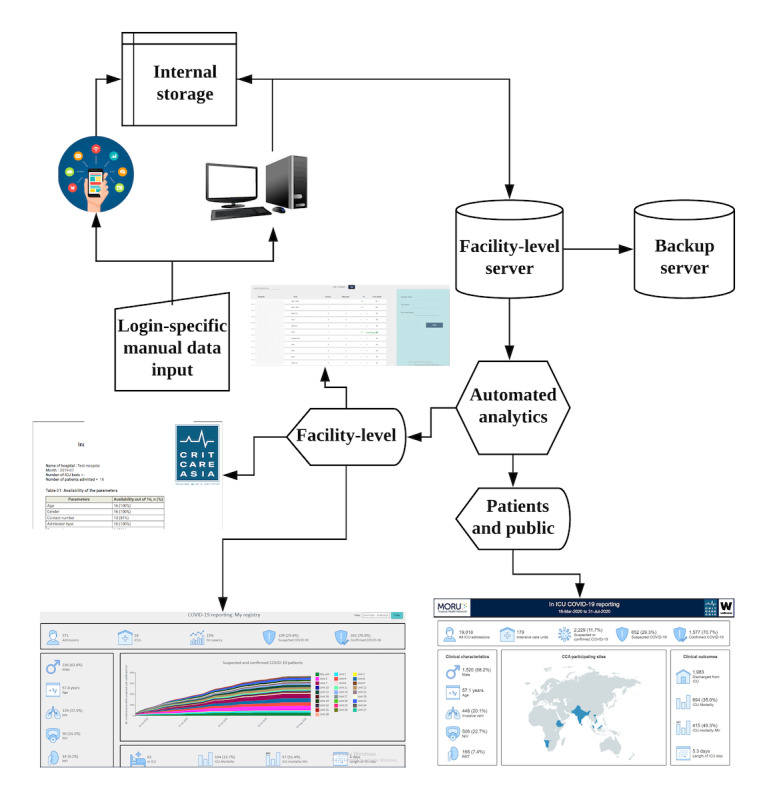
The COVID-19 pandemic has revealed limitations in real-time surveillance needed for responsive health care action in low- and middle-income countries (LMICs). The Pakistan Registry for Intensive CarE (PRICE) was adapted to enable International Severe Acute Respiratory and emerging Infections Consortium (ISARIC)-compliant real-time reporting of severe acute respiratory infection (SARI). The cloud-based common data model and standardized nomenclature of the registry platform ensure interoperability of data and reporting between regional and global stakeholders. Inbuilt analytics enable stakeholders to visualize individual and aggregate epidemiological, clinical, and operational data in real time. The PRICE system operates in 5 of 7 administrative regions of Pakistan. The same platform supports acute and critical care registries in eleven countries in South Asia and sub-Saharan Africa. ISARIC-compliant SARI reporting was successfully implemented by leveraging the existing PRICE infrastructure in all 49 member intensive care units (ICUs), enabling clinicians, operational leads, and established stakeholders with responsibilities for coordinating the pandemic response to access real-time information on suspected and confirmed COVID-19 cases (N=592 as of May 2020) via secure registry portals. ICU occupancy rates, use of ICU resources, mechanical ventilation, renal replacement therapy, and ICU outcomes were reported through registry dashboards. This information has facilitated coordination of critical care resources, health care worker training, and discussions on treatment strategies. The PRICE network is now being recruited to international multicenter clinical trials regarding COVID-19 management, leveraging the registry platform. Systematic and standardized reporting of SARI is feasible in LMICs. Existing registry platforms can be adapted for pandemic research, surveillance, and resource planning.
新冠疫情暴露出中低收入国家(LMICs)在即时监测方面的局限性,无法及时采取行动应对卫生保健问题。巴基斯坦重症监护护理登记处(PRICE)经过调整,能够进行符合国际严重急性呼吸感染和新兴感染联盟(ISARIC)标准的严重急性呼吸道感染(SARI)实时报告。该登记处平台采用基于云的通用数据模型和标准化命名法,确保区域和全球利益相关者之间的数据和报告具有互操作性。内置分析功能使利益相关者能够实时可视化个体和总体流行病学、临床和运营数据。PRICE 系统在巴基斯坦的 7 个行政区中的 5 个行政区运作。同一个平台还支持南亚和撒哈拉以南非洲的 11 个国家的急性和重症监护登记处。通过利用现有 PRICE 基础设施,在所有 49 个成员重症监护病房(ICU)中成功实施了符合 ISARIC 标准的 SARI 报告,使临床医生、运营负责人和负责协调大流行应对工作的既定利益相关者能够通过安全的登记处门户实时获取疑似和确诊 COVID-19 病例的信息(截至 2020 年 5 月为 592 例)。通过登记处仪表盘报告 ICU 入住率、ICU 资源使用、机械通气、肾脏替代治疗和 ICU 结局等信息。这些信息促进了重症监护资源的协调、医护人员培训以及治疗策略的讨论。PRICE 网络现正在被招募到有关 COVID-19 管理的国际多中心临床试验中,利用登记处平台。在中低收入国家,进行 SARI 的系统和标准化报告是可行的。现有的登记处平台可适应于大流行研究、监测和资源规划。