German Mummy Project, Reiss-Engelhorn-Museen, Mannheim, Germany.
Sculpture Collection Until 1800, Dresden State Art Collections, Dresden, Germany.
PLoS One. 2020 Nov 4;15(11):e0240900. doi: 10.1371/journal.pone.0240900. eCollection 2020.
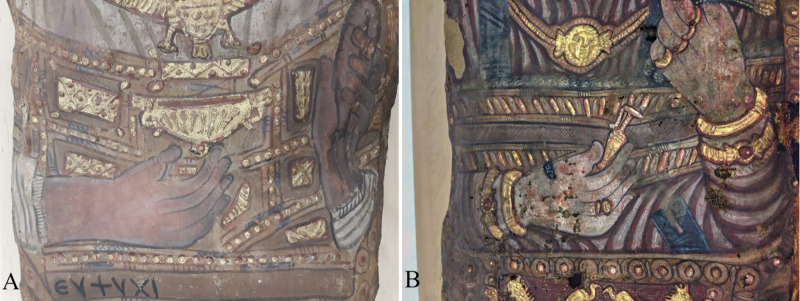
This study focuses on the multidisciplinary investigation of three stucco-shrouded mummies with mummy portrait from Egypt dating from the late 3rd to the middle of the 4th century AD, corresponding to the late Roman Period. These three mummies were excavated in the early 17th and late 19th centuries in the Saqqara necropolis near the ancient Egyptian capital of Memphis. Two of them experienced an interesting collection history, when they became part of the collection of the Elector of Saxony and King of Poland August II in Dresden, Germany, in 1728. The investigation includes information about the mummies' discovery, collection history and shroud decoration obtained through Egyptological expertise. In addition, information on the state of preservation, technique of artificial mummification, age at death, sex, body height and health of the deceased was achieved through computed tomography (CT) analysis. Research yielded an adult male, a middle-aged female and a young female. Due to the rather poorly preserved bodies of the male and middle-aged female, a specific technique of artificial mummification could not be ascertained. Brain and several internal organs of the well-preserved young female were identified. Wooden boards, beads of necklaces, a hairpin, and metal dense items, such as lead seals, nails and two coins or medallions were discovered. Paleopathological findings included carious lesions, Schmorl's nodes, evidence of arthritis and a vertebral hemangioma. The study revealed insights on the decoration and burial preparation of individuals of upper socioeconomic status living in the late Roman Period, as well as comprehensive bioanthropological information of the deceased.
本研究聚焦于对三具来自埃及的裹尸布木乃伊和木乃伊肖像进行跨学科研究,这些木乃伊的年代可追溯至公元 3 世纪末至 4 世纪中叶,对应于罗马晚期。这三具木乃伊于 17 世纪初和 19 世纪末在埃及首都孟斐斯附近的萨卡拉墓地被挖掘出土。其中两具木乃伊有着有趣的收藏历史,它们在 1728 年成为德国德累斯顿萨克森选帝侯和波兰国王奥古斯特二世收藏的一部分。研究包括通过埃及学专业知识获得的木乃伊发现、收藏历史和裹尸布装饰的信息。此外,还通过计算机断层扫描 (CT) 分析获得了有关保存状况、人工木乃伊化技术、死亡年龄、性别、身高和死者健康状况的信息。研究结果显示,这三具木乃伊分别为一名成年男性、一名中年女性和一名年轻女性。由于男性和中年女性的遗体保存状况较差,无法确定特定的人工木乃伊化技术。对保存完好的年轻女性的大脑和几个内部器官进行了识别。还发现了木板、项链珠子、发夹以及金属密集物品,如铅封、钉子和两枚硬币或奖章。在进行古病理学检查时发现了龋齿、肖尔氏结节、关节炎和椎骨血管瘤的证据。该研究揭示了有关生活在罗马晚期的社会经济地位较高的个人的装饰和丧葬准备的信息,以及对死者的全面生物人类学信息。