Eppenberger Patrick E, Cavka Mislav, Habicht Michael E, Galassi Francesco M, Rühli Frank
1Institute of Evolutionary Medicine, University of Zurich, Winterthurerstrasse 190, CH-8057 Zurich, Switzerland.
2School of Medicine, University of Zagreb, Šalata 3, 10 000 Zagreb, Croatia.
Eur Radiol Exp. 2018 Jun 20;2:12. doi: 10.1186/s41747-018-0048-3. eCollection 2018 Dec.
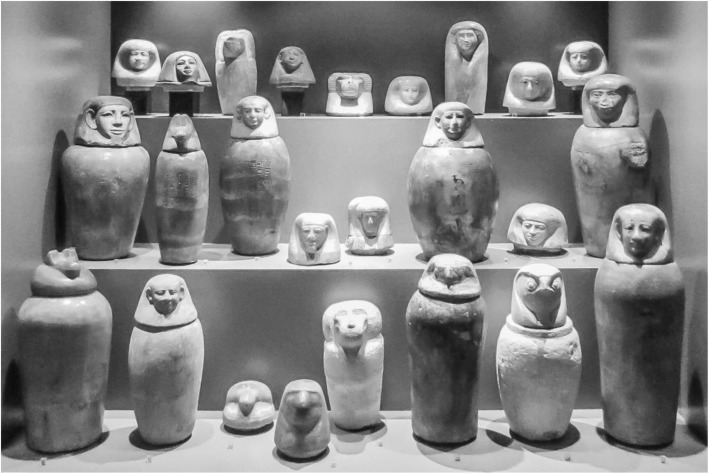
The aim of our study was to evaluate the potential and the limitations of standard clinical imaging modalities for the examination of ancient Egyptian canopic jars and the mummified visceral organs (putatively) contained within them.
A series of four ancient Egyptian canopic jars was imaged comparing the three standard clinical imaging modalities: x-rays, computed tomography (CT) and magnetic resonance imaging (MRI). Additionally, imaging-data-based volumetric calculations were performed for quantitative assessment of the jar contents.
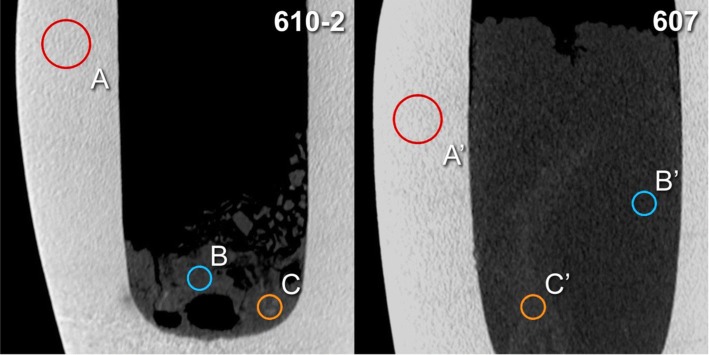
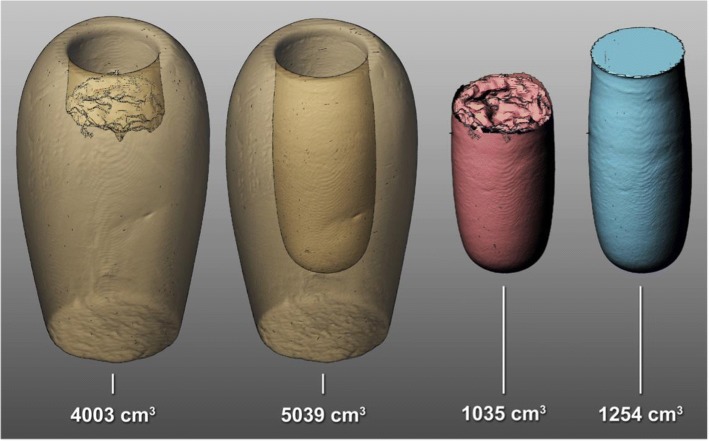
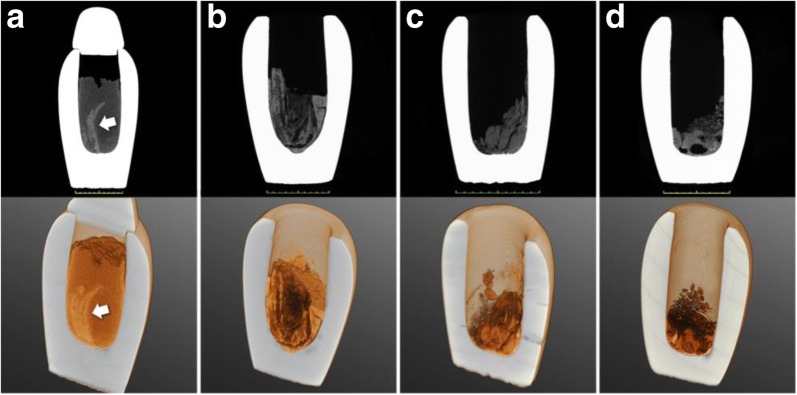
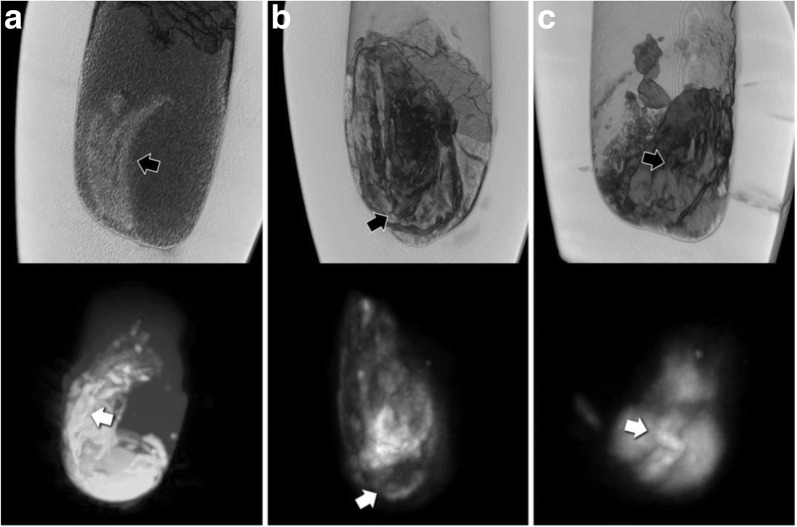
The image contrast of the x-ray images was limited by the thickness and high density of the calcite mineral constituting the examined jars. CT scans showed few artefacts and revealed hyperdense structures of organ-specific morphology, surrounded by a hypodense homogeneous material. The image quality of MRI scans was limited by the low amount of water present in the desiccated jar contents. Nevertheless, areas of pronounced signal intensity coincided well with hyperdense structures previously identified on CT scans. CT-based volumetric calculations revealed holding capacities of the jars of 626-1319 cm and content volumes of 206-1035 cm.
CT is the modality of choice for non-invasive examination of ancient Egyptian canopic jars. However, despite its limitations, x-ray imaging will often remain the only practicable method for on-site investigations. Overall, the presented radiological findings are more compatible with contained small organ fragments rather than entire mummified organs, as originally expected, with consequent implications for envisioned future sampling for chemical and genetic analysis.
我们研究的目的是评估标准临床成像方式在检查古埃及石棺罐以及其中(据推测)所含木乃伊化内脏器官方面的潜力和局限性。
对一系列四个古埃及石棺罐进行成像,比较三种标准临床成像方式:x光、计算机断层扫描(CT)和磁共振成像(MRI)。此外,基于成像数据进行体积计算,以对罐内物品进行定量评估。
x光图像的图像对比度受构成被检查罐子的方解石矿物的厚度和高密度限制。CT扫描显示伪影较少,并揭示了具有器官特异性形态的高密度结构,周围是低密度均匀物质。MRI扫描的图像质量受干燥罐内物品中少量水分的限制。然而,明显信号强度区域与先前在CT扫描中识别出的高密度结构吻合良好。基于CT的体积计算显示罐子的容纳容量为626 - 1319立方厘米,内容物体积为206 - 1035立方厘米。
CT是古埃及石棺罐非侵入性检查的首选方式。然而,尽管有其局限性,x光成像通常仍将是现场调查的唯一可行方法。总体而言,所呈现的放射学发现与所含小器官碎片而非最初预期的完整木乃伊化器官更相符,这对未来设想的化学和基因分析采样有相应影响。