Department of Pathology, Genetics and Evolution, Discipline of General Pathology, Institute of Biological and Natural Sciences, Federal University of Triângulo Mineiro, Uberaba, Minas Gerais, Brazil.
PLoS One. 2020 Nov 4;15(11):e0241745. doi: 10.1371/journal.pone.0241745. eCollection 2020.
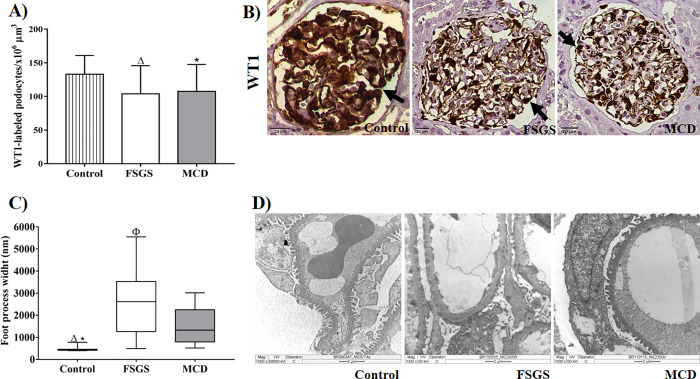
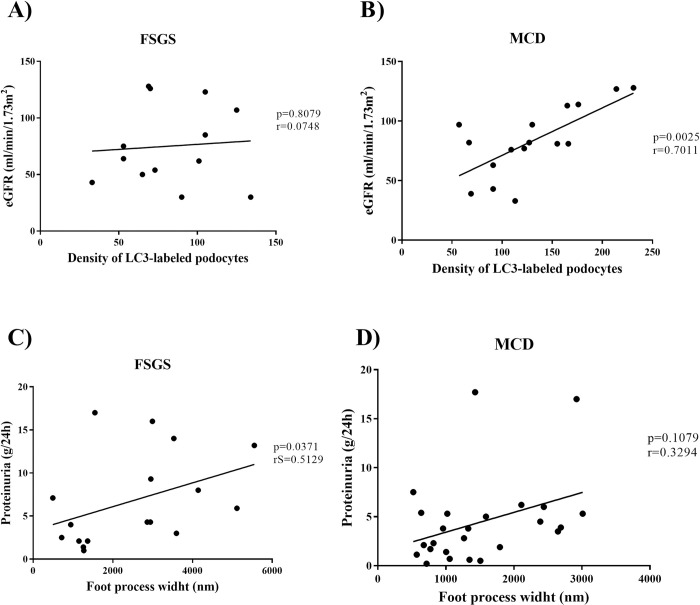
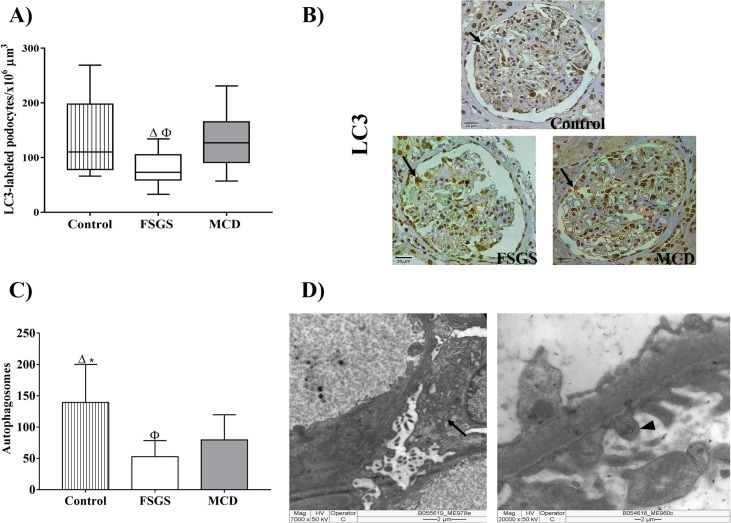
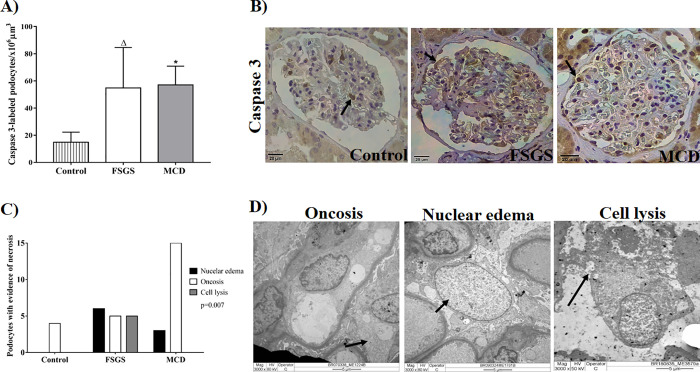
Podocyte injury in focal segmental glomerulosclerosis (FSGS) and minimal change disease (MCD) results from the imbalance between adaptive responses that maintain homeostasis and cellular dysfunction that can culminate in cell death. Therefore, an in situ analysis was performed to detect morphological changes related to cell death and autophagy in renal biopsies from adult patients with podocytopathies. Forty-nine renal biopsies from patients with FSGS (n = 22) and MCD (n = 27) were selected. In situ expression of Wilms Tumor 1 protein (WT1), light chain microtubule 1-associated protein (LC3) and caspase-3 protein were evaluated by immunohistochemistry. The foot process effacement and morphological alterations related to podocyte cell death and autophagy were analyzed with transmission electronic microscopy. Reduction in the density of WT1-labeled podocytes was observed for FSGS and MCD cases as compared to controls. Foot process width (FPW) in control group was lower than in cases of podocytopathies. In FSGS group, FPW was significantly higher than in MCD group and correlated with proteinuria. A density of LC3-labeled podocytes and the number of autophagosomes in podocytes/ pedicels were higher in the MCD group than in the FSGS group. The number of autophagosomes correlated positively with the estimated glomerular filtration rate in cases of MCD. The density of caspase-3-labeled podocytes in FSGS and MCD was higher than control group, and a higher number of podocytes with an evidence of necrosis was detected in FSGS cases than in MCD and control cases. Podocytes from patients diagnosed with FSGS showed more morphological and functional alterations resulting from a larger number of lesions and reduced cell adaptation.
足细胞损伤在局灶节段性肾小球硬化症(FSGS)和微小病变性肾病(MCD)中是由于维持内稳态的适应性反应和可能导致细胞死亡的细胞功能障碍之间的失衡所致。因此,进行了原位分析以检测与足细胞病变患者肾活检中细胞死亡和自噬相关的形态变化。选择了 49 例 FSGS(n = 22)和 MCD(n = 27)患者的肾活检。通过免疫组织化学评估 Wilms 瘤 1 蛋白(WT1)、轻链微管 1 相关蛋白(LC3)和半胱氨酸蛋白酶-3 蛋白的原位表达。用透射电子显微镜分析足突融合和与足细胞细胞死亡和自噬相关的形态改变。与对照组相比,FSGS 和 MCD 病例的 WT1 标记的足细胞密度降低。对照组的足突宽度(FPW)低于足细胞病变组。在 FSGS 组中,FPW 显著高于 MCD 组,与蛋白尿相关。MCD 组的 LC3 标记的足细胞密度和足细胞/ pedicels 中的自噬体数量高于 FSGS 组。MCD 病例中的自噬体数量与估计的肾小球滤过率呈正相关。FSGS 和 MCD 病例中 caspase-3 标记的足细胞密度高于对照组,并且在 FSGS 病例中检测到比 MCD 和对照组更多的具有坏死证据的足细胞。FSGS 诊断的患者的足细胞表现出更多的形态和功能改变,这是由于病变数量增加和细胞适应性降低所致。