Department of Psychiatry, Makerere University College of Health Sciences, Kampala, Uganda.
Department of Paediatrics and Child Health, Makerere University College of Health Sciences, Kampala, Uganda.
PLoS One. 2020 Nov 4;15(11):e0240694. doi: 10.1371/journal.pone.0240694. eCollection 2020.
Severe anaemia is a common clinical problem among young children in sub-Saharan Africa. However, the effect of severe anaemia on neurodevelopment of these children is not well described. Therefore, we assessed the neurodevelopmental performance of preschool children diagnosed with severe anaemia in Northern Uganda.
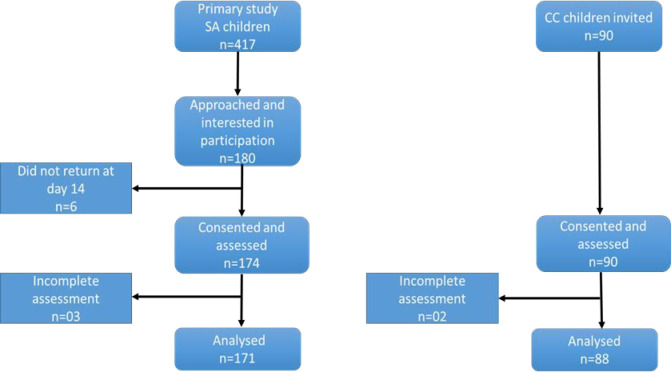
We conducted a prospective cohort study among children < 5 years of age 14 days post discharge after an episode of severe anaemia (Hb < 5.0 g/dl; n = 171; mean Hb = 3.9g/dl) at Lira Regional Referral Hospital, Uganda. Neurodevelopmental outcomes (cognitive, language and motor) were assessed using Bayley Scales of Infant and Toddler Development, 3rd edition (Bayley-III). Age-adjusted z-scores for each domain were calculated using scores from healthy community control children (n = 88) recruited from the same environment for each age category. Multiple linear regression was used to compare z-scores in the cognitive, language and motor scales between the two groups after adjusting for weight-for-age z-score, socioeconomic status, mother's education, and father's employment on all the scales.
The prevalence of neurodevelopmental impairment was 2.3% (95% CI: 0.8-6.1) for cognition, 1.7% (95%: 0.6-5.3) for language and 3.5% (95% CI: 1.6-7.6) for motor scales and 4.6% (95% CI: 2.3-9.1) for deficits in ≥1 area of neurodevelopment. Significant differences were observed between the two groups with the SA group performing worse on cognition [adjusted mean score, (Standard error, SE), P-value] [-0.20, (0.01) vs. 0.00, (0.01), P = 0.02]; language [-0.25, (0.01) vs. 0.00, (0.01), P< 0.001]; and motor [-0.17, (0.01) vs. 0.00, (0.01), P = 0.05] scales.
In children < 5 years of age, severe anaemia was associated with neurocognitive (cognition, language and motor) deficits in the immediate period post treatment. Further research is needed to identify risk factors and determine the long-term effects of poor neurodevelopment in young children with severe anaemia.
在撒哈拉以南非洲的幼儿中,严重贫血是一种常见的临床问题。然而,严重贫血对这些儿童的神经发育的影响还没有很好地描述。因此,我们评估了乌干达北部被诊断患有严重贫血的学龄前儿童的神经发育表现。
我们在乌干达利拉地区转诊医院进行了一项前瞻性队列研究,研究对象为 14 天内患有严重贫血(Hb<5.0 g/dl;n=171;平均 Hb=3.9 g/dl)的<5 岁儿童。使用贝利婴幼儿发展量表,第三版(Bayley-III)评估神经发育结果(认知、语言和运动)。使用来自同一环境中每个年龄组的 88 名健康社区对照儿童的分数,为每个领域计算年龄调整的 z 分数。在所有量表上,使用多元线性回归比较两组在认知、语言和运动量表上的 z 分数,调整体重年龄 z 分数、社会经济地位、母亲教育和父亲就业情况。
认知、语言和运动量表的神经发育损伤发生率分别为 2.3%(95%CI:0.8-6.1)、1.7%(95%CI:0.6-5.3)和 3.5%(95%CI:1.6-7.6),≥1 个神经发育领域的缺陷发生率为 4.6%(95%CI:2.3-9.1)。两组之间存在显著差异,SA 组在认知方面表现更差[调整后的平均分数(标准误差,SE),P 值] [-0.20,(0.01)比 0.00,(0.01),P=0.02];语言[-0.25,(0.01)比 0.00,(0.01),P<0.001];和运动[-0.17,(0.01)比 0.00,(0.01),P=0.05]量表。
在<5 岁的儿童中,严重贫血与治疗后即刻的神经认知(认知、语言和运动)缺陷有关。需要进一步研究以确定危险因素,并确定严重贫血的幼儿神经发育不良的长期影响。