Department of Laboratory Medicine and Pathobiology, University of Toronto, Toronto, Ontario, Canada.
SAR Laboratories, Sandra Rotman Centre for Global Health, Toronto General Hospital Research Institute, University Health Network, Toronto, Ontario, Canada.
PLoS Med. 2021 Sep 28;18(9):e1003701. doi: 10.1371/journal.pmed.1003701. eCollection 2021 Sep.
Annually 125 million pregnancies are at risk of malaria infection. However, the impact of exposure to malaria in pregnancy on neurodevelopment in children is not well understood. We hypothesized that malaria in pregnancy and associated maternal immune activation result in neurodevelopmental delay in exposed offspring.
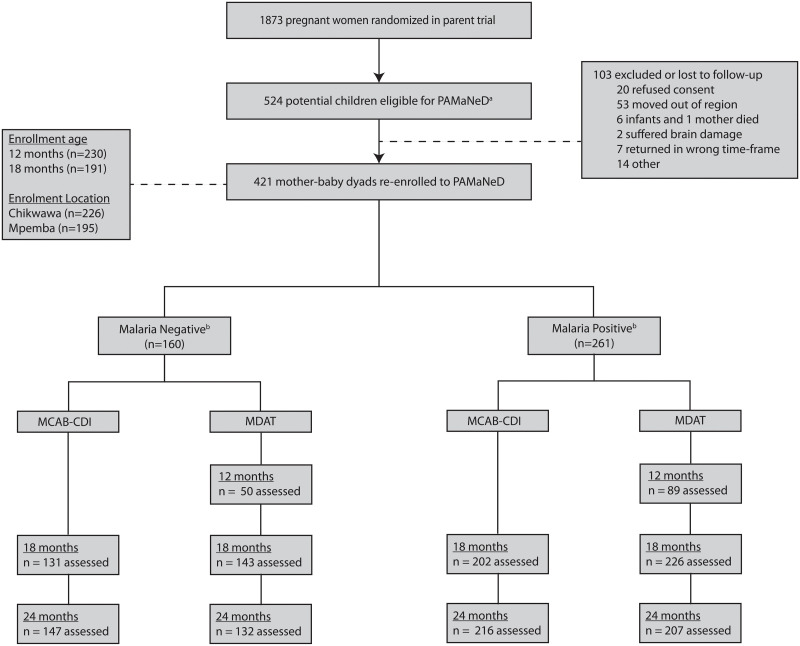
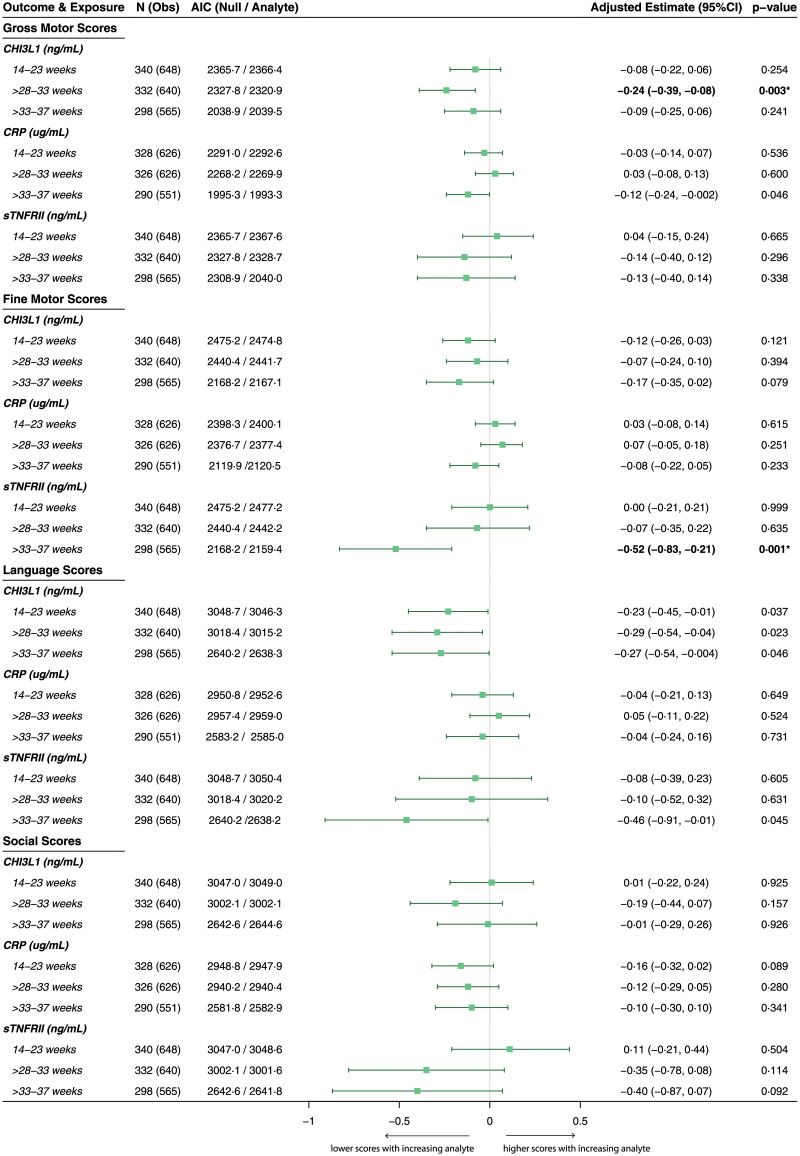
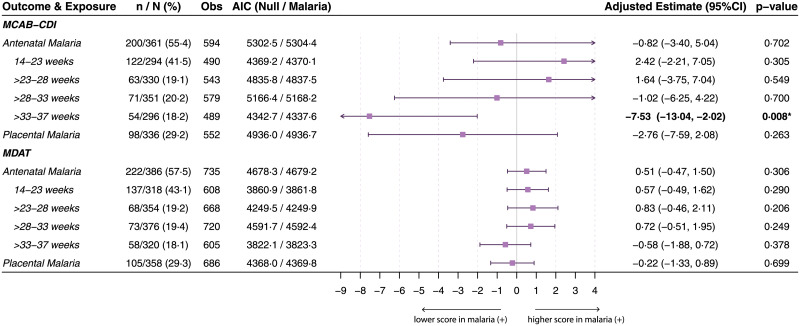
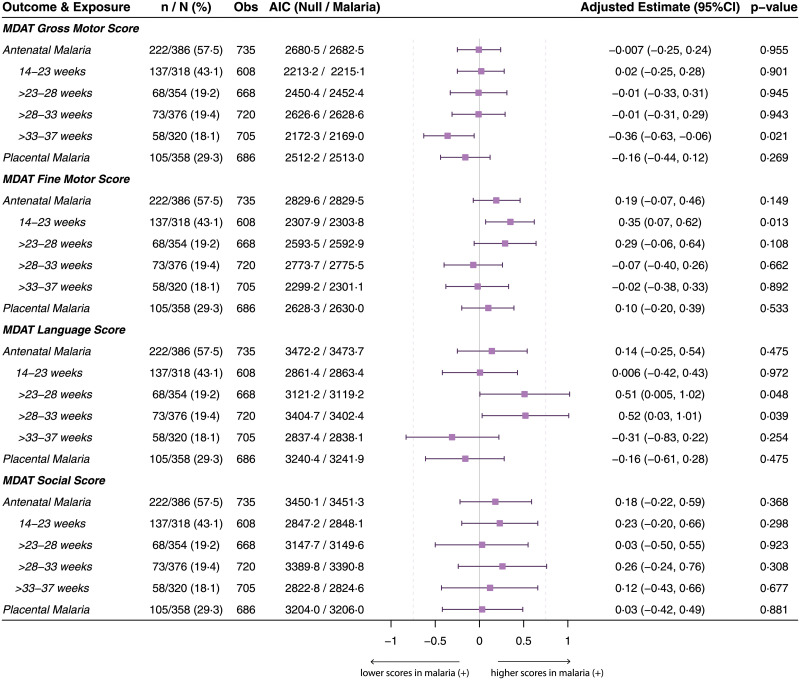
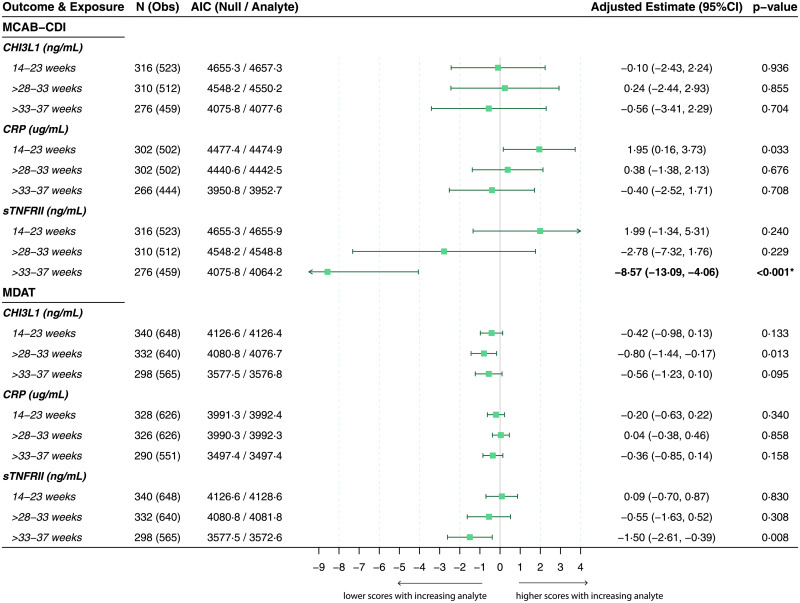
Between April 2014 and April 2015, we followed 421 Malawian mother-baby dyads (median [IQR] maternal age: 21 [19, 28] years) who were previously enrolled (median [IQR] gestational age at enrollment: 19.7 [17.9, 22.1] weeks) in a randomized controlled malaria prevention trial with 5 or 6 scheduled assessments of antenatal malaria infection by PCR. Children were evaluated at 12, 18, and/or 24 months of age with cognitive tests previously validated in Malawi: the Malawi Developmental Assessment Tool (MDAT) and the MacArthur-Bates Communicative Development Inventories (MCAB-CDI). We assessed the impact of antenatal malaria (n [%] positive: 240 [57.3]), placental malaria (n [%] positive: 112 [29.6]), and maternal immune activation on neurocognitive development in children. Linear mixed-effects analysis showed that children exposed to antenatal malaria between 33 and 37 weeks gestation had delayed language development across the 2-year follow-up, as measured by MCAB-CDI (adjusted beta estimate [95% CI], -7.53 [-13.04, -2.02], p = 0.008). Maternal immune activation, characterized by increased maternal sTNFRII concentration, between 33 and 37 weeks was associated with lower MCAB-CDI language score (adjusted beta estimate [95% CI], -8.57 [-13.09, -4.06], p < 0.001). Main limitations of this study include a relatively short length of follow-up and a potential for residual confounding that is characteristic of observational studies.
This mother-baby cohort presents evidence of a relationship between malaria in pregnancy and neurodevelopmental delay in offspring. Malaria in pregnancy may be a modifiable risk factor for neurodevelopmental injury independent of birth weight or prematurity. Successful interventions to prevent malaria during pregnancy may reduce the risk of neurocognitive delay in children.
每年有 1.25 亿例妊娠面临疟疾感染风险。然而,妊娠期间疟疾暴露对儿童神经发育的影响尚不清楚。我们假设妊娠期间疟疾和相关的母体免疫激活会导致暴露后代的神经发育迟缓。
2014 年 4 月至 2015 年 4 月,我们对 421 对马拉维母婴对子(中位[IQR]母亲年龄:21 [19, 28] 岁)进行了随访,这些母婴对子之前参加了一项随机对照疟疾预防试验,该试验有 5 或 6 次预定的 PCR 评估产前疟疾感染。在 12、18 和/或 24 个月时,使用在马拉维经过验证的认知测试:马拉维发育评估工具(MDAT)和麦克阿瑟-贝茨交际发展量表(MCAB-CDI)对儿童进行评估。我们评估了产前疟疾(n [%]阳性:240 [57.3])、胎盘疟疾(n [%]阳性:112 [29.6])和母体免疫激活对儿童神经认知发育的影响。线性混合效应分析表明,在妊娠 33 至 37 周期间暴露于产前疟疾的儿童在 2 年随访期间语言发育延迟,这一点通过 MCAB-CDI 测量(调整后的β估计值[95%CI],-7.53[-13.04, -2.02],p = 0.008)。妊娠 33 至 37 周期间母体可溶性肿瘤坏死因子受体 II 浓度增加,特征为母体免疫激活,与 MCAB-CDI 语言评分较低相关(调整后的β估计值[95%CI],-8.57[-13.09, -4.06],p < 0.001)。本研究的主要局限性包括随访时间相对较短,以及观察性研究中典型的潜在残余混杂。
该母婴队列提供了妊娠疟疾与后代神经发育迟缓之间存在关联的证据。妊娠疟疾可能是一种独立于出生体重或早产的可改变的神经发育损伤风险因素。成功的妊娠期间预防疟疾的干预措施可能会降低儿童神经认知延迟的风险。