Brigham and Women's Hospital Heart and Vascular Center, Harvard Medical School, Boston, MA (B.E.P, D.L.B., R.P.G.).
Université de Paris, AP-HP (Assistance Publique-Hôpitaux de Paris), Hôpital Bichat, FACT (French Alliance for Cardiovascular Trials), INSERM U-1148, France (Ph.G.S.).
Circulation. 2021 Jan 5;143(1):33-44. doi: 10.1161/CIRCULATIONAHA.120.050276. Epub 2020 Nov 5.
Patients with elevated triglycerides despite statin therapy have increased risk for ischemic events, including coronary revascularizations.
REDUCE-IT (The Reduction of Cardiovascular Events with Icosapent Ethyl-Intervention Trial), a multicenter, double-blind, placebo-controlled trial, randomly assigned statin-treated patients with elevated triglycerides (135-499 mg/dL), controlled low-density lipoprotein (41-100 mg/dL), and either established cardiovascular disease or diabetes plus other risk factors to receive icosapent ethyl 4 g/d or placebo. The primary and key secondary composite end points were significantly reduced. Prespecified analyses examined all coronary revascularizations, recurrent revascularizations, and revascularization subtypes.
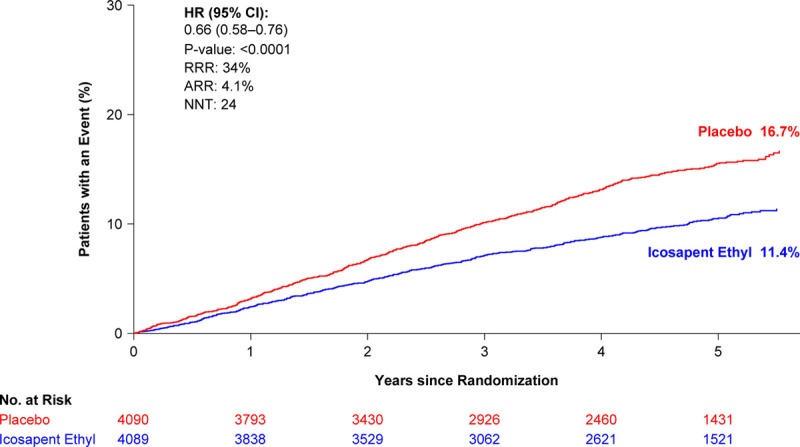
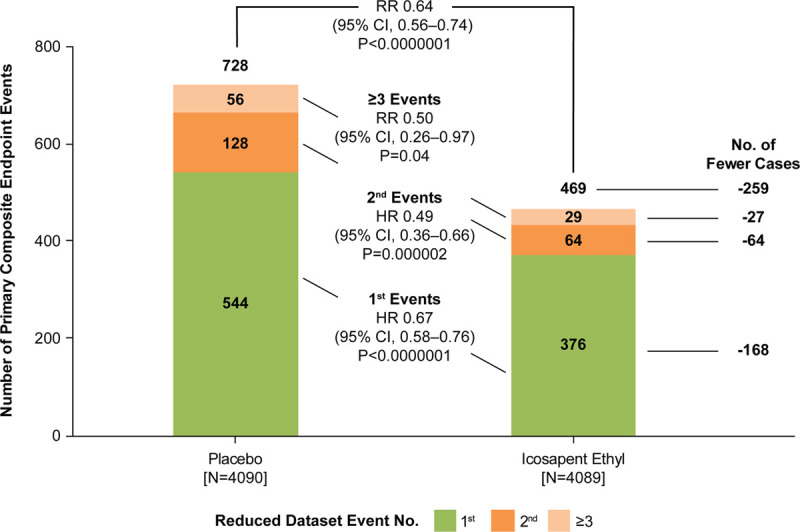
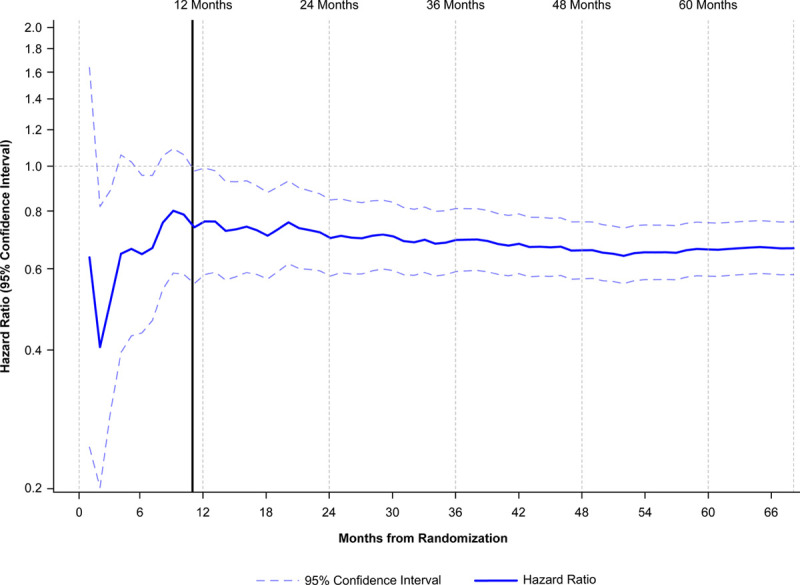
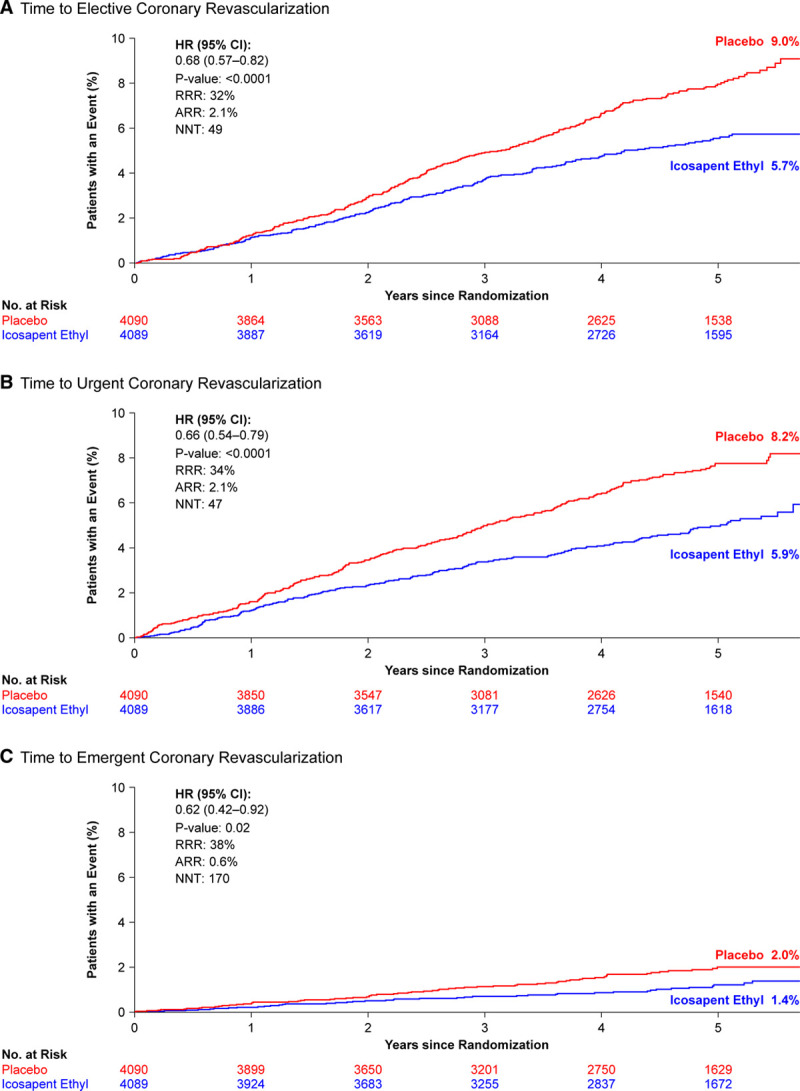
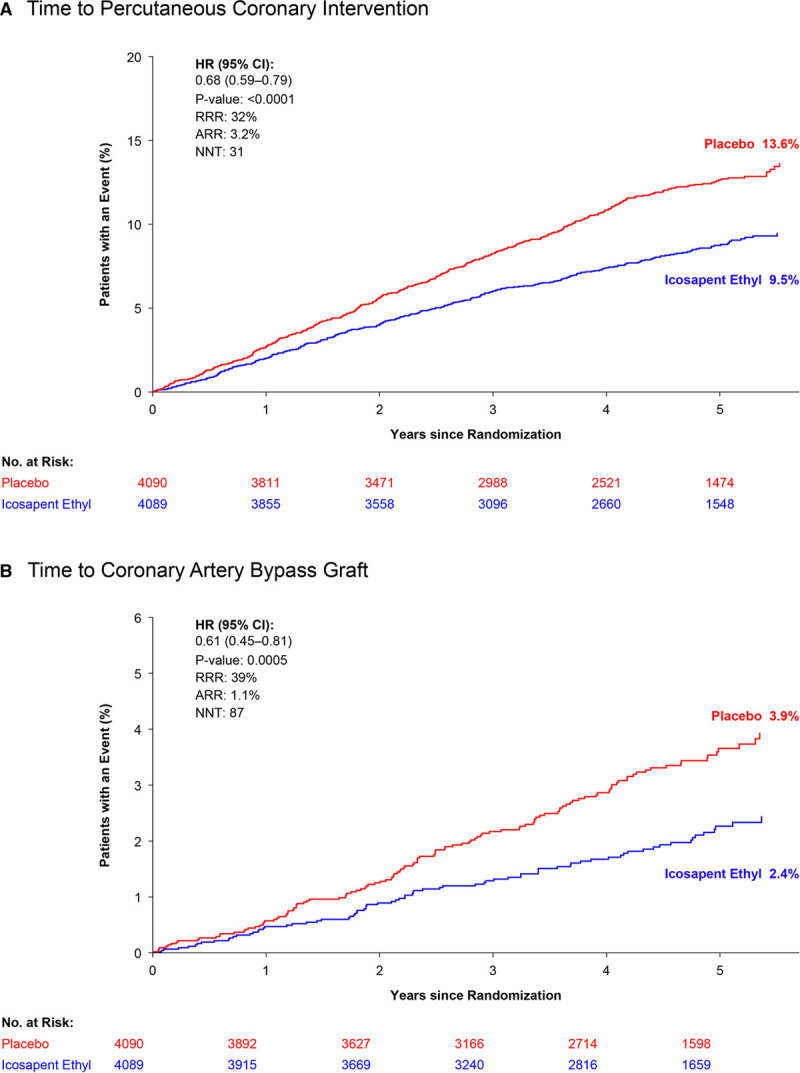
A total of 8179 randomly assigned patients were followed for 4.9 years (median). First revascularizations were reduced to 9.2% (22.5/1000 patient-years) with icosapent ethyl versus 13.3% (33.7/1000 patient-years) with placebo (hazard ratio, 0.66 [95% CI, 0.58-0.76]; <0.0001; number needed to treat for 4.9 years=24); similar reductions were observed in total (first and subsequent) revascularizations (negative binomial rate ratio, 0.64 [95% CI, 0.56-0.74]; <0.0001), and across elective, urgent, and emergent revascularizations. Icosapent ethyl significantly reduced percutaneous coronary intervention (hazard ratio, 0.68 [95% CI, 0.59-0.79]; <0.0001) and coronary artery bypass grafting (hazard ratio, 0.61 [95% CI, 0.45-0.81]; =0.0005).
Icosapent ethyl reduced the need for first and subsequent coronary revascularizations in statin-treated patients with elevated triglycerides and increased cardiovascular risk. To our knowledge, icosapent ethyl is the first non-low-density lipoprotein-lowering treatment that has been shown to reduce coronary artery bypass grafting in a blinded, randomized trial. Registration: URL: https://www.clinicaltrials.gov; Unique identifier: NCT01492361.
尽管接受他汀类药物治疗,甘油三酯升高的患者发生缺血事件(包括冠状动脉血运重建)的风险仍会增加。
RE- D UCE- IT(依泽替米贝降低心血管事件试验)是一项多中心、双盲、安慰剂对照的临床试验,将接受他汀类药物治疗、甘油三酯(135-499mg/dL)升高、低密度脂蛋白(41-100mg/dL)控制良好且患有已确诊的心血管疾病或糖尿病及其他危险因素的患者随机分为两组,分别接受icosapent ethyl 4g/d 或安慰剂治疗。主要和关键次要复合终点显著降低。预设分析检查了所有冠状动脉血运重建、再血运重建和血运重建类型。
共 8179 例随机分配的患者接受了 4.9 年的随访(中位数)。与安慰剂组(22.5/1000 患者年)相比,icosapent ethyl 组首次血运重建减少至 9.2%(33.7/1000 患者年)(风险比,0.66[95%CI,0.58-0.76];<0.0001;4.9 年治疗人数=24);总(首次和随后)血运重建也观察到类似的减少(负二项式率比,0.64[95%CI,0.56-0.74];<0.0001),并涵盖了择期、紧急和紧急血运重建。Icosapent ethyl 显著降低了经皮冠状动脉介入治疗(风险比,0.68[95%CI,0.59-0.79];<0.0001)和冠状动脉旁路移植术(风险比,0.61[95%CI,0.45-0.81];=0.0005)。
在接受他汀类药物治疗、甘油三酯升高且心血管风险增加的患者中,icosapent ethyl 降低了首次和随后的冠状动脉血运重建的需求。据我们所知,icosapent ethyl 是首例在盲法、随机试验中显示可降低冠状动脉旁路移植术的非低密度脂蛋白降低治疗药物。