Schneider Andrew M, Schmitt Daniel R, Brown Nicholas M
Department of Orthopaedic Surgery and Rehabilitation, Loyola University Medical Center, 2160 S. 1st Ave, Maywood, IL, 60153, USA.
Knee Surg Relat Res. 2020 Nov 4;32(1):59. doi: 10.1186/s43019-020-00078-9.
While multiple studies have demonstrated a lower venous thromboembolism disease (VTED) risk for unicompartmental knee arthroplasty (UKA) compared to primary total knee arthroplasty (TKA), recent reports have shown that revision TKA also had a lower VTED risk compared to primary TKA, an unexpected finding because of its theoretical increased risk. Given the paucity of up-to-date comparative studies, our goal was to perform a high-powered VTED risk comparison study of UKA and revision TKA to primary TKA using recent data.
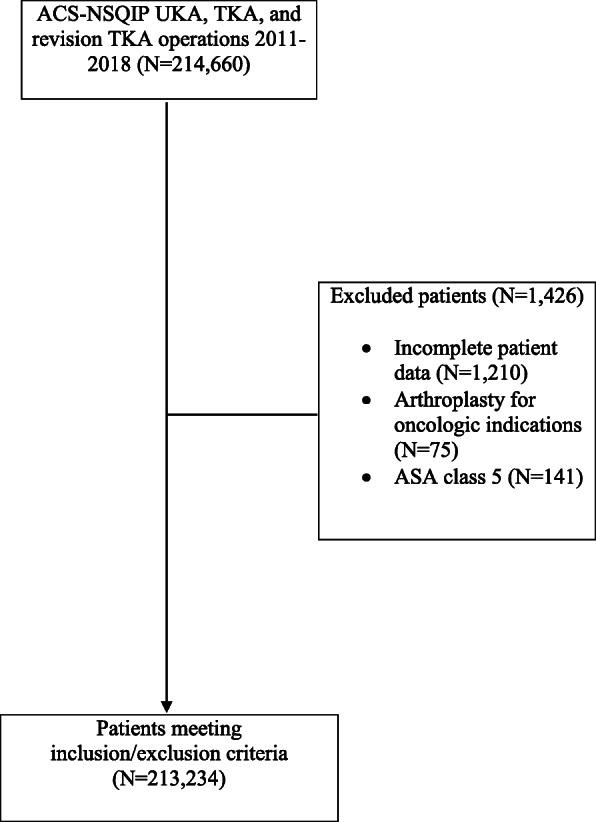
The National Surgical Quality Improvement Program (NSQIP) database was queried between 2011 and 2018, and we identified 213,234 patients for inclusion: 191,810 primary TKA, 9294 UKA, and 12,130 revision TKA. Demographics, medical comorbidities, and possible VTE risk factors were collected. Thirty-day outcomes, including deep vein thrombosis (DVT), pulmonary embolism (PE), and all-cause VTED were compared between knee arthroplasty types.
On multivariate analysis, UKA was significantly associated with lower rates of DVT [OR 0.44 (0.31-0.61); P < 0.001], PE [OR 0.42 (0.28-0.65); P < 0.001], and all-cause VTED [OR 0.42 (0.32-0.55); P < 0.001] when compared to primary TKA. Revision TKA was significantly associated with lower rates of PE [OR 0.62 (0.47-0.83); P = 0.002], and all-cause VTED [OR 0.82 (0.70-0.98); P = 0.029] when compared to primary TKA.
Utilizing recent data from a nationwide patient cohort and controlling for confounding variables, our results showed that both revision TKA and UKA had a lower risk of VTED compared to primary TKA, corroborating the results of recent investigations. Additional prospective investigations are needed to explain this unexpected result.
虽然多项研究表明,与初次全膝关节置换术(TKA)相比,单髁膝关节置换术(UKA)的静脉血栓栓塞性疾病(VTED)风险较低,但最近的报告显示,与初次TKA相比,翻修TKA的VTED风险也较低,这是一个意外发现,因为从理论上讲其风险会增加。鉴于缺乏最新的比较研究,我们的目标是利用最新数据,对UKA、翻修TKA与初次TKA进行一项关于VTED风险的高效比较研究。
查询2011年至2018年期间的国家外科质量改进计划(NSQIP)数据库,我们确定了213234例纳入患者:191810例初次TKA、9294例UKA和12130例翻修TKA。收集了人口统计学、合并症和可能的VTE风险因素。比较了不同类型膝关节置换术的30天结局,包括深静脉血栓形成(DVT)、肺栓塞(PE)和全因VTED。
多变量分析显示,与初次TKA相比,UKA的DVT发生率显著较低[比值比(OR)0.44(0.31 - 0.61);P < 0.001]、PE发生率显著较低[OR 0.42(0.28 - 0.65);P < 0.001]以及全因VTED发生率显著较低[OR 0.42(0.32 - 0.55);P < 0.001]。与初次TKA相比,翻修TKA的PE发生率显著较低[OR 0.62(0.47 - 0.83);P = 0.002]以及全因VTED发生率显著较低[OR 0.82(0.70 - 0.98);P = 0.029]。
利用来自全国患者队列的最新数据并控制混杂变量,我们的结果表明,与初次TKA相比,翻修TKA和UKA的VTED风险均较低,这证实了近期研究的结果。需要进一步的前瞻性研究来解释这一意外结果。