School of Medicine, Keele University, Keele, UK
Haywood Academic Rheumatology Centre, Haywood Hospital, Stoke-on-Trent, UK.
BMJ Open. 2020 Nov 3;10(11):e040634. doi: 10.1136/bmjopen-2020-040634.
To explore the acceptability of different bisphosphonate regimens for the treatment of osteoporosis among patients, clinicians and managers, payers and academics.
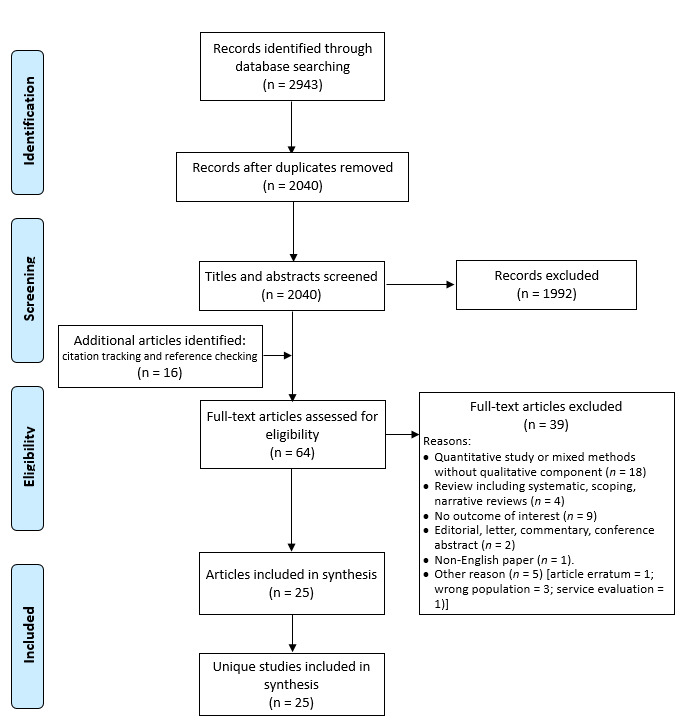
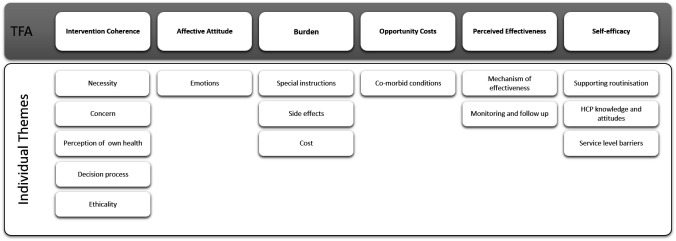
A systematic review of primary qualitative studies. Seven databases were searched from inception to July 2019. Screening, data extraction and quality assessment of full-articles selected for inclusion were performed independently by two authors. A framework synthesis was applied to extracted data based on the theoretical framework of acceptability (TFA). The TFA includes seven domains relating to sense-making, emotions, opportunity costs, burden, perceived effectiveness, ethicality and self-efficacy. Confidence in synthesis findings was assessed.
Any developed country healthcare setting.
Patients, healthcare professionals, managers, payers and academics.
Experiences and views of oral and intravenous bisphosphonates.
Twenty-five studies were included, mostly describing perceptions of oral bisphosphonates. We identified, with high confidence, how patients and healthcare professionals make sense (coherence) of bisphosphonates by balancing perceptions of need against concerns, how uncertainty prevails about bisphosphonate perceived effectiveness and a number of individual and service factors that have potential to increase self-efficacy in recommending and adhering to bisphosphonates. We identified, with moderate confidence, that bisphosphonate taking induces concern, but has the potential to engender reassurance, and that both side effects and special instructions for taking oral bisphosphonates can result in treatment burden. Finally, we identified with low confidence that multimorbidity plays a role in people's perception of bisphosphonate acceptability.
By using the lens of acceptability, our findings demonstrate with high confidence that a theoretically informed, whole-system approach is necessary to both understand and improve adherence. Clinicians and patients need supporting to understand the need for bisphosphonates, and clinicians need to clarify to patients what constitutes bisphosphonate treatment success. Further research is needed to explore perspectives of male patients and those with multimorbidity receiving bisphosphonates, and patients receiving intravenous treatment.
CRD42019143526.
探讨患者、临床医生和管理者、支付者和学者对不同双膦酸盐治疗骨质疏松症方案的可接受性。
对原始定性研究的系统评价。从建立到 2019 年 7 月,检索了 7 个数据库。两名作者独立进行了筛选、全文入选的提取和质量评估。根据可接受性的理论框架(TFA),对提取的数据进行了框架综合。TFA 包括与意义感、情绪、机会成本、负担、感知效果、伦理和自我效能相关的七个领域。评估了综合结果的置信度。
任何发达国家的医疗保健环境。
患者、医疗保健专业人员、管理人员、支付者和学者。
口服和静脉双膦酸盐的经验和观点。
共纳入 25 项研究,主要描述了对口服双膦酸盐的看法。我们非常有信心地确定了患者和医疗保健专业人员如何通过平衡对需要的看法和对担忧的看法来理解(一致性)双膦酸盐,以及对双膦酸盐感知效果的不确定性以及一些可能提高推荐和坚持使用双膦酸盐的自我效能的个人和服务因素。我们非常有信心地确定,服用双膦酸盐会引起关注,但有可能带来安心,并且双膦酸盐的副作用和特殊服用说明都会导致治疗负担。最后,我们非常有信心地确定,多种疾病在人们对双膦酸盐可接受性的看法中起着作用。
通过使用可接受性的视角,我们的研究结果非常有信心地表明,需要采用理论上有依据的、整个系统的方法来理解和提高坚持治疗的程度。临床医生和患者需要支持来理解使用双膦酸盐的必要性,临床医生需要向患者澄清什么构成双膦酸盐治疗的成功。需要进一步研究来探索男性患者和接受双膦酸盐治疗的多种疾病患者的观点,以及接受静脉治疗的患者的观点。
PROSPERO 注册号:CRD42019143526。