Pollegioni Paola, North Ace R, Persampieri Tania, Bucci Alessandro, Minuz Roxana L, Groneberg David Alexander, Nolan Tony, Papathanos Philippos-Aris, Crisanti Andrea, Müller Ruth
Polo d'Innovazione di Genomica Genetica e Biologia Società Consortile R.L. Terni Italy.
National Research Council Research Institute on Terrestrial Ecosystems Porano Italy.
J Appl Ecol. 2020 Oct;57(10):2086-2096. doi: 10.1111/1365-2664.13702. Epub 2020 Jul 20.
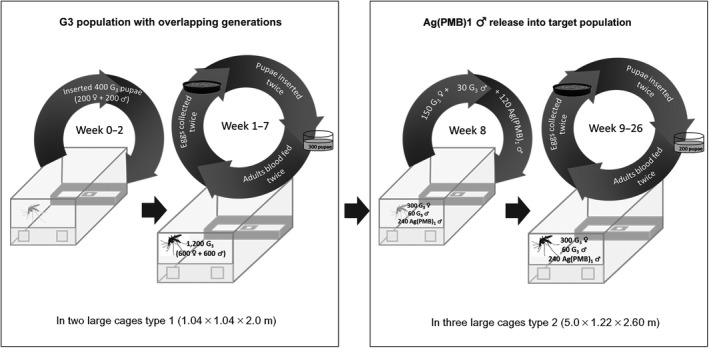
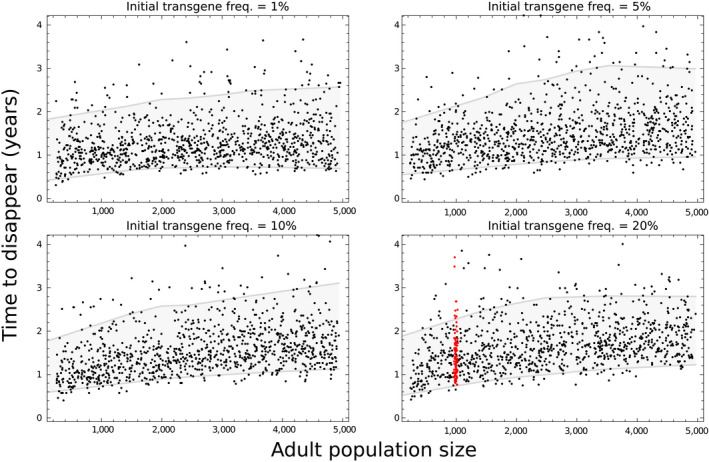
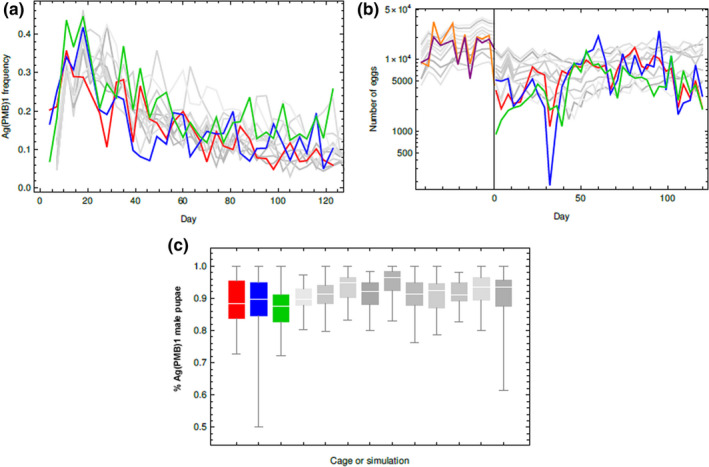
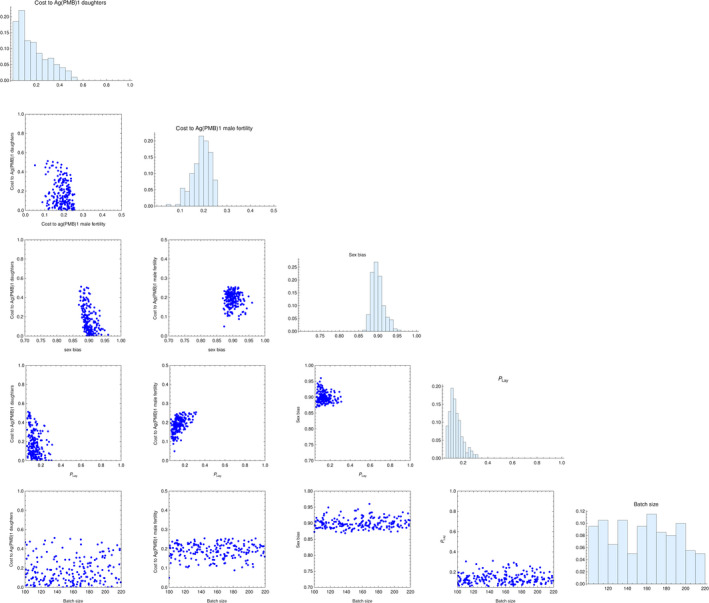
The development of genetically modified (GM) mosquitoes and their subsequent field release offers innovative and cost-effective approaches to reduce mosquito-borne diseases, such as malaria. A sex-distorting autosomal transgene has been developed recently in G3 mosquitoes, a laboratory strain of the malaria vector s.l. The transgene expresses an endonuclease called I-PpoI during spermatogenesis, which selectively cleaves the X chromosome to result in ~95% male progeny. Following the World Health Organization guidance framework for the testing of GM mosquitoes, we assessed the dynamics of this transgene in large cages using a joint experimental modelling approach.We performed a 4-month experiment in large, indoor cages to study the population genetics of the transgene. The cages were set up to mimic a simple tropical environment with a diurnal light-cycle, constant temperature and constant humidity. We allowed the generations to overlap to engender a stable age structure in the populations. We constructed a model to mimic the experiments, and used the experimental data to infer the key model parameters.We identified two fitness costs associated with the transgene. First, transgenic adult males have reduced fertility and, second, their female progeny have reduced pupal survival rates. Our results demonstrate that the transgene is likely to disappear in <3 years under our confined conditions. Model predictions suggest this will be true over a wide range of background population sizes and transgene introduction rates. . Our study is in line with the World Health Organization guidance recommendations in regard to the development and testing of GM mosquitoes. Since the transgenic sex ratio distorter strain (Ag(PMB)1) has been considered for genetic vector control of malaria, we recorded the dynamics of this transgene in indoor-large cage populations and modelled its post-release persistence under different scenarios. We provide a demonstration of the self-limiting nature of the transgene, and identified new fitness costs that will further reduce the longevity of the transgene after its release. Finally, our study has showcased an alternative and effective statistical method for characterizing the phenotypic expression of a transgene in an insect pest population.
转基因蚊子的研发及其随后的野外释放为减少疟疾等蚊媒疾病提供了创新且具成本效益的方法。最近在冈比亚按蚊(G3)这一疟疾传播媒介的实验室品系中开发了一种导致性别扭曲的常染色体转基因。该转基因在精子发生过程中表达一种名为I-PpoI的核酸内切酶,它选择性地切割X染色体,从而产生约95%的雄性后代。遵循世界卫生组织关于转基因蚊子测试的指导框架,我们采用联合实验建模方法评估了该转基因在大型笼子中的动态变化。我们在大型室内笼子中进行了为期4个月的实验,以研究该转基因的群体遗传学。笼子的设置模拟了一个具有昼夜光照周期、恒定温度和恒定湿度的简单热带环境。我们让各代重叠,以使种群中形成稳定的年龄结构。我们构建了一个模型来模拟实验,并利用实验数据推断关键模型参数。我们确定了与该转基因相关的两种适合度代价。第一,转基因成年雄性的生育力降低;第二,其雌性后代的蛹存活率降低。我们的结果表明,在我们的受限条件下,该转基因可能在不到3年的时间内消失。模型预测表明,在广泛的背景种群规模和转基因引入率范围内都是如此。我们的研究符合世界卫生组织关于转基因蚊子研发和测试的指导建议。由于转基因性别比例畸变品系(Ag(PMB)1)已被考虑用于疟疾的遗传病媒控制,我们记录了该转基因在室内大型笼子种群中的动态变化,并对其在不同情况下释放后的持久性进行了建模。我们证明了该转基因的自我限制性质,并确定了新的适合度代价,这将在释放后进一步缩短该转基因的寿命。最后,我们的研究展示了一种用于表征害虫种群中转基因表型表达的替代且有效的统计方法。