Chen Xi, Zhang Chunlan, Li Jingping, Liu Wei, Zhang Jingjing, Zhou Zhiguang
National Clinical Research Center for Metabolic Diseases, Metabolic Syndrome Research Center, Key Laboratory of Diabetes Immunology (Central South University), Ministry of Education, Department of Metabolism and Endocrinology, The Second Xiangya Hospital of Central South University, Changsha 410011, Hunan, People's Republic of China.
Department of Metabolic Surgery, Department of Biliopancreatic Surgery, The Second Xiangya Hospital, Central South University, Changsha 410011, Hunan, People's Republic of China.
Diabetes Metab Syndr Obes. 2020 Oct 29;13:4095-4103. doi: 10.2147/DMSO.S274614. eCollection 2020.
Laparoscopic sleeve gastrectomy (LSG) is one of the most effective therapies to treat obesity. Due to a lack of longitudinal research, we explored the changes in BMD and bone metabolism in Chinese patients with obesity before and after LSG.
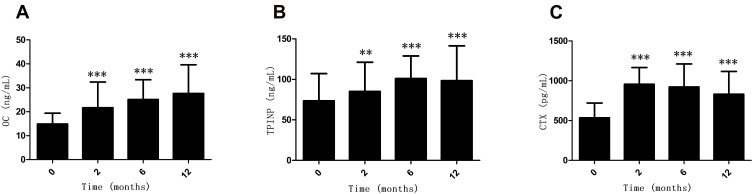
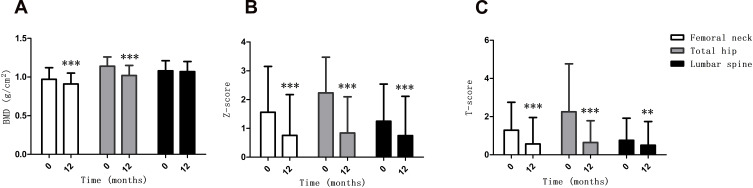
A total of 49 obese Chinese patients with obesity were recruited from the Second Xiangya Hospital of Central South University. All patients underwent LSG, and the metabolic indicators were evaluated, including the serum osteocalcin (OC), total-terminal propeptide of type I procollagen (TPINP) and carboxy terminal telopeptide of collagen type I (CTX) levels at baseline and 2, 6 and 12 months postoperatively. Dual energy X-ray absorptiometry (DEXA) was used to measure body composition and BMD before and 12 months after LSG.
The body mass index (BMI) significantly decreased at 12 months postoperatively, and no patients developed osteoporosis. The BMD of femoral neck and total hip significantly decreased from the baseline to 12 months postoperatively, while the BMD of lumbar spine did not change significantly. The OC, TPINP and CTX levels significantly increased at 12 months postoperatively. The excess BMI loss (EBMIL) was positively related while the reduction in visceral adipose tissue (VAT) mass was negatively related to the decreases in BMD of the femoral neck and total hip at 12 months postoperatively. The increase in OC was negatively correlated with the decrease in BMD of the femoral neck, while the increase in TPINP was positively correlated with the decrease in BMD of total hip.
Based on the 12-month follow-up results, the BMD of the femoral neck and total hip was decreased in Chinese patients with obesity after LSG, while bone remodelling was active. This finding suggested that weight loss, a decrease in the VAT mass and an increase in bone remodelling may be correlated with a reduction in BMD.
腹腔镜袖状胃切除术(LSG)是治疗肥胖症最有效的方法之一。由于缺乏纵向研究,我们探讨了中国肥胖患者在LSG前后骨密度(BMD)和骨代谢的变化。
从中南大学湘雅二医院招募了49例肥胖中国患者。所有患者均接受了LSG,并评估了代谢指标,包括基线时以及术后2、6和12个月时的血清骨钙素(OC)、I型前胶原总端肽(TPINP)和I型胶原羧基末端肽(CTX)水平。采用双能X线吸收法(DEXA)在LSG前和术后12个月测量身体成分和BMD。
术后12个月体重指数(BMI)显著下降,且无患者发生骨质疏松。股骨颈和全髋的BMD从基线到术后12个月显著下降,而腰椎的BMD无显著变化。术后12个月OC、TPINP和CTX水平显著升高。术后12个月,多余体重指数损失(EBMIL)与股骨颈和全髋BMD的降低呈正相关,而内脏脂肪组织(VAT)质量的减少与股骨颈和全髋BMD的降低呈负相关。OC的升高与股骨颈BMD的降低呈负相关,而TPINP的升高与全髋BMD的降低呈正相关。
基于12个月的随访结果,中国肥胖患者在LSG后股骨颈和全髋的BMD降低,而骨重塑活跃。这一发现表明体重减轻、VAT质量减少和骨重塑增加可能与BMD降低有关。