Biotherapy Center, The First Affiliated Hospital, Zhengzhou University, Zhengzhou 450052, China.
Cancer Center, The First Affiliated Hospital, Zhengzhou University, Zhengzhou 450052, China.
Biomed Res Int. 2020 Oct 23;2020:8765028. doi: 10.1155/2020/8765028. eCollection 2020.
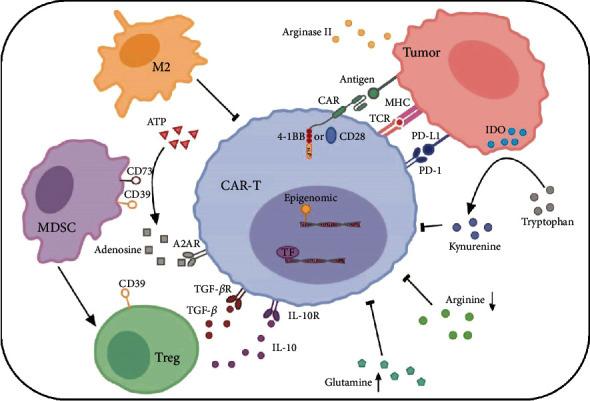
Immunotherapy, especially based on chimeric antigen receptor (CAR) T cells, has achieved prominent success in the treatment of hematological malignancies. However, approximately 30-50% of patients will have disease relapse following remission after receiving CD19-targeting CAR-T cells, with failure of maintaining a long-term effect. Mechanisms underlying CAR-T therapy inefficiency consist of loss or modulation of target antigen and CAR-T cell poor persistence which mostly results from T cell exhaustion. The unique features and restoration strategies of exhausted T cells (Tex) have been well described in solid tumors. However, the overview associated with CAR-T cell exhaustion is relatively rare in hematological malignancies. In this review, we summarize the characteristics, cellular, and molecular mechanisms of Tex cells as well as approaches to reverse CAR-T cell exhaustion in hematological malignancies, providing novel strategies for immunotherapies.
免疫疗法,特别是嵌合抗原受体(CAR)T 细胞疗法,在治疗血液系统恶性肿瘤方面取得了显著的成功。然而,大约 30-50%的患者在接受 CD19 靶向 CAR-T 细胞治疗后缓解后会出现疾病复发,无法长期维持疗效。CAR-T 治疗无效的机制包括靶抗原的丢失或调节以及 CAR-T 细胞的持续存在不良,这主要是由于 T 细胞耗竭所致。在实体肿瘤中,已经很好地描述了耗竭 T 细胞(Tex)的独特特征和恢复策略。然而,在血液系统恶性肿瘤中,与 CAR-T 细胞耗竭相关的综述相对较少。在这篇综述中,我们总结了 Tex 细胞的特征、细胞和分子机制,以及逆转血液系统恶性肿瘤中 CAR-T 细胞耗竭的方法,为免疫治疗提供了新的策略。