Ng Teng Fong General Hospital, Singapore 609606, Singapore.
Sri Ramachandra Institute of Higher Education and Research, Chennai, Tamil Nadu 600116, India.
Int J Environ Res Public Health. 2020 Nov 3;17(21):8100. doi: 10.3390/ijerph17218100.
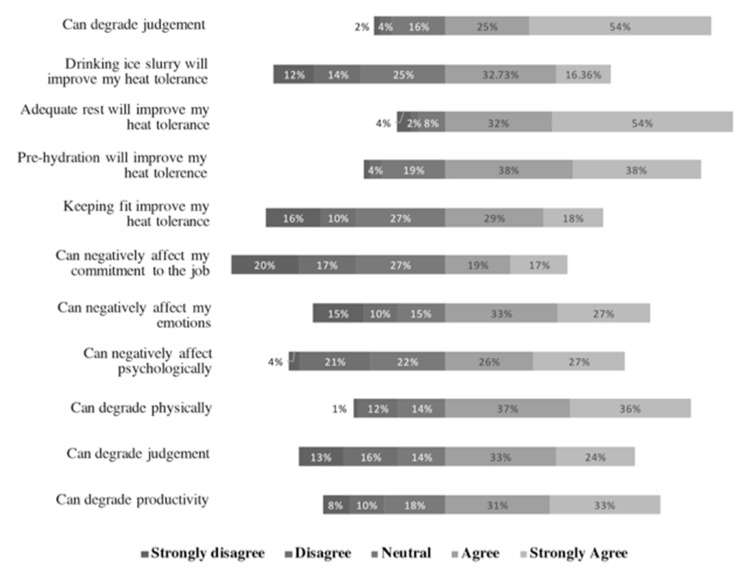
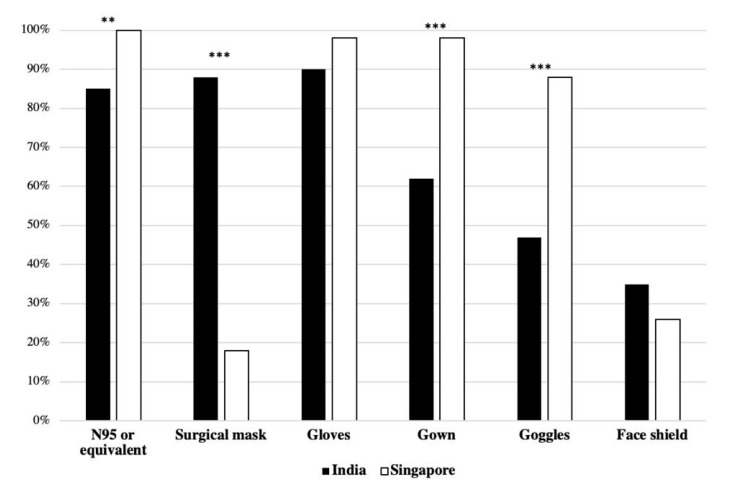
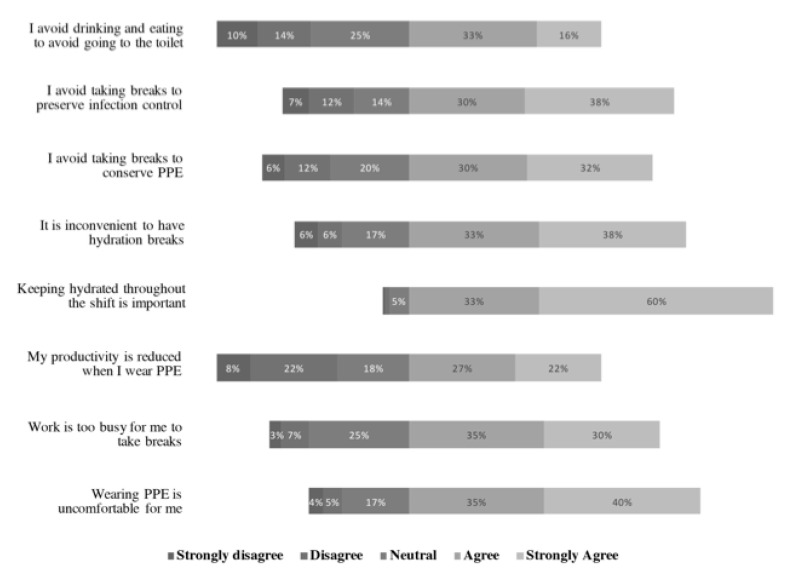
The need for healthcare workers (HCWs) to wear personal protective equipment (PPE) during the coronavirus disease 2019 (COVID-19) pandemic heightens their risk of thermal stress. We assessed the knowledge, attitudes, and practices of HCWs from India and Singapore regarding PPE usage and heat stress when performing treatment and care activities. One hundred sixty-five HCWs from India ( = 110) and Singapore ( = 55) participated in a survey. Thirty-seven HCWs from Singapore provided thermal comfort ratings before and after ice slurry ingestion. Differences in responses between India and Singapore HCWs were compared. A -value cut-off of 0.05 depicted statistical significance. Median wet-bulb globe temperature was higher in India (30.2 °C (interquartile range [IQR] 29.1-31.8 °C)) than in Singapore (22.0 °C (IQR 18.8-24.8 °C)) ( < 0.001). Respondents from both countries reported thirst ( = 144, 87%), excessive sweating ( = 145, 88%), exhaustion ( = 128, 78%), and desire to go to comfort zones ( = 136, 84%). In Singapore, reports of air-conditioning at worksites ( = 34, 62%), dedicated rest area availability ( = 55, 100%), and PPE removal during breaks ( = 54, 98.2%) were higher than in India ( = 27, 25%; = 46, 42%; and = 66, 60%, respectively) ( < 0.001). Median thermal comfort rating improved from 2 (IQR 1-2) to 0 (IQR 0-1) after ice slurry ingestion in Singapore ( < 0.001). HCWs are cognizant of the effects of heat stress but might not adopt best practices due to various constraints. Thermal stress management is better in Singapore than in India. Ice slurry ingestion is shown to be practical and effective in promoting thermal comfort. Adverse effects of heat stress on productivity and judgment of HCWs warrant further investigation.
在 2019 年冠状病毒病(COVID-19)大流行期间,医护人员(HCWs)需要穿戴个人防护设备(PPE),这增加了他们遭受热应激的风险。我们评估了来自印度和新加坡的 HCWs 对 PPE 使用和治疗及护理活动中热应激的知识、态度和实践。来自印度的 165 名 HCWs(=110)和新加坡的 55 名 HCWs 参与了这项调查。来自新加坡的 37 名 HCWs 在摄入冰浆前后提供了热舒适度评分。比较了印度和新加坡 HCWs 的反应差异。A 值截止值为 0.05,表示具有统计学意义。印度的湿球黑球温度中位数较高(30.2°C(四分位距[IQR]29.1-31.8°C)),而新加坡的湿球黑球温度中位数较低(22.0°C(IQR 18.8-24.8°C))(<0.001)。来自两个国家的受访者均报告口渴(=144,87%)、过度出汗(=145,88%)、疲惫(=128,78%)和渴望去舒适区(=136,84%)。在新加坡,报告工作场所有空调(=34,62%)、有专用休息区(=55,100%)和休息期间脱下 PPE(=54,98.2%)的比例高于印度(=27,25%;=46,42%;和=66,60%)(<0.001)。在新加坡,摄入冰浆后,热舒适度评分中位数从 2(IQR 1-2)改善至 0(IQR 0-1)(<0.001)。HCWs 意识到热应激的影响,但由于各种限制,可能不会采用最佳实践。新加坡的热应激管理优于印度。摄入冰浆被证明是一种实用且有效的促进热舒适度的方法。热应激对 HCWs 的生产力和判断力的不利影响值得进一步研究。