MRC Clinical Trials Unit, University College London Institute for Clinical Trials and Methodology, London, UK.
Clin Trials. 2020 Dec;17(6):644-653. doi: 10.1177/1740774520944377. Epub 2020 Aug 16.
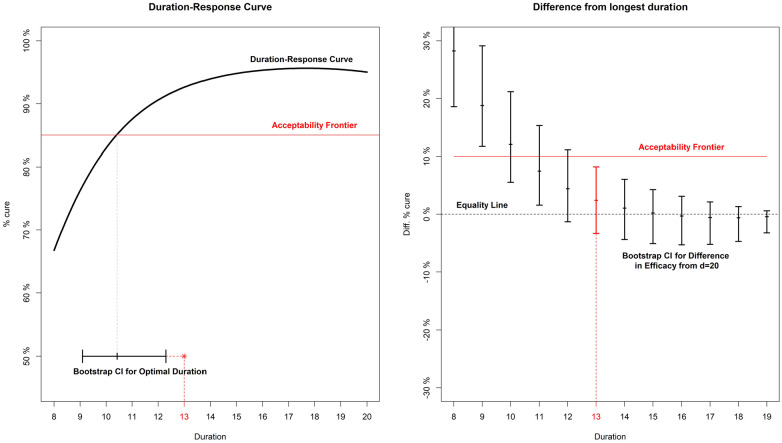
Designing trials to reduce treatment duration is important in several therapeutic areas, including tuberculosis and bacterial infections. We recently proposed a new randomised trial design to overcome some of the limitations of standard two-arm non-inferiority trials. This DURATIONS design involves randomising patients to a number of duration arms and modelling the so-called 'duration-response curve'. This article investigates the operating characteristics (type-1 and type-2 errors) of different statistical methods of drawing inference from the estimated curve.
Our first estimation target is the shortest duration non-inferior to the control (maximum) duration within a specific risk difference margin. We compare different methods of estimating this quantity, including using model confidence bands, the delta method and bootstrap. We then explore the generalisability of results to estimation targets which focus on absolute event rates, risk ratio and gradient of the curve.
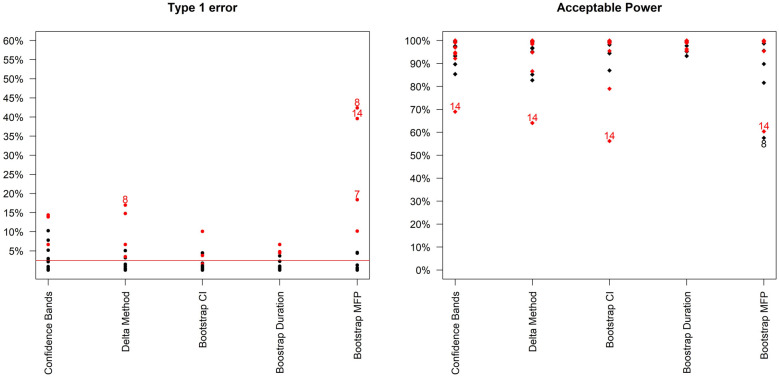
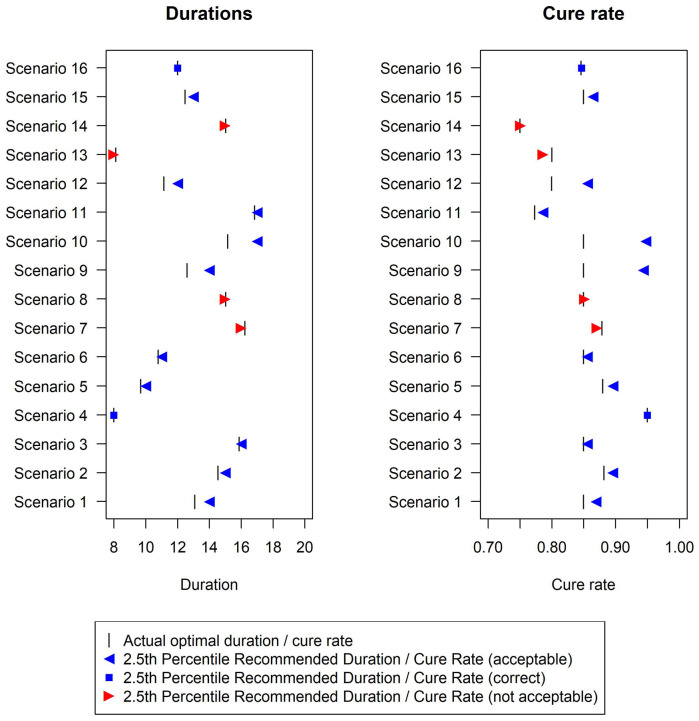
We show through simulations that, in most scenarios and for most of the estimation targets, using the bootstrap to estimate variability around the target duration leads to good results for DURATIONS design-appropriate quantities analogous to power and type-1 error. Using model confidence bands is not recommended, while the delta method leads to inflated type-1 error in some scenarios, particularly when the optimal duration is very close to one of the randomised durations.
Using the bootstrap to estimate the optimal duration in a DURATIONS design has good operating characteristics in a wide range of scenarios and can be used with confidence by researchers wishing to design a DURATIONS trial to reduce treatment duration. Uncertainty around several different targets can be estimated with this bootstrap approach.
在包括结核病和细菌感染在内的多个治疗领域,缩短治疗时间的临床试验设计非常重要。我们最近提出了一种新的随机临床试验设计,以克服标准两臂非劣效试验的一些局限性。这种 DURATIONS 设计涉及将患者随机分配到多个时间臂,并对所谓的“时间-反应曲线”进行建模。本文研究了从估计曲线得出推断的不同统计方法的操作特性(Ⅰ型和Ⅱ型错误)。
我们的第一个估计目标是在特定风险差异范围内,比对照(最大)时间短的最短非劣效时间。我们比较了不同的估计方法,包括使用模型置信区间、Delta 方法和 bootstrap。然后,我们探索了结果对关注绝对事件率、风险比和曲线斜率的估计目标的泛化能力。
通过模拟表明,在大多数情况下,对于大多数估计目标,使用 bootstrap 估计目标时间的变异性可得到适合 DURATIONS 设计的良好结果,类似于功效和Ⅰ型错误的数量。不建议使用模型置信区间,而在某些情况下,Delta 方法会导致Ⅰ型错误膨胀,特别是当最佳时间非常接近随机时间之一时。
在 DURATIONS 设计中使用 bootstrap 估计最佳时间在广泛的场景中具有良好的操作特性,希望设计缩短治疗时间的 DURATIONS 试验的研究人员可以有信心地使用。这种 bootstrap 方法可以估计几个不同目标的不确定性。