School of Public Health, Zunyi Medical University, Zunyi 563000, China.
Scientific Research Center, The Third Affiliated Hospital of Guang Dong Medical University (Long Jiang Hospital of Shunde District Foshan City), Foshan 528318, China.
Asian J Androl. 2021 Mar-Apr;23(2):170-177. doi: 10.4103/aja.aja_59_20.
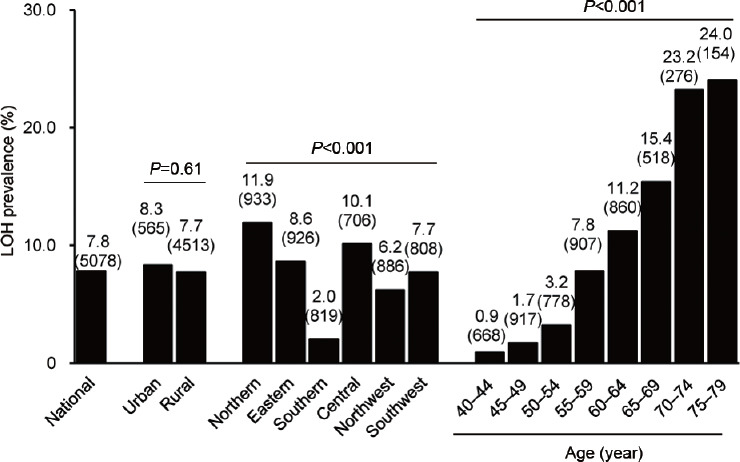
This study aimed to propose an operational definition of late-onset hypogonadism (LOH) that incorporates both clinical symptoms and serum testosterone measurements to evaluate the prevalence of LOH in aging males in China. A population-based sample of 6296 men aged 40 years-79 years old was enrolled from six representative provinces in China. Serum total testosterone (TT), sex hormone-binding globulin (SHBG), and luteinizing hormone (LH) were measured and free testosterone (cFT) was calculated. The Aging Males' Symptoms (AMS) scale was used to evaluate the LOH symptoms. Finally, 5078 men were included in this analysis. The TT levels did not decrease with age (P = 0.59), and had no relationship with AMS symptoms (P = 0.87 for AMS total score, P = 0.74 for ≥ 3 sexual symptoms). The cFT levels decreased significantly with age (P < 0.01) and showed a negative association with the presence of ≥ 3 sexual symptoms (P = 0.03). The overall estimated prevalence of LOH was 7.8% (395/5078) if a cFT level <210 pmol l combined with the presence of ≥ 3 sexual symptoms was used as the criterion of LOH. Among them, 26.1% (103/395) and 73.9% (292/395) had primary and secondary hypogonadism, respectively. After adjustment for confounding factors, primary and secondary hypogonadism was positively related to age and comorbidities. Body mass index was an independent risk factor for secondary hypogonadism. The results suggest that the AMS total score is not an appropriate indicator for decreased testosterone, and that the cFT level is more reliable than TT for LOH diagnosis. Secondary hypogonadism is the most common form of LOH.
本研究旨在提出一个包含临床症状和血清睾酮测量的迟发性性腺功能减退症(LOH)的操作性定义,以评估中国老年男性中 LOH 的患病率。这项基于人群的研究纳入了来自中国六个代表性省份的 6296 名 40 岁至 79 岁的男性。测量了血清总睾酮(TT)、性激素结合球蛋白(SHBG)和黄体生成素(LH),并计算了游离睾酮(cFT)。采用男性衰老症状(AMS)量表评估 LOH 症状。最终,有 5078 名男性纳入本分析。TT 水平随年龄增长而无下降(P = 0.59),与 AMS 症状也无相关性(AMS 总分的 P = 0.87,≥3 项性症状的 P = 0.74)。cFT 水平随年龄增长显著下降(P < 0.01),与≥3 项性症状的存在呈负相关(P = 0.03)。如果将 cFT 水平<210 pmol l 与≥3 项性症状同时作为 LOH 的标准,则总体估计 LOH 的患病率为 7.8%(395/5078)。其中,原发性和继发性性腺功能减退症分别占 26.1%(103/395)和 73.9%(292/395)。校正混杂因素后,原发性和继发性性腺功能减退症与年龄和合并症呈正相关。体质指数是继发性性腺功能减退症的独立危险因素。结果表明,AMS 总分不是睾酮降低的合适指标,cFT 水平比 TT 更适合诊断 LOH。继发性性腺功能减退症是 LOH 最常见的形式。