Department of Psychological Sciences, University of Missouri, Columbia, MO, USA.
Sci Rep. 2020 Nov 5;10(1):19081. doi: 10.1038/s41598-020-76136-9.
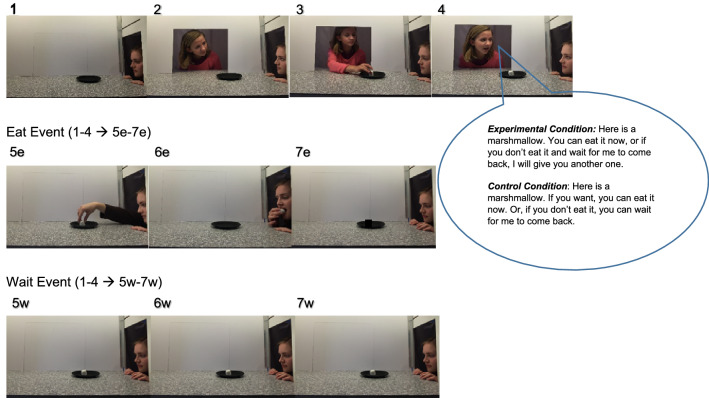
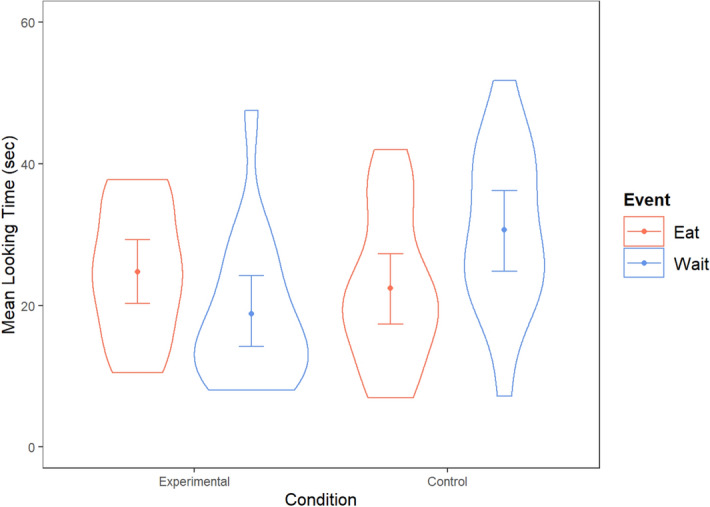
Choices between immediate gratification and long-term (but larger) gains are prevalent in human life, which is why the decision-making processes to delay gratification have been studied extensively throughout different developmental ages. Children's delay-of-gratification behaviors have been examined in the well-known "marshmallow test," in which 3- to 5-year-olds are given a marshmallow and told by an experimenter that they can eat it immediately or wait for an unspecified duration of time (which can be capped at 15 min) until the experimenter returns so that they can receive another marshmallow. Children's wait time has been viewed as a good indicator of their later development. Here we show that a group of 22-month-old infants (N = 32) already held expectations about others' choices in a violation-of-expectation looking-time task modeled after the marshmallow test. The infants expected an agent to defer gratification based on a speaker's promise of the second marshmallow available in the future, but to eat the currently attainable marshmallow when the speaker made no such promise. Our findings indicate an early-emerging understanding of others' choices of delayed or instant gratification and shed new light on the development of delay-of-gratification behaviors.
在人类生活中,即时满足与长期(但更大)收益之间的选择很常见,这就是为什么在不同的发展阶段,人们广泛研究了延迟满足的决策过程。在著名的“棉花糖测试”中,研究人员检验了儿童的延迟满足行为。在这个测试中,3 到 5 岁的儿童会得到一个棉花糖,并被告知可以立即吃掉它,也可以等待一段时间(最长可达 15 分钟),直到实验者回来,这样他们就可以得到另一个棉花糖。儿童的等待时间被视为他们日后发展的良好指标。在这里,我们展示了一组 22 个月大的婴儿(N=32)已经在一个类似于棉花糖测试的违反预期的观察时间任务中对他人的选择有了预期。婴儿期望代理人根据说话者对未来第二个棉花糖的承诺来延迟满足,而当说话者没有做出这样的承诺时,代理人会选择吃掉当前可获得的棉花糖。我们的发现表明,婴儿对他人延迟或即时满足的选择有了早期的理解,这为延迟满足行为的发展提供了新的视角。