Cortijo-Campos Sandra, Ramírez-Jiménez Rafael, Climent-Pascual Esteban, Aguilar-Pujol Montserrat, Jiménez-Villacorta Félix, Martínez Lidia, Jiménez-Riobóo Rafael, Prieto Carlos, de Andrés Alicia
Instituto de Ciencia de Materiales de Madrid, Consejo Superior de Investigaciones Científicas, Cantoblanco, 28049 Madrid, Spain.
Departamento de Física, Escuela Politécnica Superior, Universidad Carlos III de Madrid, Avenida Universidad 30, Leganés, 28911, Madrid, Spain.
Mater Des. 2020 Apr 2;192:108702. doi: 10.1016/j.matdes.2020.108702. eCollection 2020 Jul.
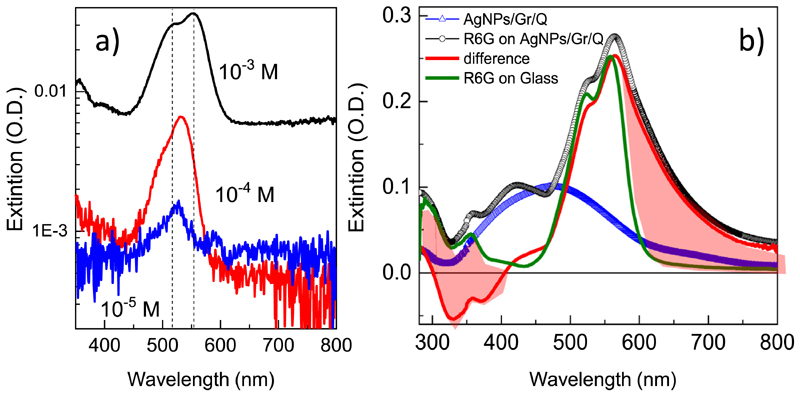
Size, shape and hot spots are crucial to optimize Raman amplification from metallic nanoparticle (NPs). The amplification from radius = 1.8 ± 0.4 nm ultra-small silver NPs was explored. Increasing NP density redshifts and widens their plasmon that, according to simulations for NPs arrays, is originated by the reduction of the interparticle distance, d, becoming remarkable for d ≤ R. Inter-particle interaction red-shifts (N130 nm) and widens (N90 nm) the standard plasmon of non-interacting spherical particles. Graphene partly delocalizes the carriers enhancing the NIR spectral weight. Raman amplification of graphene phonons is moderate and depends smoothly on d while that of Rhodamine 6G (R6G) varies almost exponentially due to their location at hotspots that depend strongly on d. The experimental correlation between amplification and plasmon position is well reproduced by simulations. The amplification originated by the ultra-small NPs is compared to that of larger particles, granular silver films with 7 < R < 15 nm grains, with similar extinction values. The amplification is found to be larger for the 1.8nm NPs due to the higher surface/volume ration that allows higher density of hot spots. It is demonstrated that Raman amplification can be efficiently increased by depositing low density layers of ultra-small NPs on top of granular films.
尺寸、形状和热点对于优化金属纳米颗粒(NP)的拉曼放大至关重要。研究了半径为1.8±0.4nm的超小银纳米颗粒的放大情况。增加NP密度会使等离激元红移并展宽,根据对NP阵列的模拟,这是由于颗粒间距离d的减小引起的,当d≤R时这种现象变得明显。颗粒间相互作用使非相互作用球形颗粒的标准等离激元发生红移(N130nm)并展宽(N90nm)。石墨烯部分地使载流子离域,增强了近红外光谱权重。石墨烯声子的拉曼放大适中,且平滑地依赖于d,而罗丹明6G(R6G)的拉曼放大由于其位于强烈依赖于d的热点处而几乎呈指数变化。模拟很好地再现了放大与等离激元位置之间的实验相关性。将超小NP产生的放大与具有相似消光值的较大颗粒(7<R<15nm晶粒的颗粒状银膜)的放大进行了比较。发现1.8nm的NP放大更大,这是因为其更高的表面/体积比允许更高密度的热点。结果表明,通过在颗粒状薄膜顶部沉积低密度的超小NP层,可以有效地提高拉曼放大。