Inflammation, Infection and Immunity Laboratory, TMDU Advanced Research Institute, Tokyo Medical and Dental University (TMDU), Tokyo, Japan.
Department of Cellular Physiology, Graduate School of Medicine, Dentistry and Pharmaceutical Sciences, Okayama University, Okayama, Japan.
Front Immunol. 2020 Oct 14;11:601504. doi: 10.3389/fimmu.2020.601504. eCollection 2020.
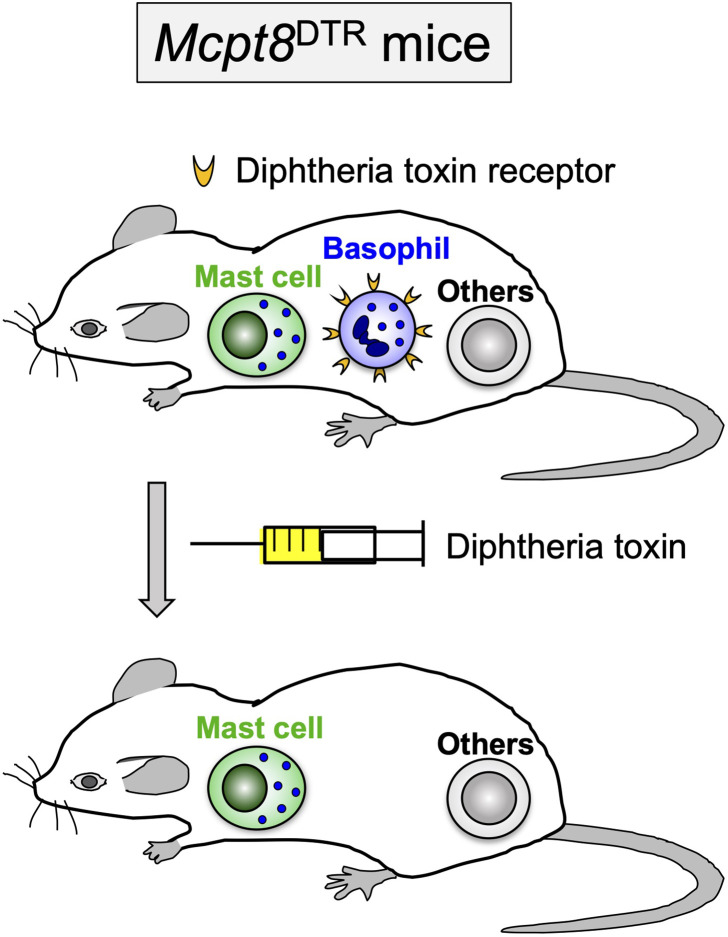
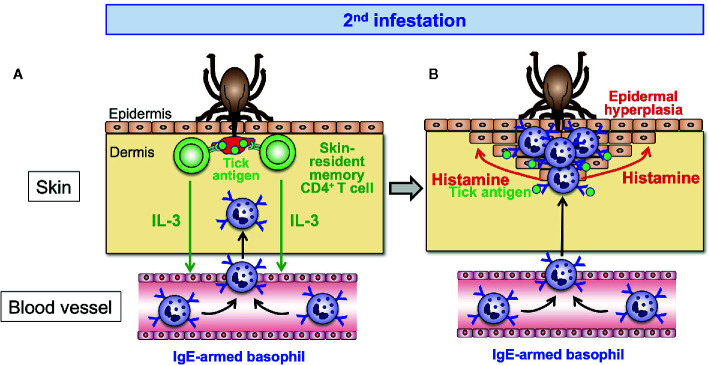
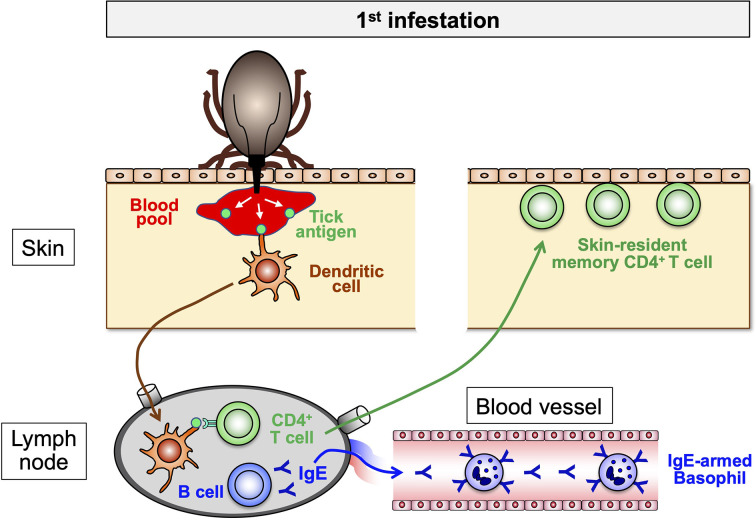
Ticks are blood-sucking arthropods of great importance in the medical and veterinary fields worldwide. They are considered second only to mosquitos as vectors of pathogenic microorganisms that can cause serious infectious disorders, such as Lyme borreliosis and tick-borne encephalitis. Hard () ticks feed on host animals for several days and inject saliva together with pathogens to hosts during blood feeding. Some animal species can acquire resistance to blood-feeding by ticks after a single or repeated tick infestation, resulting in decreased weights and numbers of engorged ticks or the death of ticks in subsequent infestations. Importantly, this acquired tick resistance (ATR) can reduce the risk of pathogen transmission from pathogen-infected ticks to hosts. This is the basis for the development of tick antigen-targeted vaccines to forestall tick infestation and tick-borne diseases. Accumulation of basophils is detected in the tick re-infested skin lesion of animals showing ATR, and the ablation of basophils abolishes ATR in mice and guinea pigs, illustrating the critical role for basophils in the expression of ATR. In this review article, we provide a comprehensive overview of recent advances in our understanding of the cellular and molecular mechanisms responsible for the development and manifestation of ATR, with a particular focus on the role of basophils.
蜱是一种吸血节肢动物,在全球医学和兽医领域具有重要意义。它们被认为仅次于蚊子,是携带病原体微生物的载体,这些微生物可以引起严重的传染病,如莱姆病和蜱传脑炎。硬蜱以宿主动物为食数天,并在吸血时将唾液与病原体一起注入宿主。一些动物物种在单次或重复蜱感染后可以获得对蜱吸血的抵抗力,导致饱血的蜱数量和体重减少,或随后的感染中蜱死亡。重要的是,这种获得的蜱抵抗力(ATR)可以降低从感染病原体的蜱向宿主传播病原体的风险。这是开发针对蜱抗原的疫苗以阻止蜱感染和蜱传疾病的基础。在表现出 ATR 的动物重新感染的皮肤损伤中检测到嗜碱性粒细胞的积累,并且嗜碱性粒细胞的消融在小鼠和豚鼠中消除了 ATR,这说明了嗜碱性粒细胞在 ATR 表达中的关键作用。在这篇综述文章中,我们全面概述了我们对导致 ATR 发展和表现的细胞和分子机制的理解的最新进展,特别关注嗜碱性粒细胞的作用。