
临床互动模拟人在药师预注册培训中的应用:设计与评估。
Interactive Clinical Avatar Use in Pharmacist Preregistration Training: Design and Review.
机构信息
School of Pharmacy and Bioengineering, Keele University, Keele, United Kingdom.
出版信息
J Med Internet Res. 2020 Nov 6;22(11):e17146. doi: 10.2196/17146.
BACKGROUND
Virtual patients are interactive computer-based simulations that are being increasingly used in modern health care education. They have been identified as tools that can provide experiential learning and assessment in a standardized and safe environment. However, the study of high-fidelity virtual patients such as interactive clinical avatars within pharmacy is limited.
OBJECTIVE
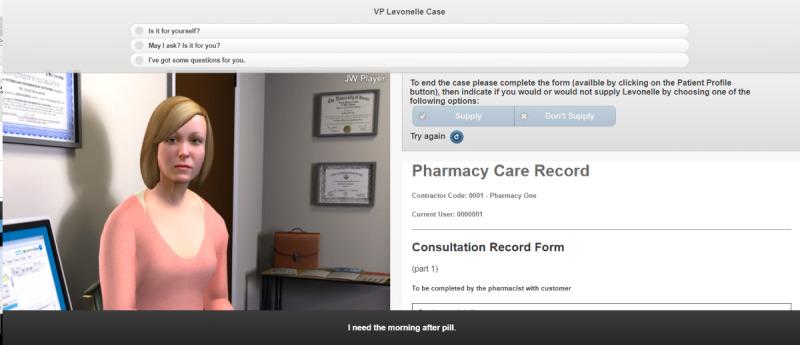
The aim of this paper is to describe the design and review of three interactive clinical avatar simulations as part of pharmacist preregistration training.
METHODS
A multistep design approach was taken to create interactive clinical avatar simulations on the topics of emergency hormonal contraception (EHC), calculation of renal function, and childhood illnesses. All case studies were reviewed by registered pharmacists to establish content and face validity. The EHC case study and data collection questionnaire were also reviewed by a purposive sample of preregistration trainees and newly qualified pharmacists. The questionnaire used Likert ranking statements and open-ended questions to obtain users' feedback on the design, usability, and usefulness of the interactive clinical avatars as learning tools. Descriptive statistics and content analysis were undertaken on the data.
RESULTS
Ten preregistration trainees and newly qualified pharmacists reviewed the EHC interactive clinical avatars and data collection questionnaire. The data collection questionnaire was associated with a Cronbach alpha=.95, demonstrating good reliability. All three interactive clinical avatar simulations were reported as usable and appropriately designed for preregistration training. Users perceived they were developing skills and knowledge from the simulations. The high-fidelity nature of the avatars and relevance of the simulations to real-life practice were reported as aspects that encouraged the application of theory to practice. Improvements were suggested to ensure the simulations were more user-friendly.
CONCLUSIONS
The design and creation of the interactive clinical avatar simulations was successful. The multistep review process ensured validity and reliability of the simulations and data collection questionnaire. The in-depth explanation of the design process and provision of a questionnaire may help widen the use and evaluation of interactive clinical avatars or other simulation tools in pharmacy education. The interactive clinical avatars were reported as novel learning tools that promoted experiential learning and allowed users to feel like they were engaging in real-life scenarios, thus developing transferable knowledge and skills. This may be potentially beneficial for many health care training courses as a way to provide standardized experiences promoting active learning and reflection.
背景
虚拟患者是一种交互式的基于计算机的模拟,它在现代医疗保健教育中越来越多地被使用。它们被认为是一种可以在标准化和安全的环境中提供体验式学习和评估的工具。然而,在药剂学中,高保真度的虚拟患者(如交互式临床虚拟人)的研究是有限的。
目的
本文旨在描述作为药剂师预注册培训的一部分的三个交互式临床虚拟人模拟的设计和审查。
方法
采用多步骤设计方法,制作了关于紧急激素避孕(EHC)、肾功能计算和儿童疾病的三个交互式临床虚拟人模拟。所有的病例研究都由注册药剂师进行了审查,以确定内容和表面效度。EHC 病例研究和数据收集问卷也由预注册学员和新合格药剂师的一个有针对性的样本进行了审查。问卷采用李克特等级陈述和开放式问题,以获得用户对交互式临床虚拟人作为学习工具的设计、可用性和有用性的反馈。对数据进行了描述性统计和内容分析。
结果
十名预注册学员和新合格药剂师审查了 EHC 交互式临床虚拟人及数据收集问卷。数据收集问卷的克朗巴赫α系数为.95,表明可靠性良好。所有三个交互式临床虚拟人模拟都被报告为可用且适合预注册培训。用户认为他们从模拟中获得了技能和知识。虚拟人的高保真度和模拟与实际实践的相关性被认为是鼓励将理论应用于实践的方面。建议进行改进,以确保模拟更便于用户使用。
结论
交互式临床虚拟人模拟的设计和创建是成功的。多步骤审查过程确保了模拟和数据收集问卷的有效性和可靠性。对设计过程的深入解释和提供问卷可能有助于拓宽在药剂学教育中使用交互式临床虚拟人或其他模拟工具的范围和评估。交互式临床虚拟人被报告为新颖的学习工具,它们促进了体验式学习,并让用户感觉自己正在参与真实场景,从而培养可转移的知识和技能。这对于许多医疗保健培训课程来说可能是有益的,因为它提供了标准化的体验,促进了主动学习和反思。


 Zotero 插件